
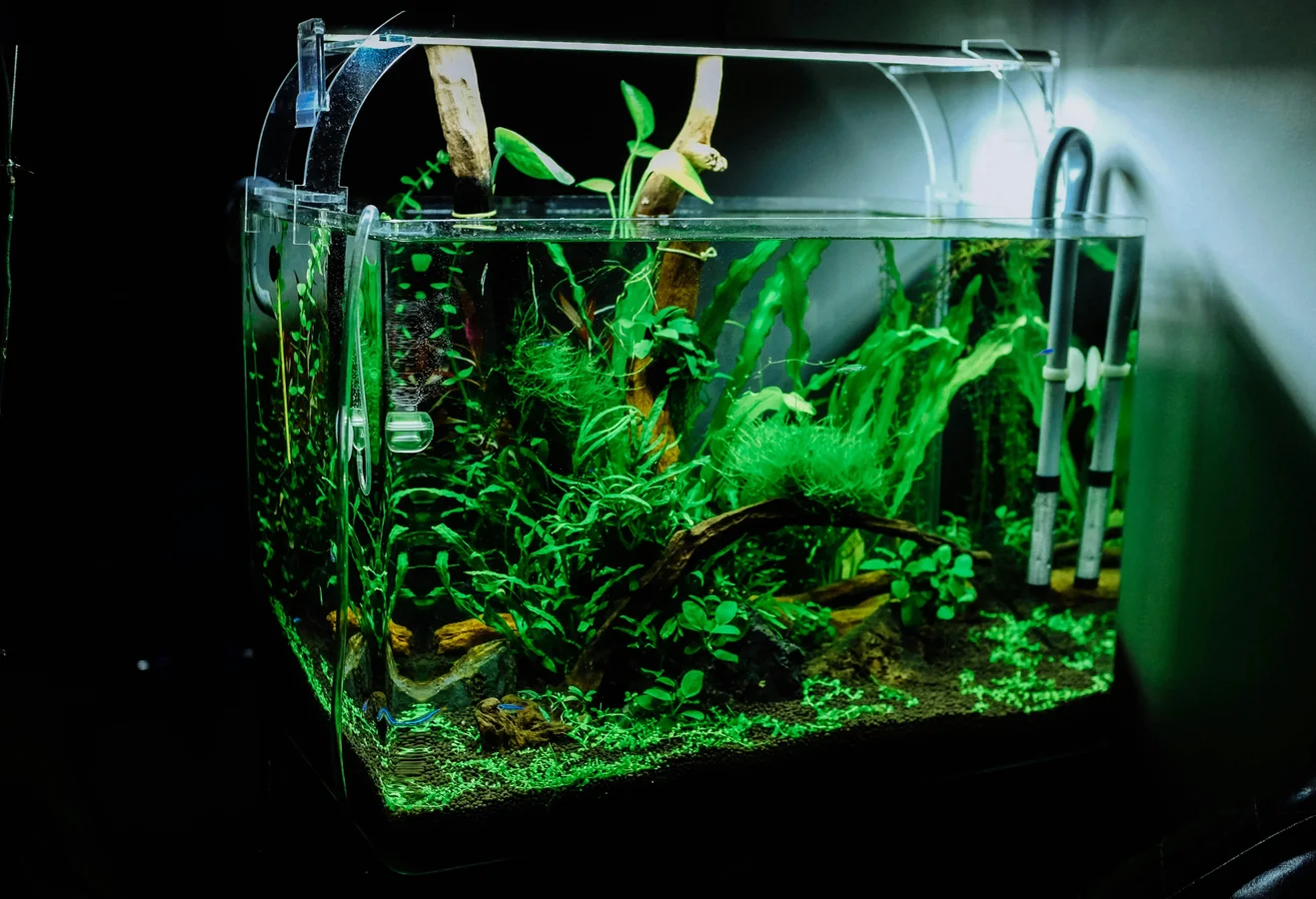
CO2 injection adds carbon dioxide to aquarium water to support plant photosynthesis and growth. This guide walks through what CO2 injection actually does, whether your planted tank needs it, the equipment involved, and how to run and monitor a basic setup as a beginner.
What Is CO2 Injection in an Aquarium?
Aquatic plants use dissolved carbon dioxide, along with light and nutrients, to photosynthesize and grow. Some CO2 is naturally present in aquarium water from fish respiration, decomposition, and gas exchange with the air, but the amount available this way is often limited.
CO2 injection is the practice of adding extra carbon dioxide directly into the water column, usually from a pressurized cylinder, to increase how much carbon is available to plants beyond what naturally occurs. This does not replace light or nutrients — it's one part of the growth equation, not the whole thing.
Do Planted Aquariums Need CO2?
Not necessarily. Many planted aquariums grow successfully without injected CO2. Plants such as Java fern, Anubias, various Cryptocoryne species, and many mosses are commonly kept in low-tech setups that rely only on the CO2 naturally present in the water.
Whether a tank benefits from injected CO2 depends on the combination of plant selection, lighting intensity, nutrient dosing, and what growth results you're aiming for. A tank with modest lighting and undemanding plants may never need it. A tank with strong lighting and carbon-hungry species is more likely to benefit.
When Does CO2 Injection Help?
Aquarists commonly consider CO2 injection when they want:
- Faster or denser plant growth than a low-tech setup typically provides
- Success with more demanding plant species, including some carpeting and stem plants
- More consistent carbon availability alongside higher light intensity
- To help plants stay competitive with algae in a higher-light aquarium
These are common reasons CO2 injection is used, not guarantees. Results still depend on the rest of the aquarium's conditions, and there's no fixed lighting level at which CO2 suddenly becomes required.
How a Basic CO2 System Works
At a basic level, a pressurized CO2 setup follows this path: a CO2 source supplies gas to a regulator, which controls the pressure and delivery; tubing carries the gas to a diffuser or reactor, which dissolves it into the aquarium water. A solenoid valve and timer are often added so the system can turn on and off automatically, and a bubble counter lets you observe roughly how much gas is flowing.
CO2 Equipment for Beginners
CO2 Source
Most beginner setups use a pressurized CO2 cylinder as the gas source. Cylinder size is typically chosen based on tank size and how often you're willing to refill it; larger tanks generally use larger cylinders to reduce refill frequency.
Regulator
The regulator attaches to the cylinder and steps the gas down from cylinder pressure to a lower, controllable working pressure, giving you a way to manage how much CO2 is delivered to the rest of the system.
Solenoid
A solenoid valve, connected to a timer or controller, can automatically turn CO2 flow on and off on a schedule. This is commonly used so CO2 doesn't run continuously, but not every setup uses one, and some aquarists manage injection manually.
Tubing
Tubing carries CO2 gas from the regulator to the diffuser. It should be rated for CO2 use and compatible with the fittings on your specific system — check your equipment's documentation for what's recommended.
Diffuser or Reactor
A diffuser or reactor is what actually gets CO2 into the water, typically by breaking the gas into fine bubbles or mixing it with water flow so it dissolves rather than escaping to the surface. Different designs vary in how efficiently they dissolve gas.
Bubble Counter
A bubble counter lets you see roughly how fast gas is flowing through the system. It's a useful reference point for making small adjustments over time, but bubble size and diffuser efficiency vary between setups, so a bubble count from one aquarium doesn't translate directly to another.
CO2 Injection Schedule
CO2 injection is commonly coordinated with the aquarium's lighting period, since plants use CO2 during photosynthesis and use much less of it once the lights are off. Many aquarists start injection some time before lights turn on, so dissolved CO2 has time to build up, and stop it before lights turn off to avoid unnecessary buildup overnight.
Exact timing varies by aquarium, water volume, and equipment, so any specific schedule you see elsewhere should be treated as one example rather than a universal rule. It's generally worth adjusting the schedule for your own tank and observing how plants, fish, and shrimp respond.
Monitoring CO2
Rather than relying on bubble count alone, it helps to monitor several signals together over time:
- How plants are responding — new growth, coloration, and overall health
- Fish behavior, including activity level and whether they spend unusual time near the surface
- Shrimp behavior, if you keep them, since they can be sensitive to water changes
- Dissolved CO2 indicators, such as a drop checker, used as a general reference rather than a precise real-time reading
- Aquarium pH trends, interpreted carefully alongside carbonate hardness (KH) rather than as a standalone number
No single measurement tells the whole story. A drop checker's color change lags behind the water's actual CO2 level, and pH on its own doesn't indicate a safe or correct CO2 concentration without accounting for KH. Consistency and gradual adjustment matter more than chasing one exact number.
CO2 and Fish and Shrimp Safety
Excessive dissolved CO2 can stress fish and shrimp. Possible warning signs include fish gasping at the surface, unusual surface activity, or other atypical behavior from your livestock.
If you notice signs like these:
- Stop or reduce CO2 injection
- Increase surface agitation or aeration to help gas exchange
- Check your other water parameters
- Look into what may have changed in the setup
Livestock tolerance and aquarium conditions vary, so there isn't one CO2 concentration that's guaranteed safe for every aquarium, every fish species, or every shrimp species. When adjusting CO2, small, gradual changes give you more room to notice and respond to problems before they become serious.
CO2, Light, and Nutrients
Plant growth depends on the balance between CO2, light, and nutrients together, not any one of them in isolation. Increasing CO2 alone doesn't fix a growth problem caused by insufficient light or a nutrient deficiency, and the same is true in reverse.
Stronger lighting tends to increase how much a planted tank benefits from consistent CO2 and nutrient availability, since faster photosynthesis increases demand for both. Running strong light without enough of the other resources plants need is one factor that can contribute to algae issues, though it's rarely the only cause.
Common Beginner Mistakes
Chasing bubble count
Bubble size and diffuser design differ between products and setups, so a bubble-per-second count isn't a reliable stand-in for actual dissolved CO2 concentration.
Increasing CO2 too quickly
Large, fast adjustments make it harder to catch problems early. Small changes, made gradually while observing livestock and plants, are generally easier to manage safely.
Ignoring gas exchange
Surface agitation and aeration affect how quickly CO2 escapes the water, which in turn affects how much builds up overnight and how it interacts with your injection settings.
Running strong lighting without considering carbon availability
Higher light increases the demand plants place on available CO2 and nutrients. There's no single lighting threshold that applies to every tank, but it's worth considering the relationship rather than treating light and CO2 as unrelated settings.
Assuming more CO2 is always better
Higher CO2 doesn't automatically mean better growth, and pushing levels higher increases the risk to fish and shrimp without a guaranteed benefit to plants.
Using equipment incorrectly
Regulators, cylinders, diffusers, and valves vary by manufacturer. Following the specific instructions for your equipment reduces the chance of leaks, pressure issues, or other setup mistakes.
Beginner CO2 Setup Checklist
- Choose a CO2 source appropriate for your aquarium size.
- Use a regulator compatible with that source.
- Connect CO2-rated tubing.
- Install a diffuser or reactor suited to your tank.
- Check all connections for leaks, following your equipment's instructions.
- Set up a consistent injection schedule tied to your lighting period.
- Observe fish, shrimp, and plants after starting injection.
- Adjust gradually rather than making large changes at once.
- Monitor the aquarium over time, not just at setup.
- Maintain your equipment according to the manufacturer's guidance.
CO2 for Saltwater Reef Tanks?
This guide focuses on CO2 injection for freshwater planted aquariums. Reef aquariums have different water-chemistry goals, and intentionally adding CO2 is not generally used as a method for supplying carbon to corals. CO2 also affects seawater pH and carbonate chemistry, so reef-aquarium applications should be evaluated in the context of the complete system rather than applying freshwater planted-tank practices directly.