
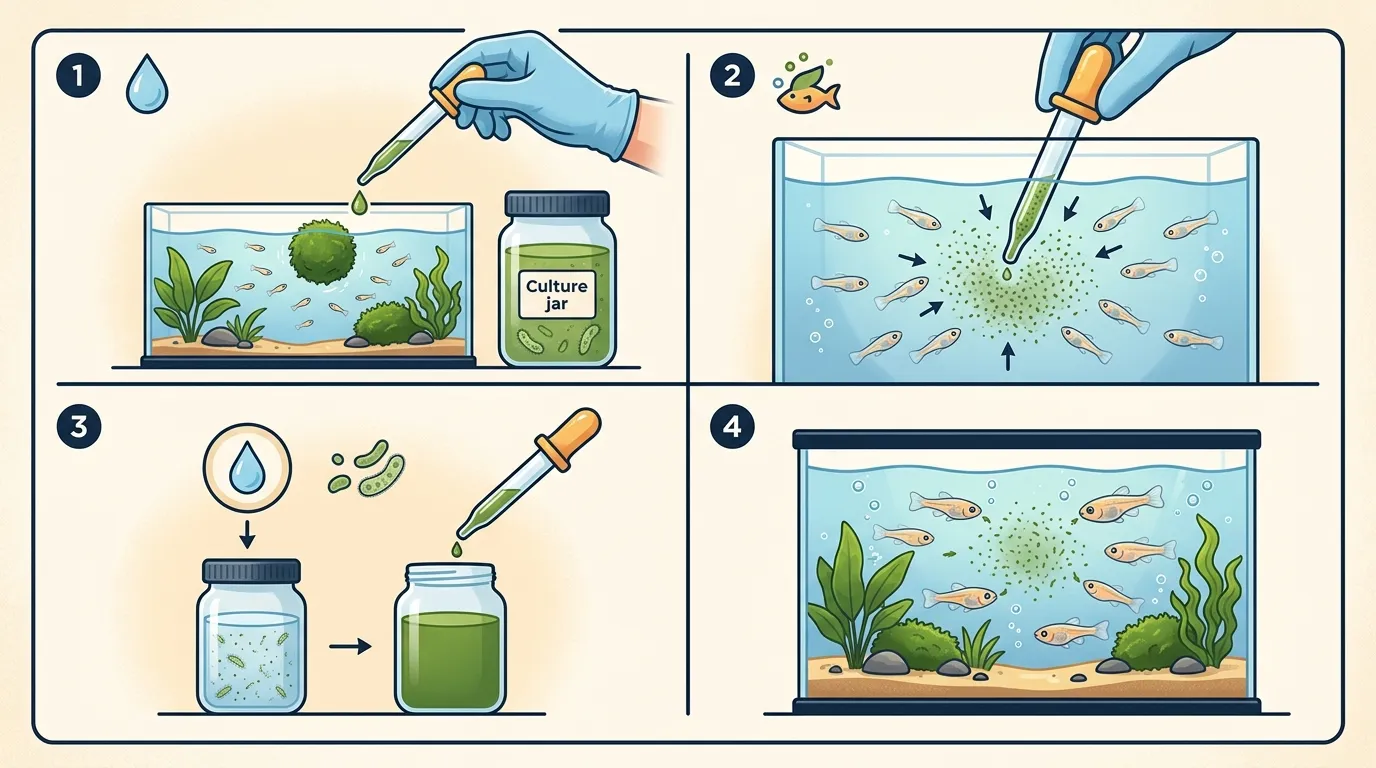
How do fish fry start feeding?
Fish fry do not all begin external feeding at the same time or require the same first food. Early development can include a period in which larvae rely on endogenous reserves before they become capable of effective exogenous feeding.
Once external feeding begins, mouth development, swimming ability, prey-capture ability and digestive development become important factors in choosing food.
| Factor | Why it matters | What to observe |
|---|---|---|
| Species | Developmental rate and first-food requirements differ between fish families | Consult species-specific hatchery or aquaculture guidance |
| Water temperature | Warmer water generally accelerates larval development; cooler water slows it | Track temperature and adjust feeding expectations accordingly |
| Egg type | Yolk-sac size at hatch varies; larger reserves extend the endogenous phase | Observe yolk-sac absorption before introducing first foods |
| Mouth development | Fry cannot ingest food larger than their gape permits | Assess mouth size relative to available food particle size |
| Swimming and prey-capture ability | Fry must be able to locate and capture food before feeding can succeed | Watch for active searching or pursuit behavior |
Fish fry feeding is developmental, not calendar-based
A common mistake is to create a universal day-by-day feeding schedule and apply it to every species. Fish larvae develop at different rates, and the timing of external feeding depends on species, temperature, egg type, developmental stage and rearing conditions.
A better approach is to identify the developmental stage of the fry and then select food that the fish can physically capture and ingest.
Developmental cues are more reliable than day numbers
- Yolk-sac absorption: the visible yolk sac shrinks and disappears as endogenous reserves are used; external feeding should begin around this transition
- Mouth opening: the mouth becomes functional and opens; fry can begin attempting prey capture
- Active swimming: fry move purposefully through the water column rather than resting passively
- Feeding behavior: fry strike at or pursue food particles or live prey
- Body growth: visible increase in body length indicates feeding is succeeding
From endogenous nutrition to exogenous feeding
Newly hatched larvae may initially rely on internal reserves. As development proceeds, the larvae become capable of feeding from the environment. This transition is a major point in fry husbandry because food must become physically accessible once endogenous reserves are no longer sufficient.
The exact timing varies between species, so a universal day-number schedule should not be assumed.
| Characteristic | Endogenous feeding (internal reserves) | Exogenous feeding (external food) |
|---|---|---|
| Nutrient source | Yolk sac; sometimes oil globule | Food captured or ingested from the environment |
| Keeper action required | Minimal; focus on water quality and light | Appropriate food must be offered in accessible form |
| Duration | Varies by species and yolk-sac size | Continues through juvenile and adult stages |
| Risk if mismanaged | Poor water quality can harm larvae before they can feed | Wrong food size, type or distribution causes starvation |
| Key observation | Monitor yolk-sac absorption | Monitor active feeding behavior and growth |
Why mouth gape matters
Mouth gape is one of the major physical constraints on early larval feeding. A food particle can be nutritionally suitable but still unusable if the fry cannot physically ingest it.
As the mouth develops and the fry grows, the range of prey and feed particles that can be captured and swallowed changes. This is why feed selection needs to follow development rather than remain fixed throughout the fry stage.
Mouth gape: practical implications
- Food that is too large will be ignored or spit out, even if the fry approaches it
- Food that is too small may not trigger a feeding response in some species
- Mouth shape (terminal, inferior, superior) also affects which prey or food items are easiest to capture
- Gape increases as body length increases, so food size should be reassessed regularly
- Observing actual capture attempts is more reliable than estimating gape from body length alone
How feed particle size changes as fry grow
Fry feeding programs commonly transition toward larger feed particles as fish size and feeding structures develop. Aquaculture manuals provide species- and size-specific examples of this progression.
These examples demonstrate an important principle but do not justify a universal particle-size formula measured in microns for every aquarium fish. Species, developmental stage and actual feeding ability must be considered together.
| Fry stage | Typical food size range (indicative) | Example food types | Key consideration |
|---|---|---|---|
| First exogenous feeders (very small fry) | Smallest available particles or micro-organisms | Infusoria, rotifers, commercial micro-fry diets | Mouth gape is the primary constraint; observe capture attempts |
| Early fry (growing) | Small live prey or small prepared particles | Newly hatched brine shrimp nauplii, micro-worms, fine powdered feeds | Transition when fry can consistently capture current food |
| Developing fry (larger body) | Larger live prey or crumble-grade prepared feeds | Larger brine shrimp, micro-pellets, finely crushed flake | Growth rate and feeding behavior guide the transition |
| Juvenile | Standard small pellet or flake | Species-appropriate pellets, flake, frozen foods | Species diet preferences become more relevant at this stage |
Important: the stage descriptions and food examples above are illustrative of a general developmental principle. Specific size thresholds and appropriate food types differ between species. Always verify against species-specific guidance.
Very small first foods
Early exogenous feeders may require very small food particles or organisms that they can capture with their developing mouths. The correct option depends strongly on the species and larval stage.
Transition to larger foods
As fry grow, their mouth size and prey-capture ability increase. Food can then transition toward larger particles or more substantial feed forms when the fish can successfully ingest them.
What can you feed fish fry?
The appropriate first food depends on the species and developmental stage. Depending on the fish, early exogenous feeding may involve suitable live prey, cultured organisms, prepared larval diets or combinations of these.
Do not assume that a food suitable for one species' fry will be appropriate for another. The most important test is whether the fry can encounter, capture and ingest the food successfully.
| Food type | Typical use stage | Advantages | Disadvantages | Notes |
|---|---|---|---|---|
| Infusoria (cultured micro-organisms) | Very early first feeders | Very small size; live movement triggers feeding response | Requires culturing; nutritional profile varies | Often used for species with very small mouths at first feeding |
| Rotifers | Early larvae | Small, live, widely used in commercial aquaculture | Requires live culture maintenance; short shelf life | Commonly enriched with lipid supplements in aquaculture settings |
| Newly hatched brine shrimp (Artemia nauplii) | Early to mid fry | Live, active, widely available, well-studied | Nutritional value declines if not enriched; requires hatching | A staple first food for many species; not suitable for very small-mouthed fry |
| Micro-worms and similar nematodes | Early to mid fry | Easy to culture at home; live movement | Sink to bottom; may not suit surface or mid-water feeders | Useful for species that feed near the substrate |
| Commercial powdered/micro-fry diets | Variable; check manufacturer guidance | Convenient; formulated nutritional profile; no live culture needed | Inert; may not trigger feeding in species expecting live prey | Quality and particle size vary between products; check suitability for species |
| Egg yolk (hard-boiled, strained) | Emergency or first feeding for some species | Readily available; fine particles when strained | Rapidly degrades water quality; nutritional profile incomplete | Not a recommended long-term food; use sparingly and with water-quality monitoring |
| Crushed or powdered adult flake/pellet | Mid to later fry | Convenient; available in most households | Particle size inconsistent; may not suit very early fry | More appropriate as a supplement once fry are growing well on primary food |
How often should fish fry be fed?
Young fish often require feeding strategies that differ from those used for adult fish because of their small size, developmental stage and feeding capacity. However, there is no universal number of feeds per day that applies to all fry.
Frequency should be considered in relation to species, developmental stage, food type, feeding response and the ability of the rearing system to manage the resulting waste.
Factors that influence feeding frequency
- Digestive capacity: very small fry have limited stomach volume and may benefit from smaller, more frequent offerings rather than large, infrequent ones
- Food type: live prey that remains active in the tank can be present continuously; prepared feeds settle and degrade, so timing matters more
- Water temperature: metabolism and digestive rate are temperature-dependent; warmer conditions generally support higher feeding frequency
- Species feeding style: some species graze continuously; others strike at prey intermittently
- Rearing system: high-frequency feeding in a small tank without adequate filtration increases waste accumulation rapidly
- Growth rate: actively growing fry with good feeding response can often support more frequent feeding than fry showing poor response
How do you know if fry are actually eating?
Watch the fry rather than relying only on the amount of food offered. Successful feeding can involve active pursuit, capture and ingestion of suitable particles or prey.
If fry repeatedly fail to interact with the food, consider whether the particles are too large, too difficult to capture, unsuitable for the species or poorly distributed in the water.
Feeding success indicators
| Observation | Likely interpretation | Suggested action |
|---|---|---|
| Fry actively pursue and strike at food | Feeding is occurring; food type and size appear appropriate | Continue current feeding approach; monitor growth |
| Fry approach food but do not ingest it | Food may be too large for current mouth gape | Try smaller particles or finer live prey |
| Fry ignore food entirely | Food may be wrong type, wrong size, wrong water column position, or fry not yet ready for external feeding | Assess developmental stage; try different food type or distribution method |
| Fry show thin or concave belly | Fry may not be receiving adequate nutrition | Review food type, particle size, frequency and distribution; check water quality |
| Fry bellies appear rounded after feeding | Feeding is succeeding and digestive tract is filling | Maintain current approach; continue monitoring |
| Rapid food disappearance with no visible feeding | Food may be sinking or dissolving before fry encounter it | Adjust distribution method; consider live prey that remains active in water column |
Fish fry feeding and water quality
Fry feeding creates a balance between providing enough accessible food and preventing excessive organic waste. Uneaten food and waste can affect water quality, particularly in small rearing systems.
Feeding frequency and food quantity therefore need to be considered together with filtration, water exchange and the ability of the system to process waste.
Water quality and feeding: key interactions
- Uneaten food decomposition: prepared feeds that are not consumed begin to decompose, consuming oxygen and releasing ammonia
- Ammonia spikes: small fry are sensitive to ammonia; waste accumulation in poorly filtered systems can cause rapid deterioration
- Oxygen demand: live cultures (brine shrimp, rotifers) also consume oxygen; monitor dissolved oxygen if using high densities of live food
- Filtration choice: strong flow can sweep small fry; sponge filters are widely used for fry tanks as they provide biological filtration with gentle water movement
- Partial water changes: regular partial water changes help manage waste accumulation; avoid large, sudden changes that can stress fry
- Observation after feeding: check for uneaten food and remove or siphon if it is accumulating
| Consideration | Live food | Prepared (dry/frozen) food |
|---|---|---|
| Water fouling if uneaten | Live prey remains active and may be consumed later; risk lower in short term | Begins to decompose quickly; greater immediate water-quality risk if overfed |
| Oxygen consumption | Live prey consumes oxygen; relevant at high densities | Decomposing feed consumes oxygen through bacterial activity |
| Feeding response | Movement generally stimulates strong feeding response | Some species may not recognize inert particles as food |
| Keeper effort | Requires culturing or purchasing live cultures | Convenient; no culture maintenance required |
| Nutritional consistency | Varies depending on what live prey has consumed (gut-loading matters) | More consistent if from a reputable formulated product |
When should fry move to larger food?
The transition to larger food should follow development rather than an arbitrary date. Increasing body size, developing mouth structures and successful handling of the current feed are useful observations when deciding whether the fish can manage a different particle size or feed form.
Species-specific hatchery or aquaculture guidance should take priority when it is available because developmental timing differs substantially between fish.
Checklist: signs that fry may be ready for larger food
- Fry are consistently and successfully capturing their current food
- Body length has visibly increased since the current food was introduced
- Mouth size appears proportionally larger relative to current food particles
- Water quality remains stable, suggesting feeding efficiency is good
- Fry appear to seek out or strike at objects larger than their current food
- Species-specific guidance or aquaculture references indicate a transition at this approximate size or stage
Common fish fry feeding mistakes
- Using a universal calendar: fry development differs among species, so one day-by-day schedule cannot safely cover every fish
- Using food that is too large: mouth gape limits what early fry can physically ingest
- Assuming one particle size works throughout development: feed requirements change as the fry grow
- Using a universal feeds-per-day rule: frequency depends on species, stage, food and rearing conditions
- Ignoring water quality: uneaten food and waste can rapidly become a problem in small rearing systems
- Offering food before fry are developmentally ready: introducing external food too early or too late relative to yolk-sac absorption can result in poor outcomes
- Not observing actual feeding behavior: assuming food has been eaten because it has disappeared, rather than watching fry actively ingest it
- Using adult food crushed finely as a default: the nutritional profile of adult foods may not match what developing larvae require
- Transferring assumptions between species: what works for one species' fry is not automatically appropriate for another
Fish fry feeding: quick-reference comparison table
| Variable | Applies universally? | What determines it? |
|---|---|---|
| When to start external feeding | No | Species, yolk-sac absorption, developmental stage, temperature |
| First food type | No | Species, mouth size, feeding behavior, prey availability |
| Particle size | No | Mouth gape, developmental stage, body size |
| Feeds per day | No | Species, food type, water temperature, rearing system, developmental stage |
| Transition to larger food | No | Observed feeding success, body growth, species-specific guidance |
| Live vs. prepared food | No | Species feeding behavior, keeper resources, developmental stage |
| Water-quality management | Yes — always needed | Applies regardless of species or food type; intensity scales with system size and feeding load |
Fish fry feeding guide: key takeaways
Fish fry feeding should follow development rather than a universal calendar. Early larvae may transition from endogenous reserves to exogenous feeding, after which mouth gape and feeding ability constrain food choice. As fry grow, feed particle size and feed type can change. Feeding frequency also varies by species and developmental stage, so use species-specific evidence and observed feeding response rather than a universal numerical rule.
- Development, not calendar days, is the correct framework for fry feeding decisions
- The endogenous-to-exogenous transition is a critical window: food must be available and accessible when reserves are exhausted
- Mouth gape is a hard physical limit; food that cannot be ingested has no feeding value regardless of nutritional content
- Food type, particle size and feeding frequency all change as fry develop; a single static approach will not remain appropriate throughout the fry stage
- Watching fry feed is more informative than watching the amount of food offered
- Water quality management is non-negotiable and interacts directly with feeding choices
- Species-specific aquaculture or hatchery guidance should take priority over general rules wherever it is available