
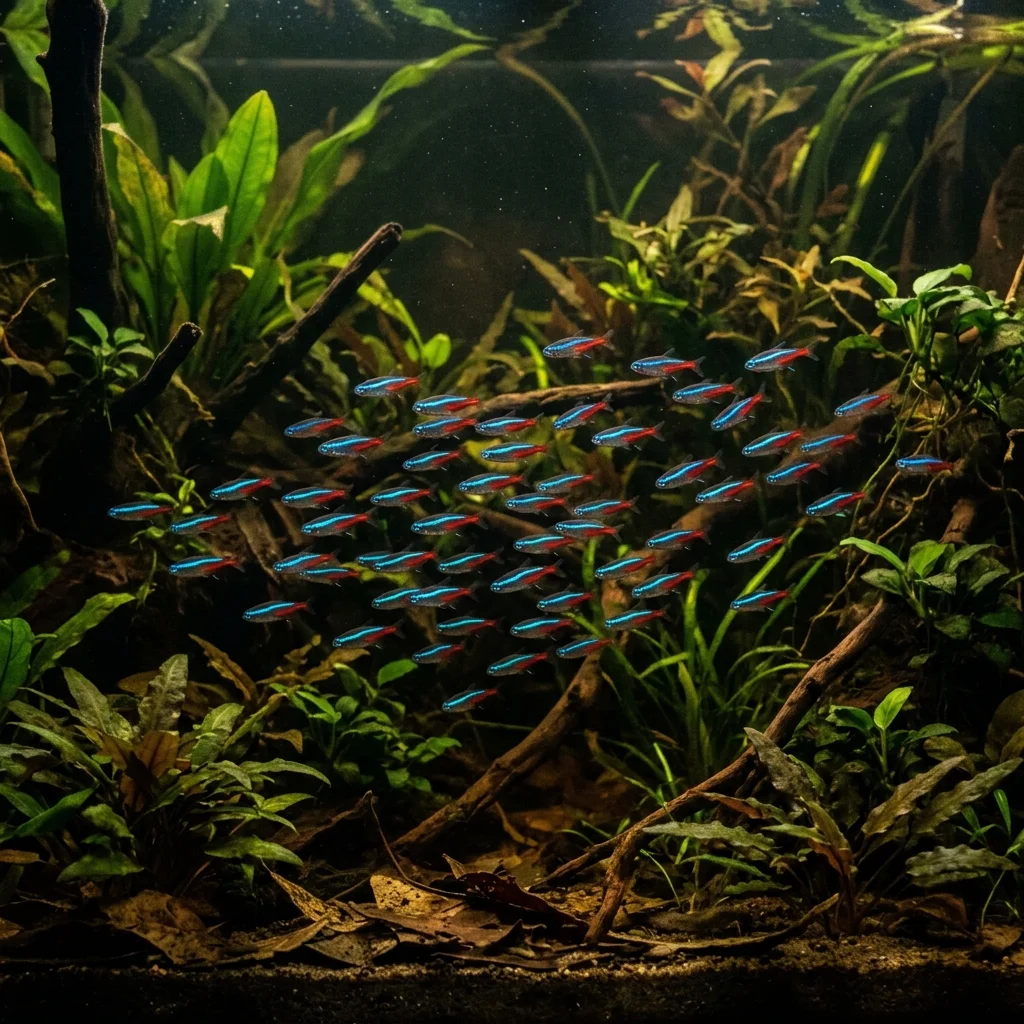
When beginners think of “tetra,” the neon tetra (Paracheirodon innesi) is usually the first image that comes to mind. But the tetra family (Characidae) includes over 1500 species, many of which are more vibrant, hardier, or better suited to your specific tank. Here’s a detailed comparison of the most popular tetras to help you choose your school.
Neon Tetra (Paracheirodon innesi)
Size: 1.2 inches (3 cm)
Tank size: 15+ gallons (57+ L) for a school of about 10 or more
Water: 6.0–7.0 pH, soft, 20–26°C
Pros: Inexpensive, widely available, classic neon blue and red stripe.
Cons: Can be susceptible to disease; appearance alone does not diagnose Neon Tetra Disease. Small groups may be shy or stressed.
Best for: Beginners who want the classic look and have soft, stable water. Avoid if you have very hard water or keep them with large cichlids.
Cardinal Tetra (Paracheirodon axelrodi)
Size: 1.5 inches (4 cm)
Tank size: 20+ gallons (76+ L) for a school of about 10 or more
Water: 5.5–7.0 pH, very soft, 22–26°C
Pros: The red stripe runs the entire length of the body (more vibrant than neon), generally hardier than neons.
Cons: Slightly more expensive, sensitive to hard/alkaline water.
Best for: Aquarists with established soft‑water tanks who want maximum color. Not for beginners with tap water above 7.0 pH.
Ember Tetra (Hyphessobrycon amandae)
Size: 0.8 inches (2 cm)
Tank size: 10+ gallons, school of 8+
Water: 6.0–7.0 pH, adaptable, 22–26°C
Pros: Tiny size allows larger schools in small tanks, warm orange/red color that pops against green plants, very peaceful.
Cons: Can be shy if not in a large school, slightly more expensive than neons.
Best for: Nano tanks (10–15 gallons) and planted community tanks with other small fish like Boraras rasboras.
Black Neon Tetra (Hyphessobrycon herbertaxelrodi)
Size: 1.4 inches (3.5 cm)
Tank size: 15+ gallons, school of 8+
Water: 5.5–7.5 pH, very adaptable, 22–26°C
Pros: Hardy, peaceful, striking black body with greenish‑gold stripe, seldom fin‑nip.
Cons: Not as brightly colored as neons or cardinals.
Best for: Beginners with average tap water, community tanks, and anyone who wants a more subdued but elegant look.
Green Neon Tetra (Paracheirodon simulans)
Size: 1 inch (2.5 cm)
Tank size: 10+ gallons, school of 8+
Water: 5.5–7.0 pH, very soft, 22–26°C
Pros: Smaller and more delicate than neon, brilliant turquoise‑blue stripe (no red), very active.
Cons: Less common, more expensive, intolerant of poor water quality.
Best for: Experienced keepers with blackwater or soft‑water setups who want a unique look.
Other Notable Tetras
- Rummy Nose Tetra (Hemigrammus rhodostomus): Striking red nose and zebra tail. Schooling is tighter than any other tetra. Needs very clean water (0 nitrates ideal). 20+ gallons, school of 10+.
- Congo Tetra (Phenacogrammus interruptus): Large (3 inches), iridescent, flowing fins. Requires 30+ gallons, school of 6+. Best for larger community tanks.
- Lemon Tetra (Hyphessobrycon pulchripinnis): Pale yellow body with red eyes. Very hardy and peaceful. Good for beginners who want something different.
- Serpae Tetra (Hyphessobrycon eques): Blood red with black fin markings. Semi‑aggressive, known to nip long fins. Best kept in groups of 10+ to contain aggression.
How to Choose Your School
Start with your water parameters. If your tap water is hard and alkaline (pH 7.5+), avoid cardinals and green neons — they will be stressed and short‑lived. In that case, black neon tetras, Buenos Aires tetras, or even lemon tetras are better choices. For planted soft‑water tanks, you can’t go wrong with cardinals or rummy noses.
Next, tank size: use the species-specific group guidance above—15+ gallons for about 10 Neons and 20+ gallons for about 10 Cardinals. A larger footprint and volume may be needed for bigger schools or community setups.
Finally, consider tankmates. Tetras are generally peaceful, but small tetras (neon, ember) can be eaten by larger cichlids. Serpae tetras should not be kept with bettas or angelfish because of fin‑nipping.
School Size Matters
All tetras are schooling fish. A school of 6 is the absolute minimum, but 10–15 is much better. In larger schools, you’ll see natural behavior: synchronized swimming, reduced aggression (for semi‑aggressive species), and brighter colors (males display more). For Neons and Cardinals, use the species-specific group guidance above; tank volume and footprint should suit the group and other inhabitants.