
What this paludarium water volume calculator measures
A paludarium combines terrestrial and aquatic sections, meaning the actual volume of water it holds is substantially lower than what the enclosure's outer dimensions suggest. Unlike standard aquariums that are filled near the top, a paludarium features a shallow water column, a defined aquatic footprint, and internal barriers.
This calculator focuses strictly on the aquatic zone. It determines the raw geometric water capacity from your internal water-basin dimensions and lets you subtract estimated displacement from land features, rocks, and false bottoms to find your true net usable water volume.
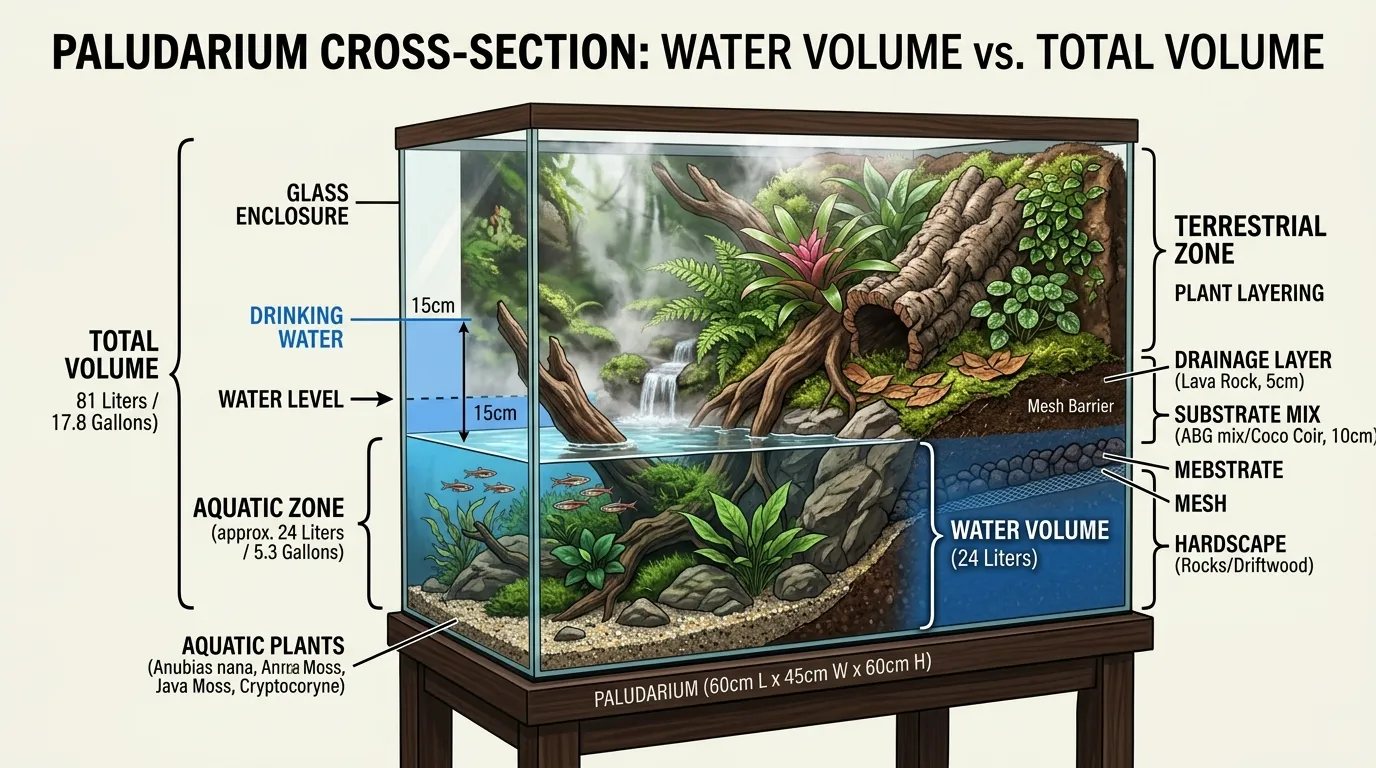
How to calculate water volume for a paludarium
To calculate the water capacity of a rectangular paludarium aquatic zone, follow these steps:
- Measure the usable internal length and width of the aquatic basin in inches (do not include glass thickness or land sections outside the water barrier).
- Measure the vertical water depth from the bottom of the tank to the intended water line (do not use the total tank height).
- Calculate total cubic inches:
Length × Width × Water Height = Cubic Inches. - Convert to US Gallons: Divide cubic inches by 231 (
Cubic Inches ÷ 231 = US Gallons). - Convert to Liters: Multiply US gallons by 3.78541 (
Gallons × 3.78541 = Liters). - Deduct displacement: Subtract the estimated volume occupied by submerged hardscape, driftwood, expanding foam, and substrate banks to find net usable water volume.
Use internal aquatic-zone dimensions
Always measure the dimensions of the actual space containing water rather than using the enclosure's external specs.
You need three core measurements:
- Internal length: The usable inside length of the aquatic section.
- Internal width: The usable inside width of the aquatic section.
- Water height: The actual vertical depth of water, not the overall height of the glass tank.
If the paludarium has an irregularly shaped aquatic zone, divide the footprint into smaller rectangular segments, calculate each section, and sum the volumes.
How the calculation works
The calculator uses standard volumetric conversions:
Length (in) × Width (in) × Water Height (in) = Cubic Inches
For cubic inches converted to US gallons:
US Gallons = Cubic Inches ÷ 231
For US gallons converted to liters:
Liters = US Gallons × 3.78541
When an optional displacement estimate is entered, the engine subtracts that value directly from the geometric volume while enforcing a minimum net floor of zero.
Paludarium Water Volume Calculator in Litres
This tool outputs both US gallons and metric liters (litres) simultaneously. Enter your internal measurements to obtain both units instantly, providing clear volume targets for water conditioners, filter sizing, and biological load planning.
Geometric volume versus net usable volume
Geometric water volume is the theoretical capacity of the rectangular basin before any décor, pumps, or land bases are placed inside.
Net usable water volume represents the actual volume of liquid water remaining after accounting for displacement. In planted paludariums, rocks, roots, foam backgrounds, and drainage grids can easily displace 15% to 40% of the aquatic zone's capacity.
Example calculation
Consider a paludarium basin measuring 24 × 12 inches with a water depth of 6 inches:
- 24 × 12 × 6 = 1,728 cubic inches.
- 1,728 ÷ 231 = 7.48 US gallons.
- 7.48 × 3.78541 = 28.32 liters.
The raw geometric water volume is 7.48 US gallons (28.32 liters).
If rockwork and land boundaries displace an estimated 1.5 gallons, the net usable water volume is approximately 5.98 US gallons (22.64 liters).
How to estimate displacement
Whenever possible, calculate displacement using physical measurements rather than arbitrary guesses:
- Known hardscape: Submerge rocks or driftwood in a bucket of water and measure water displacement.
- Geometric land barriers: If a glass divider walls off half the tank footprint, only measure the open water section.
- Substrate bed: If gravel or sand fills the bottom 1.5 inches of the aquatic zone, subtract that bed height from your total water depth measurement before calculating.
Why external tank dimensions mislead
Standard aquarium gallons (e.g., a "20-gallon long") assume a bare glass box filled to the rim. In a paludarium, water is intentionally kept low to preserve terrestrial space, and false bottoms or land barriers further diminish the footprint. Calculating maintenance doses based on factory enclosure labels can lead to severe overdosing of dechlorinators or medications.
Irregular aquatic zones
Many paludariums feature winding shorelines or multi-tier water features. A single rectangular formula serves as an estimate. For stepped shorelines, calculate the deep pool and shallow marsh areas as two distinct rectangular zones and add their volumes together.
What this calculator does not determine
Water capacity is purely a baseline physical parameter. This calculator does not evaluate bioload capacity, pump flow rates (GPH/LPH), biological filter maturation, or heating wattages. Stocking decisions for aquatic species such as micro-rasboras, shrimp, or vampire crabs depend heavily on surface air exchange, land-water transitions, and water stability rather than water volume alone.
Frequently asked questions
What dimensions should I enter?
Enter the inside length, inside width, and actual water depth of the aquatic area. Do not use external tank measurements or total enclosure height.
Should water height be the total tank height?
No. Use the depth of the water from the bottom of the basin to the intended water line.
What is the difference between geometric and net usable volume?
Geometric volume reflects the raw open basin capacity. Net usable volume deducts the physical space consumed by hardscape, background foam, and land barriers.
Can I enter dimensions in centimeters?
The primary inputs use inches. If measuring in centimeters, divide centimeters by 2.54 to convert to inches prior to input.
Does the calculation account for substrate?
If you have a substrate layer at the bottom of the water section, either reduce your water depth measurement by the thickness of the substrate layer or include its volume in the displacement field.
Can this tool be used for standard aquariums?
Yes. If you enter the full internal dimensions and full water height of a regular aquarium, the geometric result will accurately calculate full-tank water volume.
Does this calculate stocking capacity for fish or crabs?
No. Stocking requires evaluating species territory, bioload, filtration efficiency, and terrestrial land ratio.