Overview
You come home from work and find your guppy hovering at the surface, its lips pale and slightly ragged. Within hours a grey-white patch spreads across its back like a saddle. Columnaris is a gram-negative bacterial infection caused by Flavobacterium columnare that invades the skin, gills, and mouth of freshwater fish, producing lesions that mimic fungal growth. Unlike true fungal infections such as Saprolegnia, which colonize dead tissue with fluffy, cotton-like filaments, Columnaris attacks living skin and spreads across the epidermis in flat, slimy sheets. It is one of the most misdiagnosed diseases in aquariums because hobbyists reach for antifungals when they see the cottony mouth tufts. The same stressors that trigger Ichthyophthirius multifiliis outbreaks—temperature spikes, poor water quality, overcrowding—also breach the mucus coat and allow Flavobacterium to colonize. In my practice, I see Columnaris most often in livebearer tanks kept above 26°C/79°F where the bacteria replicate every 12–20 hours.
Identification
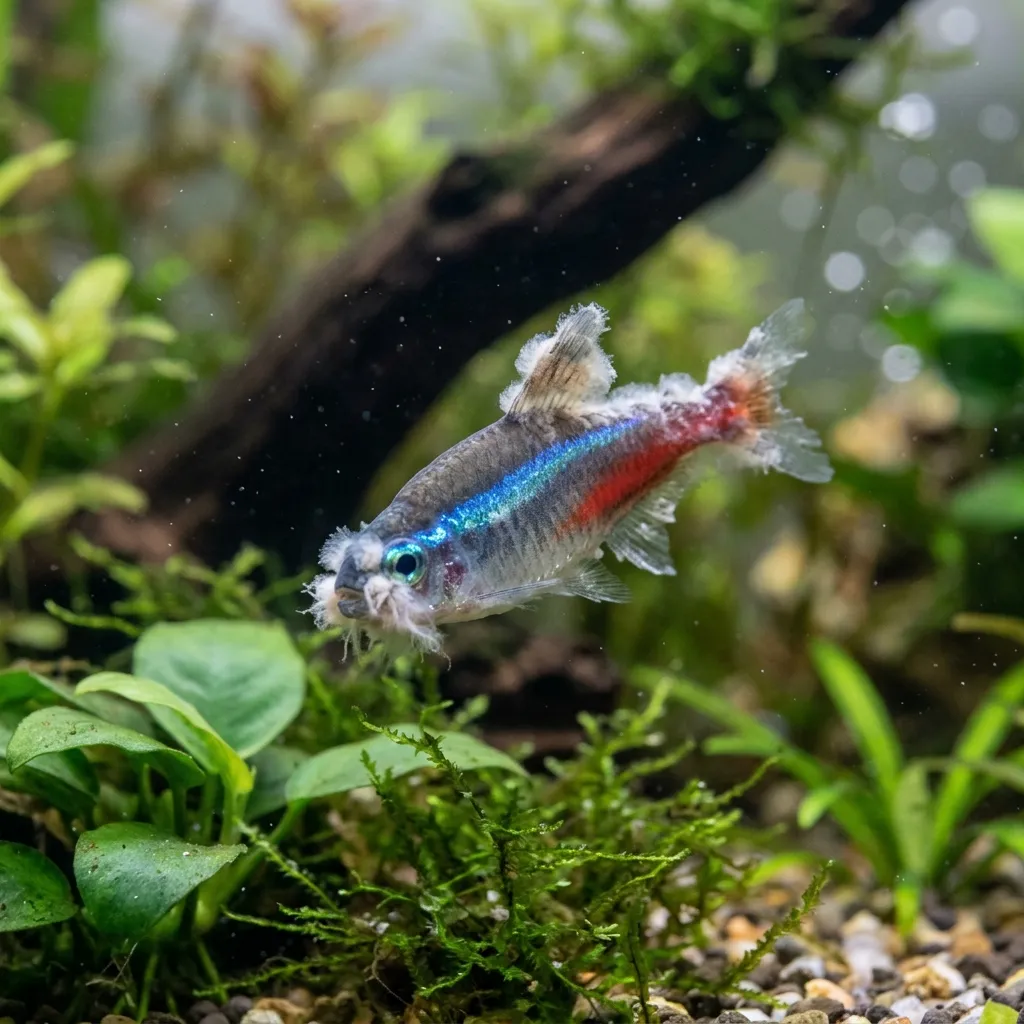
Columnaris is an external bacterial disease characterized by flat, grey-white lesions that typically begin on the lips, fin edges, or dorsal surface and spread rapidly across living tissue. The classic saddleback lesion appears as a pale band across the dorsal muscle behind the head, distinct from the uneven, fluffy patches of Saprolegnia fungus. Infected fish develop frayed fins with white margins, clamped fins, and rapid opercular movement as gill filaments erode. The mouth form produces cottony tufts that look exactly like fungal growth but feel slimy rather than fuzzy. Gill infections cause flashing and gasping long before skin lesions appear. Do not confuse Columnaris with fin rot caused by Aeromonas or Pseudomonas, which usually begins at the fin rays and progresses slowly without the characteristic saddleback patch. Ich presents as discrete salt-grain spots, whereas Columnaris spreads as continuous, sheet-like lesions.
Life Cycle
Columnaris is a bacterial disease that progresses through rapid binary fission of Flavobacterium columnare, with explosive replication in warm water that can overwhelm a tank within 48 hours. At 28°C/82°F, the doubling time can be as short as 12 hours, which explains why a single fish with lip lesions can produce a tank-wide mortality event within two days. The bacteria form biofilms on tank surfaces, filter media, and substrate, surviving for weeks in organic debris even without fish hosts. When water temperature drops below 20°C/68°F, replication slows dramatically and the disease becomes chronic rather than acute. This temperature dependency means warm-water species like guppies and discus face explosive outbreaks, while cold-water goldfish may carry subclinical infections for weeks. Stress hormones from handling, shipping, or ammonia spikes suppress immune function and trigger latent bacterial populations to bloom.
Treatment
Columnaris is a bacterial infection that requires gram-negative antibiotics because the pathogen is protected by an outer membrane impermeable to most standard aquarium remedies. The most effective protocol I use is a combination of Kanaplex (kanamycin) dosed at 1 level measure per 5 gallons every 48 hours for three total doses, paired with Furan-2 (nitrofurazone) at one packet per 10 gallons every 24 hours for four consecutive days. This dual approach targets protein synthesis and cellular metabolism simultaneously. Reduce water temperature to 22–24°C/72–75°F immediately; every degree above 26°C/79°F accelerates bacterial division and shortens the window for intervention. Acriflavine-based products such as API Fungus Cure provide a mild antiseptic bath that suppresses surface biofilms but should not replace antibiotics. Salt at 1–2 ppt reduces osmotic stress and supports gill function during recovery. Remove activated carbon and turn off UV sterilizers during antibiotic treatment or the medication is adsorbed and degraded. Perform a 25% water change before each new antibiotic dose to control waste buildup. This is the step most beginners skip, and it is why treatment fails: they add medicine to dirty water and the bacteria never face a therapeutic concentration. Treatment duration typically runs 7–10 days, with visible lesion recession beginning around day 3 if the protocol is correct. Fish with gill involvement need the full 10 days; stopping at day 5 because the saddleback patch faded is a common relapse trigger.
Calculate Treatment Dose
Once you have identified the medication and confirmed its label dosage, use the Medication Dosage Calculator to calculate the amount required for your aquarium volume.
Prevention
Always isolate new or sick fish; see our guide on Quarantine Tanks: Essential Disease Prevention.
Columnaris prevention is a multi-layered strategy that combines temperature management, quarantine protocols, and water quality maintenance to stop Flavobacterium columnare from colonizing stressed fish. Maintain ammonia and nitrite at 0 ppm, nitrates below 20 ppm, and avoid overcrowding. Quarantine new fish for 14 days at 24°C/75°F, inspecting daily for lip pallor or fin edge whitening. During summer heatwaves, increase aeration and shade outdoor tanks to keep temperature below 26°C/79°F. Livebearers and labyrinth fish are particularly vulnerable after shipping stress; I recommend a 30-minute acclimation with a mild antiseptic dip before introducing them to community tanks. Disinfect nets and equipment with a diluted bleach solution between systems because the bacteria form persistent biofilms on plastic surfaces. A single contaminated net can seed Columnaris into an otherwise healthy tank within hours. Never pour bag water from a pet store into your aquarium; it is often the primary vector for bacterial introduction.