
Overview
Watching your prized fish violently rub their bodies against the gravel or gasp helplessly at the water's surface is highly distressing, especially when their skin looks completely clear. When you rule out ammonia poisoning and Ich, the most likely culprit is an invisible infestation of flukes. Flukes are microscopic trematodes (flatworms) that embed a ring of sharp hooks (the haptor) directly into the fish's flesh, feeding on blood and epithelial tissue.
There are two primary culprits in the aquarium hobby: Gyrodactylus (skin flukes) and Dactylogyrus (gill flukes). While they target different areas, both cause intense irritation and stimulate excessive mucus production as the fish attempts to flush the parasites away. Left untreated, heavy fluke loads destroy the delicate respiratory lamellae of the gills, leading to secondary bacterial infections and ultimately suffocation. Because these parasites are entirely invisible to the naked eye, hobbyists frequently misdiagnose the symptoms or delay treatment until irreversible tissue damage has occurred.
Identification
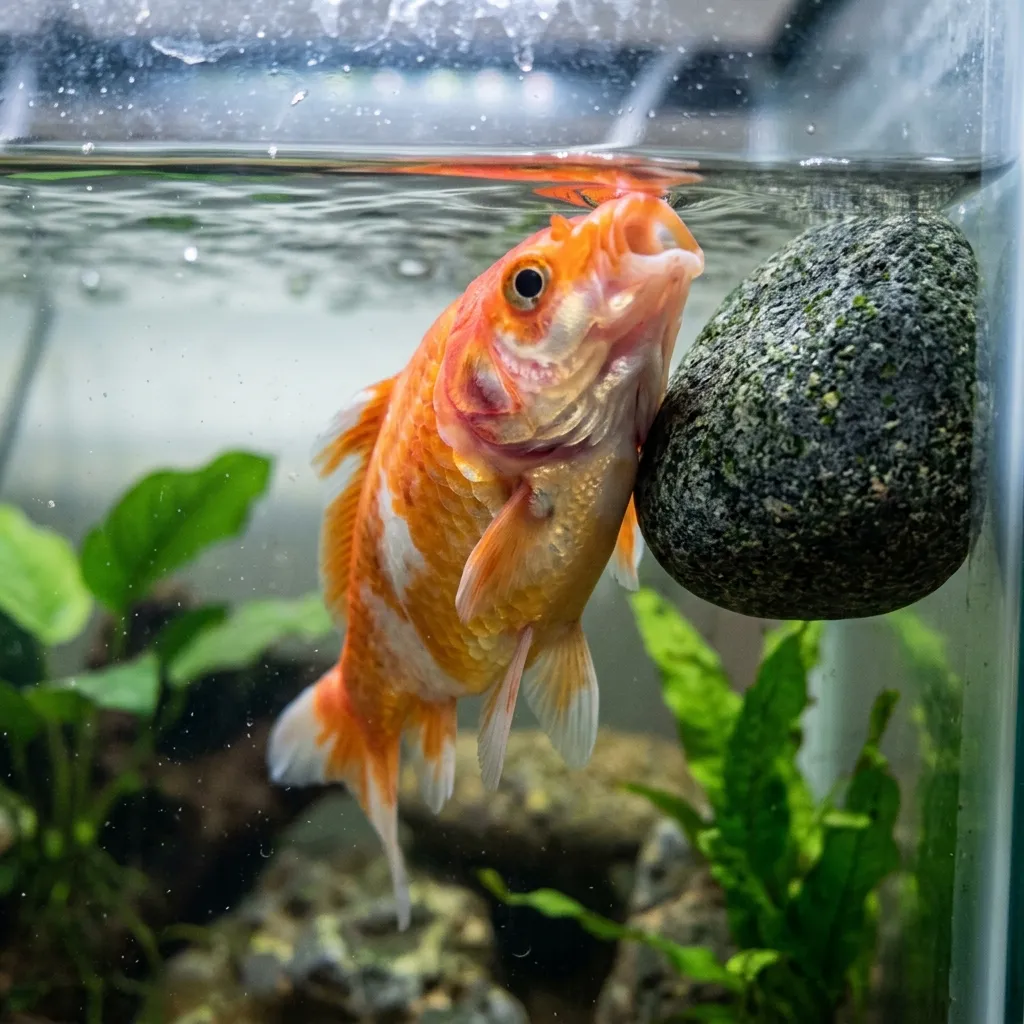
Because you cannot see flukes without a microscope, identification relies heavily on clinical signs. The hallmark behavior of a fluke infestation is 'flashing'—a rapid, darting maneuver where the fish intentionally scrapes its flanks or operculum (gill cover) against rocks, driftwood, or the substrate to scratch the intense itch.
For gill flukes (Dactylogyrus), respiratory distress is the primary symptom. You will observe rapid, labored breathing (hyperpnea), hanging near the surface or filter outtake where oxygen is highest, and 'yawning' behaviors. A classic telltale sign is unilateral breathing, where the fish clamps one gill shut entirely to limit the pain while breathing heavily out of the other. Physically, the gills may appear swollen, protruding past the operculum, and look pale or mottled rather than a healthy, vibrant red.
Skin flukes (Gyrodactylus) cause localized skin irritation. You may notice a grayish, cloudy film over the fish's body due to excess slime coat production, clamped fins, and localized redness or pinpoint hemorrhages where the hooks have penetrated. If you see distinct, salt-like white grains, you are dealing with Ich, not flukes.
Life Cycle
Understanding the fluke lifecycle is the absolute key to eradicating them, because their reproductive strategies dictate the treatment protocol.
Skin flukes (Gyrodactylus) are viviparous live-bearers. They do not lay eggs. Astonishingly, an adult skin fluke contains a fully developed juvenile inside it, which in turn contains another juvenile inside it. This allows them to reproduce exponentially directly on the host fish, moving rapidly from fish to fish through direct contact or short swims. Because they lack a resistant egg stage, a single, sustained dose of medication is often enough to wipe out a population.
Gill flukes (Dactylogyrus) are oviparous egg-layers. The adult worms lay tough, chemically resistant eggs that drop off the fish and settle into the substrate or filter media. Depending on water temperature, these eggs hatch in 2 to 5 days, releasing free-swimming ciliated larvae (oncomiracidia) that must find a host within 48 hours or die. Medications cannot penetrate the fluke egg casing. If you only dose the tank once, you will kill the adults, but the eggs waiting in your gravel will hatch days later, restarting the entire nightmare.
Treatment
Treating flukes requires an anthelmintic (anti-worm) medication. General antiparasitics like Copper or Metronidazole are useless against trematodes. The veterinary gold standard is Praziquantel, frequently sold in liquid form as PraziPro. Praziquantel is exceptionally safe for fish, plants, and your biological filter. It works by causing severe calcium ion influx into the parasite, triggering violent muscle spasms and paralysis that force the hooks to release.
To treat successfully, you must bypass your chemical filtration (remove activated carbon or Purigen) and turn off UV sterilizers, as these will neutralize the medication. Dose the Praziquantel into the water column at 2.5 mg/L.
The protocol for gill flukes is rigid:
- Day 1: Execute a 25% water change and administer the first dose. This kills all adults and hatched larvae.
- Days 2-4: Leave the tank alone. The adults are dead, but the eggs in the substrate are hatching.
- Day 5 or 6 (at 25°C/77°F): Execute a 50% water change and administer the second dose. This kills the newly hatched larvae before they mature enough to lay a new generation of eggs.
If your water is cooler than 22°C (72°F), the eggs develop slower, and you may need to wait 7-9 days before the second dose, or execute a third dose to cover the extended hatching window.
Calculate Treatment Dose
Once you have identified the medication and confirmed its label dosage, use the Medication Dosage Calculator to calculate the amount required for your aquarium volume.
Prevention
Always isolate new or sick fish; see our guide on Quarantine Tanks: Essential Disease Prevention.
Flukes are ubiquitous in the ornamental fish trade, and you should assume every fish you purchase is carrying a low-level load. Stress from shipping and new environments suppresses their immune system, allowing the flukes to rapidly multiply upon introduction to your tank.
The only effective prevention is proactive medical quarantine. Every new fish should be placed in a dedicated quarantine system for a minimum of three weeks. During this period, administer two doses of Praziquantel spaced 6 days apart, regardless of whether the fish are flashing. This routine prophylactic deworming guarantees you will never introduce these invisible destroyers into your main display aquarium.