Overview
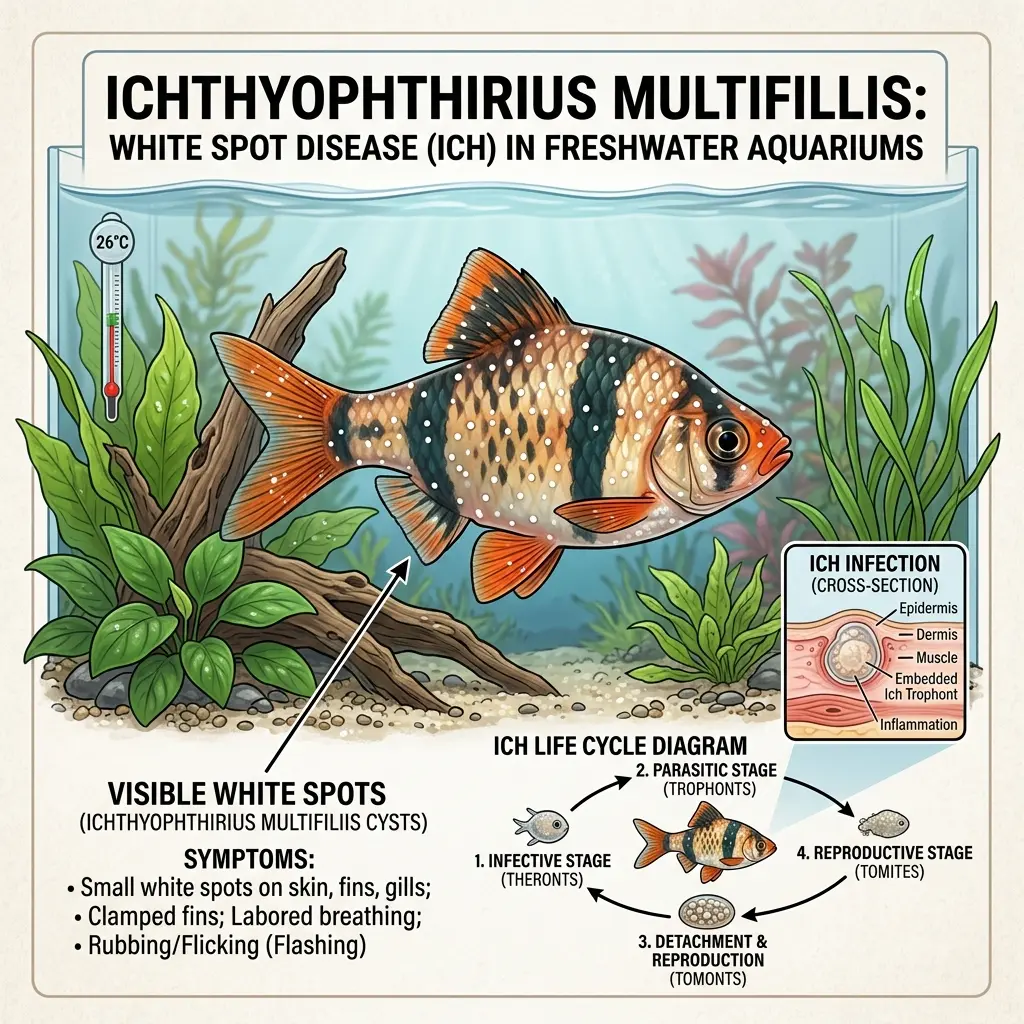
You glance at your community tank and notice your tetra flashing against the driftwood, tiny white dots peppering its fins like grains of salt. Within days half the tank is scratching against rocks and breathing hard. Ichthyophthirius multifiliis, commonly called Ich or white spot disease, is a ciliated protozoan parasite that burrows into the skin and gills of freshwater fish, producing visible white cysts and causing severe respiratory distress. Unlike bacterial infections such as Columnaris that spread through direct tissue invasion, Ich is an external parasite with a complex multi-stage life cycle that makes eradication dependent on timing. The white spots you see are trophonts embedded in the skin, completely protected from medication. Treatment only works against the free-swimming theront stage, which means you must continue therapy long after the last visible spot disappears. In my practice, I see Ich outbreaks most often after temperature fluctuations, new fish introductions without quarantine, or heater failures that drop water below 24°C/75°F overnight. A single missed tomont on the substrate can release hundreds of theronts and reinfect the entire tank.
Identification
Ichthyophthirius multifiliis is a ciliated protozoan parasite distinguished by visible white salt-grain spots distributed across the body, fins, and gills of infected fish. The spots are raised, discrete cysts 0.5–1.0 mm in diameter that do not wipe off with gentle pressure. Infected fish flash against decor, pipe against the substrate, and develop clamped fins as gill trophonts cause respiratory distress. Heavy infestations produce labored breathing, lethargy, and loss of appetite as the parasite damages gill filaments. Do not confuse Ich with the flat grey-white lesions of Columnaris, which spread as continuous sheets rather than discrete spots. Epistylis, a stalked ciliate, produces similar white patches but these are fluffy and attached by visible stalks. Fungal infections such as Saprolegnia create cottony, irregular growths on dead tissue, not uniform salt-grain spots on living skin.
Life Cycle
Ichthyophthirius multifiliis is a ciliated protozoan parasite with a temperature-dependent multi-stage life cycle that includes a protected feeding stage on fish and vulnerable free-swimming infectious stages in the water. The trophont burrows into the epidermis or gill epithelium and feeds on host cells for 3–7 days at 25°C/77°F, appearing as a visible white spot. When mature, the trophont drops off the fish and encysts on the substrate as a tomont, where it divides into hundreds of daughter cells called tomites. These develop into theronts, the free-swimming infectious stage that must locate a fish host within 48–72 hours or die. At 30°C/86°F the entire cycle completes in 3–4 days; at 20°C/68°F it stretches to 2–3 weeks. This temperature dependency is the foundation of heat treatment: raising temperature accelerates the cycle, forcing tomonts to hatch faster and exposing more theronts to medication or salt before they can reinfect.
Treatment
Ichthyophthirius multifiliis requires a multi-pronged treatment approach that targets the free-swimming theront stage while supporting fish health during the infection, because trophonts embedded in skin are immune to all chemical treatments. The most effective protocol I use combines three elements: temperature, salt, and medication — however, you must modify this immediately if you keep scaleless fish (loaches, corydoras), invertebrates, or live plants. Raise water temperature gradually by 1°C per hour until reaching 30°C/86°F; this accelerates the parasite life cycle and forces tomonts to hatch into vulnerable theronts more quickly. Add aquarium salt at 1–3 teaspoons per gallon, dissolved completely before adding, to support fish osmotic balance and create an environment less favorable to theronts — WARNING: skip the salt entirely if you have live plants, loaches, or corydoras, as they are highly sensitive to it. Dose a malachite green or formalin-based medication such as Ich-X according to label instructions for 10–14 days (use half-dose for scaleless fish), removing activated carbon and turning off UV sterilizers during treatment. Increase surface agitation aggressively because warm water holds less dissolved oxygen. This is the step most beginners skip, and it is why treatment fails: they raise temperature without adding air stones, and the fish suffocate from low oxygen before the parasite dies. Perform 25% water changes every 2–3 days to remove organic waste and maintain medication concentration. Continue treatment for a minimum of 4 days after the last visible spot disappears to ensure all hatched theronts are killed.
Prevention
Always isolate new or sick fish; see our guide on Quarantine Tanks: Essential Disease Prevention.
Preventing Ich means interrupting the introduction of parasites before they establish in the tank and maintaining conditions that keep fish immunity strong. Quarantine all new fish, plants, and wet equipment for 4–6 weeks at 26–28°C/79–82°F, inspecting daily for white spots. Ich cysts can survive on plants and decor for up to 4 weeks, so never transfer wet items between tanks without drying or disinfection. Maintain stable temperature within 1°C day and night; heater malfunctions are the single most common trigger I see in practice. Keep ammonia at 0 ppm, nitrite at 0 ppm, and nitrates below 20 ppm through regular water changes. Avoid overstocking, which elevates stress and reduces individual immune resilience. If you have had an Ich outbreak, vacuum the substrate thoroughly after treatment to remove encysted tomonts, and consider running a UV sterilizer at low flow rate as a permanent preventive measure. A single tomont missed in the gravel can restart the entire cycle weeks later.
| Treatment Phase | Temperature Target | Aquarium Salt Dose | Duration | Primary Objective |
|---|---|---|---|---|
| Phase 1: Heat Escalation | 86°F (30°C) | None | 24 Hours | Accelerate parasite life cycle to vulnerable theront stage |
| Phase 2: Salt Dosing | 86°F (30°C) | 1 tbsp per 5 gal | Days 2–10 | Disrupt osmotic balance of free-swimming theronts |
| Phase 3: Observation | 78°F (25°C) | Dilute via 25% water changes | Days 11–14 | Verify zero white spots and monitor gill recovery |
When you have selected a medication, use the Aquarium Medication Dosage Calculator to calculate the correct volume-based dose for your tank. Always use net water volume (accounting for substrate and decor displacement) rather than the nominal tank size printed on the box.