
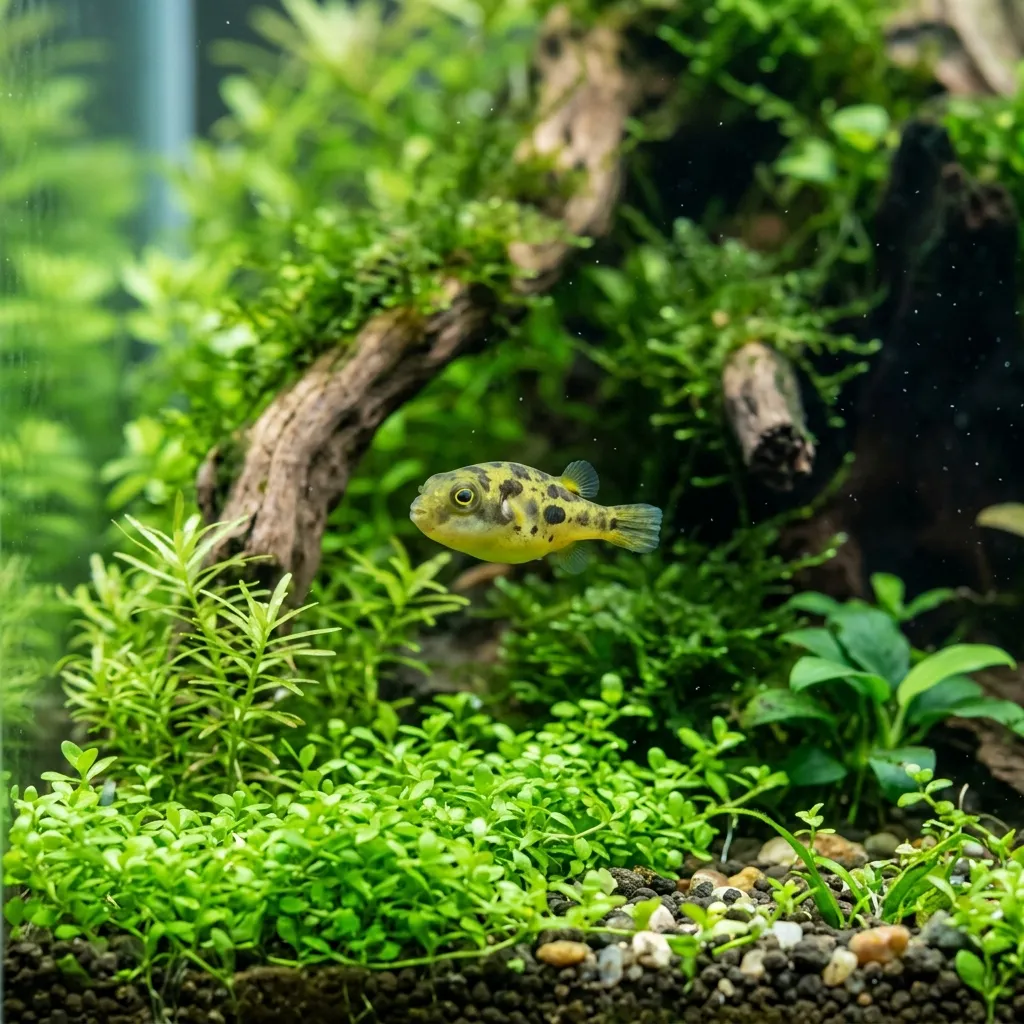
Pea puffers (Carinotetraodon travancoricus) are small freshwater pufferfish with a varied diet that includes animal and other aquatic food material. A peer-reviewed study of wild fish from the Chalakudy River in Kerala found insects and crustaceans to be important dietary components in adult fish, while early-stage fish showed a more omnivorous feeding pattern. The study also recorded annelids, diatoms, green algae and other food material.
For aquarium feeding, this means it is better to think in terms of suitable prey categories, individual feeding response and dietary variety rather than relying on a single food, a universal snail quota or a rigid mathematical feeding formula.
What do pea puffers eat?
Wild feeding research shows that pea puffer diet can include insects, crustaceans, annelids and other aquatic food material. The relative contribution of different food groups can vary with life stage and season.
| Food group | Recorded in the study? | Context |
|---|---|---|
| Insects | Yes | Important dietary component; adult fish showed preference for insects |
| Crustaceans | Yes | Important dietary component; adult fish showed preference for crustaceans |
| Annelids | Yes | Recorded as part of the diet |
| Diatoms | Yes | Recorded food material |
| Green algae | Yes | Recorded food material |
| Other food material | Yes | Diet composition varied across fish and sampling periods |
The available study therefore supports describing pea puffers as having a varied natural diet rather than reducing the species to a single prey type.
What is the natural diet of a pea puffer?
The 2020 study examined the feeding ecology of Carinotetraodon travancoricus in the Chalakudy River in the Western Ghats. Fish were sampled from October 2018 through September 2019. The researchers found differences associated with developmental stage and season. Early-stage fish showed an omnivorous feeding pattern, while adult fish showed preference for autochthonous food materials including insects and crustaceans.
The study also reported seasonal changes in feeding activity and dietary composition. This is important because a single snapshot of wild gut contents should not be converted into a universal aquarium feeding schedule.
| Finding | What it supports | What it does not establish |
|---|---|---|
| Insects were an important food component | Insect-type prey is relevant to the documented natural diet | A fixed quantity of insects for aquarium feeding |
| Crustaceans were an important food component | Crustacean prey is relevant to the documented natural diet | A universal crustacean feeding quota |
| Early-stage fish showed an omnivorous pattern | Diet can vary with developmental stage | A universal juvenile feeding formula |
| Diet changed seasonally | Natural feeding ecology is not static | A fixed aquarium schedule based on wild seasonal data |
| Other food material was recorded | The diet is broader than one prey category | That every recorded item must be supplied in captivity |
Do pea puffers need snails?
Snails are commonly offered to pea puffers in aquariums, but the cited wild-diet study does not establish a fixed daily snail requirement or a universal snail quota.
Snails can be one captive prey option. They should not, however, be presented as the only food that a pea puffer can eat or as a mathematically required daily ration.
| Question | Evidence-based interpretation |
|---|---|
| Can snails be offered as prey? | Yes, they can be one captive prey option. |
| Does the cited wild study establish a daily snail quota? | No. |
| Should snails be the only food? | The cited study describes a broader natural diet. |
| Should every pea puffer receive the same amount? | No universal numerical quota is established by the cited study. |
What can you feed a pea puffer in an aquarium?
Captive foods should provide appropriately sized animal prey that the individual fish can recognize, capture and consume. Depending on availability and acceptance, suitable categories can include small crustacean foods, aquatic worms, insect-type foods and other appropriate aquatic invertebrate prey. Snails may also be offered where appropriate.
The exact captive food list should not be presented as a direct one-to-one reproduction of wild gut contents. A wild-diet study tells us what fish consumed in a particular environment; it does not establish that every aquarium must reproduce the same proportions.
Wild diet vs. captive prey categories
| Wild-documented group | Possible captive food category | Important limitation |
|---|---|---|
| Insects / insect material | Appropriately sized live or prepared insect-type foods | Captive acceptance and nutritional suitability still need to be considered |
| Crustaceans | Small crustacean foods | Food size should suit the individual fish |
| Annelids | Appropriately sized aquatic worms | Should be offered as one food category rather than the entire diet |
| Other aquatic food material | Other suitable aquatic prey | Wild occurrence does not automatically establish a captive feeding requirement |
| Molluscs such as aquarium snails | Small snails offered as prey | Useful captive option, but no fixed daily quota is established here |
Live food vs. prepared or frozen food
Different captive foods can produce different feeding responses. The most useful practical test is whether the individual fish recognizes, captures and consumes the offered food while maintaining appropriate body condition and normal behavior.
| Food format | Potential benefit | What to monitor |
|---|---|---|
| Live prey | Can provide active movement and hunting opportunities | Prey size, hygiene, source and whether the fish actually consumes it |
| Frozen animal food | Can provide animal-based food without maintaining live prey | Whether the individual recognizes and accepts the food |
| Small aquatic invertebrate prey | Fits the general prey categories documented in wild feeding research | Appropriate size and feeding response |
| Snails | Can provide prey and a hunting opportunity | Appropriate size and whether they are being consumed rather than accumulating uneaten |
How do pea puffers feed?
Pea puffers actively search for and capture small prey. During feeding, observe the fish rather than assuming that food placed in the aquarium has actually been consumed.
- Recognizes or investigates the offered food.
- Approaches or pursues suitable prey.
- Attempts to capture the food.
- Successfully consumes the food.
- Shows an appropriate feeding response across repeated observations.
A single missed feeding does not necessarily indicate a problem. Repeated changes in feeding behavior deserve more investigation.
How big should food be for a pea puffer?
Food should be small enough for the individual fish to capture and consume without obvious difficulty. The cited research does not establish a universal prey-diameter formula that can safely be applied to every pea puffer.
Use the fish's body size, the physical characteristics of the prey and the observed feeding response when selecting food. If prey is repeatedly too large to capture or consume, choose a smaller prey category rather than relying on a fixed mathematical ratio.
| Observation | What it may indicate | Practical response |
|---|---|---|
| Fish captures and consumes prey normally | Prey is being handled successfully | Continue observing normal feeding response |
| Fish repeatedly investigates but cannot capture prey | Prey may be too large, fast or otherwise difficult to handle | Try a smaller or more manageable prey category |
| Fish captures prey but cannot consume it | Prey may be physically inappropriate | Offer smaller prey |
| Fish repeatedly ignores a food | Food may be poorly recognized or unsuitable for that individual | Consider another appropriate food category and check environmental conditions |
Why feeding response matters
Feeding response provides useful information that a rigid feeding quota cannot. Observe whether the fish actively investigates food, captures it and consumes it successfully.
| Observation | Reasonable next step |
|---|---|
| Normal pursuit and successful consumption | Continue normal observation and routine husbandry. |
| Persistent food refusal | Check prey type, presentation, water quality and recent environmental changes. |
| Unusual inactivity during feeding | Investigate water quality, environmental conditions and general health. |
| Noticeable change in body condition | Review feeding, water quality and overall health rather than assuming a simple feeding-quantity problem. |
Feeding frequency and quantity: why there is no universal calculator
Aquarium feeding should not be reduced to a single universal equation for pea puffers. Fish size, life stage, food type, prey size, water temperature, activity, health and environmental conditions can all affect feeding behavior.
The cited wild study documents natural feeding ecology but does not establish a universal aquarium feeding quota. Therefore, this guide intentionally does not provide a fixed number of snails, grams of food or prey items per day.
| Approach | Strength | Limitation |
|---|---|---|
| Fixed daily prey count | Simple to follow | Does not account for fish size, prey size, food type or changing conditions |
| Fixed food mass | Quantifiable | Different foods vary substantially in composition and water content |
| Universal snail quota | Easy to communicate | Not established by the cited wild-diet study |
| Observed feeding response | Accounts for the individual fish and actual food acceptance | Requires regular observation and judgment |
Feeding and aquarium water quality
Animal foods can contribute organic waste when they remain uneaten. Feed in a way that limits persistent leftovers and remove uneaten material when appropriate. Feeding should be considered alongside filtration, maintenance and water-quality monitoring.
- Observe whether food is actually being consumed.
- Avoid allowing substantial uneaten food to remain in the aquarium.
- Consider filtration and maintenance when feeding animal foods.
- Monitor water quality rather than assuming feeding amount is the only relevant variable.
Common pea puffer feeding mistakes
- Using only one food: the documented natural diet contains multiple food groups.
- Assuming snails are mandatory: snails can be one prey option, but the cited study does not establish a fixed daily requirement.
- Using prey that is too large: choose food the individual fish can capture and consume.
- Ignoring feeding behavior: observe whether the fish actually recognizes, captures and consumes the offered food.
- Leaving excessive food in the aquarium: persistent leftovers can contribute organic waste.
- Turning wild-diet percentages into aquarium quotas: wild gut-content percentages describe a studied population and environment; they are not automatically aquarium feeding instructions.
Wild diet evidence vs. aquarium husbandry guidance
| Statement type | Evidence category | How it should be used |
|---|---|---|
| Insects and crustaceans were important food groups in the studied adult fish | Wild gut-content research | Useful evidence about natural feeding ecology |
| Early-stage fish showed a more omnivorous feeding pattern | Wild feeding research | Evidence that diet can vary with developmental stage |
| Seasonal changes occurred in feeding activity and diet | Wild ecological research | Evidence that feeding ecology is not static |
| Aquarium prey should be appropriately sized | Husbandry guidance | Apply to the individual fish's observed feeding response |
| No universal daily snail quota is given | Evidence limitation | Do not convert the cited study into a fixed snail prescription |
| No universal prey-size equation is provided | Evidence limitation | Use individual fish and prey characteristics instead of an invented formula |
Glossary
| Term | Meaning |
|---|---|
| Gut-content analysis | A research method that examines recently consumed material in the digestive tract to investigate diet. |
| Feeding ecology | The study of what an animal eats, how it obtains food and how feeding relates to environmental and biological conditions. |
| Life-stage dietary variation | Differences in diet composition associated with developmental stage. |
| Feeding response | The observable response of a fish to offered food, including investigation, pursuit, capture and consumption. |
| Prey category | A broad type of food, such as insects, crustaceans or annelids, rather than one specific food product. |
Pea puffer feeding guide: key takeaways
- Wild research documents a varied diet including insects, crustaceans, annelids and other food material.
- Adult fish in the cited study showed preference for insects and crustaceans, while early-stage fish showed a more omnivorous feeding pattern.
- Snails can be one captive prey option, but the cited research does not establish a universal daily snail quota.
- Choose prey that the individual fish can capture and consume without obvious difficulty.
- There is no validated universal prey-size formula established by the cited study.
- Observe actual feeding response instead of relying entirely on rigid numerical feeding rules.
- Manage feeding together with filtration, maintenance and aquarium water-quality monitoring.
Source and evidence note
The primary scientific source for the natural-diet discussion is Renjithkumar, Roshni and Ranjeet (2020), Feeding ecology of the endemic freshwater puffer fish Carinotetradon travancoricus (Hora & Nair, 1941) in Western Ghats hotspot, India, International Journal of Aquatic Biology, 8(5), 300-310, DOI: 10.22034/ijab.v8i5.922.
The study examined fish from the Chalakudy River in Kerala over October 2018 to September 2019. Its findings provide evidence about feeding ecology in that wild population; they should not be interpreted as a universal aquarium feeding formula.