
Pea Puffer (Carinotetraodon travancoricus)
Quick Answer
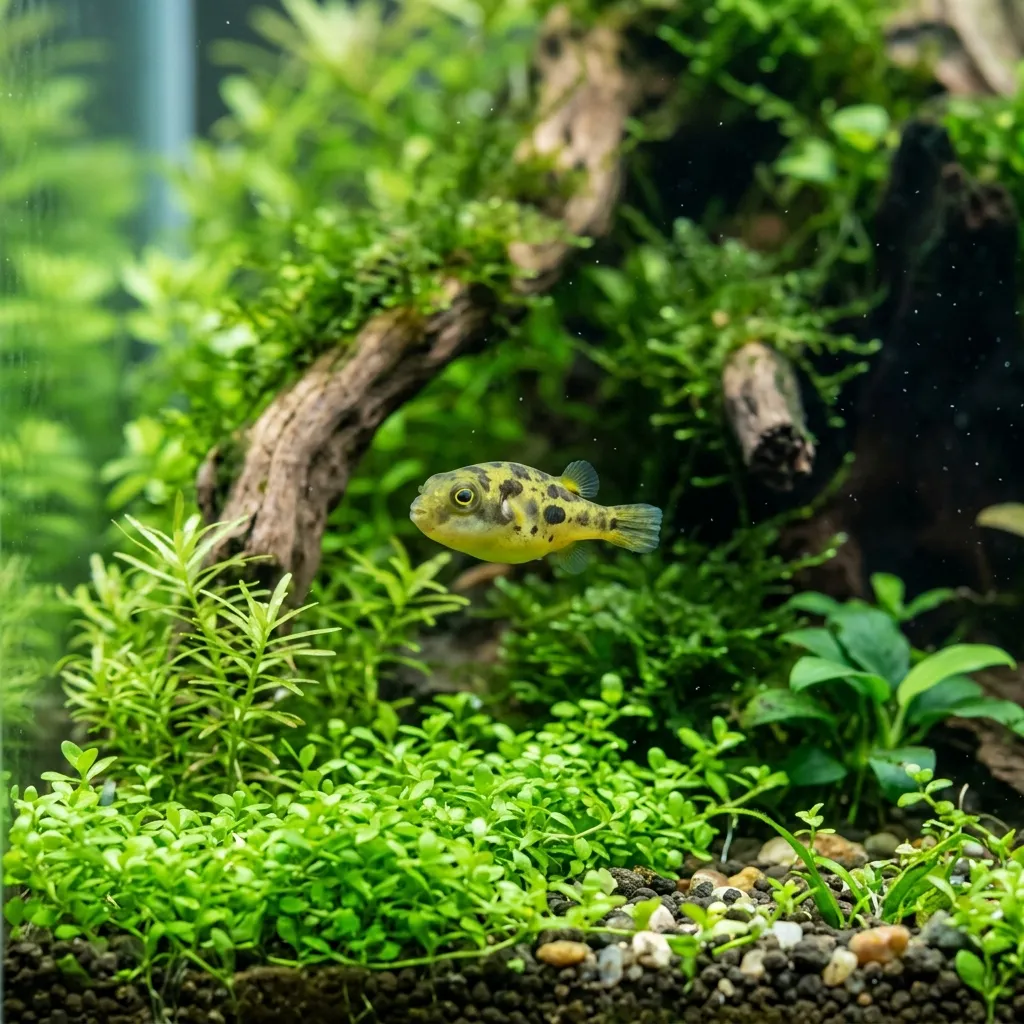
Pea Puffer (Carinotetraodon travancoricus) is a tiny, intelligent freshwater pufferfish from India requiring a minimum 10 gallon (38 liter) aquarium for a group of 6, or 5 gallons (19 liters) for a single specimen. Maintain water at 74°F - 82°F (23.3°C - 27.8°C), pH 6.5 - 7.5, and GH 5 - 20 dGH. They are obligate carnivores that require live snails and frozen foods daily. Best kept in species-only planted tanks with gentle filtration.
Quick Facts
| Scientific Name | Carinotetraodon travancoricus |
|---|---|
| Common Names | Pea Puffer |
| Family | Tetraodontidae |
| Genus | Carinotetraodon |
| Type | Freshwater |
| Temperament | aggressive |
| Care Difficulty | intermediate |
| Lifespan | 5 years |
| Maximum Size | Up to 1.5 in (4 cm) |
| Diet | Carnivore |
| Temperature | 74–82°F (23–28°C) |
| pH | 6.5–7.5 |
| Hardness | 5–20 dGH |
| Minimum Size | 10 gallons |
Key Takeaways
- Requires minimum 10 gallon (38 liter) aquarium for a group of 6; 5 gallons (19 liters) only for single specimen
- Obligate carnivore requiring live snails and frozen foods daily; refuses flakes and pellets
- Hard-shelled snails are essential for beak maintenance; without them, beaks overgrow and cause starvation
- Keep in groups of 6-12 with 1 male to 2-3 female ratio to distribute aggression
- Almost exclusively wild-caught; mandatory 21-day quarantine with prophylactic deworming required
- Scaleless and highly sensitive to medications; copper, formalin, and malachite green require reduced dosing
- IUCN Vulnerable status; choose captive-bred specimens when possible to support conservation
- Dense planting with Java moss is non-negotiable for security, territory division, and breeding
Overview
The Pea Puffer (Carinotetraodon travancoricus), also known as the Dwarf Puffer, Pygmy Puffer, or Indian Dwarf Puffer, is the smallest pufferfish species in the world and one of the most captivating nano aquarium fish available to hobbyists. Native to the inland freshwater rivers of Kerala and southern Karnataka in India, these tiny predators pack an enormous personality into a body barely larger than a pea. Their intelligence, inquisitive nature, and surprisingly complex social behaviors have earned them a devoted following among experienced aquarists.
Diet
Pea Puffers are obligate carnivores with specialized dentition that requires hard-shelled prey for beak maintenance. They categorically refuse flakes, pellets, and most dry foods. Their survival depends entirely on the aquarist's ability to provide live or frozen invertebrate prey daily.
Health
Pea Puffers present unique health challenges due to their almost exclusive wild-caught origin, scaleless bodies, sensitive skin, and specialized dietary needs. Proactive parasite management and meticulous water quality are far more effective than reactive treatment.
Internal Nematodes (Camallanus, Capillaria)
The most common and serious parasitic infection in wild-caught Pea Puffers, caused by roundworms that colonize the intestinal tract.
- Small red or brown worms protruding from the vent (pathognomonic for Camallanus). Gradual weight loss despite normal or strong appetite. Long, pale, or translucent feces. Pot-bellied or bloated appearance if intestinal blockage occurs. Reduced appetite or refusal to feed in advanced infections.
Wild collection from parasite-endemic waters. Transmission through ingestion of larvae or infective eggs. Live foods such as blackworms and tubifex can carry nematodes if sourced from contaminated cultures.
Quarantine all new Pea Puffers for minimum 21 days. Treat prophylactically with Levamisole HCl (2 mg/L for 24 hours, water change, repeat in 7 days). Source live foods from clean, established cultures. Never introduce wild-caught snails or worms directly to the display tank.
Internal Trematodes (Flukes) and Cestodes (Tapeworms)
Flatworm infections affecting the intestinal tract, liver, or gallbladder, often misdiagnosed as bacterial infections.
- Subtle wasting and lethargy over weeks to months. Reduced growth or decline after nematode treatments have failed. Periodic loss of appetite or digestive irregularities. Persistent issues in tanks containing snails or wild-collected foods. Hollow or drawn belly appearance.
Ingestion of intermediate hosts such as snails, small crustaceans, or contaminated live foods. Common in wild-caught specimens. Trematodes often invade organs rather than remaining in the gut lumen.
Quarantine and prophylactic treatment with Praziquantel (standard dose) before introducing to display tanks. Control snail populations in display tanks; snails serve as intermediate hosts. Source all live foods from clean, captive cultures.
Ichthyophthirius multifiliis (Ich / White Spot Disease)
A protozoan parasite causing white salt-like spots across the body and fins. Particularly stressful to scaleless puffers.
- White pinpoint spots resembling grains of salt on skin, fins, and gills. Fish rub against decor (flashing), exhibit labored breathing, and show clamped fins. Scaleless skin makes Ich lesions more visible and damaging than in scaled fish.
Introduction via new fish, plants, or contaminated equipment. Stress from temperature fluctuations, poor water quality, or inadequate quarantine triggers outbreaks in carriers.
Quarantine all new additions for minimum 21 days. Maintain stable temperature within 1°F (0.5°C) daily. For treatment, raise temperature to 82°F (27.8°C) and use half-dose copper (0.1 mg/L) or quarter-dose malachite green (0.025 mg/L). Scaleless fish are highly sensitive to standard Ich medications.
Fin Rot / Bacterial Infections (Secondary)
Bacterial infection causing progressive fin degradation, typically secondary to parasite infestation or aggression injuries.
- Frayed, ragged, or receding fin edges with white or red margins. Advanced cases show fin tissue rotting to the base. Often accompanied by lethargy and color loss. May follow conspecific nipping or parasite-induced immunosuppression.
Maintain pristine water conditions with zero ammonia and nitrite. Treat internal parasites first; bacterial infections often resolve once the underlying parasite burden is eliminated. Use broad-spectrum antibiotics (kanamycin, nitrofurazone) only if bacterial infection persists after parasite treatment.
Beak Overgrowth (Odontopathy)
Progressive overgrowth of the fused beak-like teeth, preventing normal feeding and leading to starvation.
- Visible overlap of upper and lower beak. Difficulty grasping or crushing food. Weight loss despite food availability. Fish may attempt to eat but drop food repeatedly. Lethargy and wasting in advanced cases.
Inadequate hard-shelled food in the diet. Without snails or other shelled invertebrates, beaks grow continuously with no natural wear. Common in puffers fed exclusively soft foods such as bloodworms.
Feed live snails (bladder or ramshorn) minimum 3-4 times weekly. Monitor beak length during weekly maintenance. If overgrowth is detected, increase snail feeding to daily. In severe cases, veterinary beak trimming under anesthesia is required. Prevention is vastly superior to correction.
Bloat / Constipation
Digestive blockage or gas accumulation causing abdominal distension and buoyancy issues.
- Severely distended, rounded belly. Difficulty swimming or maintaining position. Fish may float at the surface or sink to the bottom. Often follows overfeeding of dry or fatty foods. Feces may be absent or stringy.
Overfeeding, particularly of dry or freeze-dried foods that expand in the gut. Inadequate dietary fiber. Low water temperature slowing digestion. Secondary to internal parasites causing intestinal inflammation.
Feed small amounts twice daily rather than large single meals. Thaw all frozen foods completely before feeding. Include daphnia and snails in diet for natural fiber. Maintain temperature at 76°F (24.4°C) or above. Fast for 48 hours if bloat is suspected, then feed cooked pea (skin removed) or daphnia.
Breeding
Pea Puffers are substrate spawners that deposit adhesive eggs in dense moss. Captive breeding is moderately difficult due to the need for sex identification, conditioning, dedicated spawning tanks, and microscopic fry rearing. However, successful breeding is deeply rewarding and supports conservation by reducing wild collection pressure.
Compatible Tank Mates






Species Comparison
| Feature | Pea Puffer | Figure 8 Puffer | Green Spotted Puffer | Amazon Puffer |
|---|---|---|---|---|
| Max Size | 1.5 in (3.8 cm) | 3 in (7.6 cm) | 6 in (15 cm) | 5 in (13 cm) |
| Temperament | Aggressive (fin nipper) | Aggressive | Aggressive | Semi-Aggressive |
| Minimum Tank Size | 10 gal (38 L) for 6 | 15 gal (57 L) for 1 | 30 gal (114 L) for 1 | 40 gal (151 L) for group |
| Diet Type | Carnivore (snail specialist) | Carnivore (brackish) | Carnivore (brackish) | Carnivore (freshwater) |
| pH Range | 6.5 - 7.5 | 7.0 - 8.0 | 7.5 - 8.5 | 6.5 - 7.5 |
| Water Type | Freshwater only | Brackish required | Brackish required | Freshwater only |
| Teeth / Beak Maintenance | Hard-shelled snails required | Hard-shelled foods required | Hard-shelled foods required | Hard-shelled foods required |
| Origin | India (Kerala, Karnataka) | Southeast Asia (Thailand, Indonesia) | Southeast Asia (India to Indonesia) | South America (Amazon Basin) |