
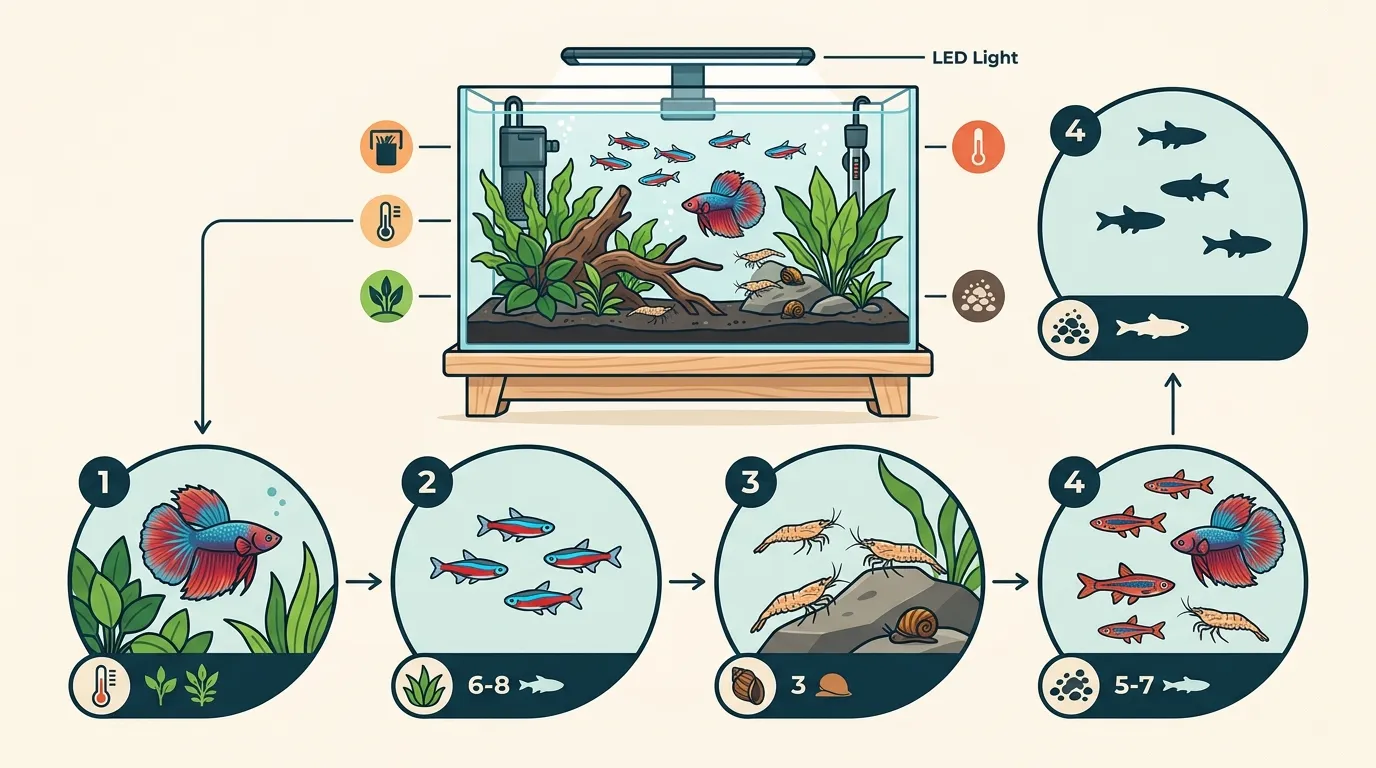
How many fish can you keep in a 10 gallon tank?
A standard 10-gallon aquarium (nominal external dimensions 20 × 10 × 12 inches / 50 × 25 × 30 cm) provides roughly 20 inches of lateral swimming run and a net water volume typically between 8 and 8.5 gallons after accounting for substrate and decor displacement. It is not an entry-level community tank for mixed pet-store selections; rather, it is a compact environment best suited to one cohesive group of suitable micro-fish, a single solitary centerpiece, or a dedicated invertebrate setup.
Stocking capacity cannot be determined from fish length alone. Adult body mass, oxygen demand, swimming behavior, territorial behavior, social requirements, and waste production all affect whether a species is appropriate for a 20-inch footprint. A small aquarium should therefore be stocked according to the specific requirements of the species rather than a universal length-based formula.
What can live in a 10 gallon aquarium?
Suitable livestock configurations depend on matching species-specific behavior, adult size, social requirements, and environmental needs to the available footprint.
Stocking option 1: Ember Tetra micro-school
Ember Tetras (Hyphessobrycon amandae) are true nano fish. FishBase records a maximum standard length of 2.0 cm (approximately 0.8 inches). A single-species school can make effective use of the midwater area of a planted 10-gallon aquarium when water quality, flow, cover, and social requirements are properly maintained.
Keep the aquarium mature and provide plant structure that creates shelter without eliminating open swimming areas. Avoid combining several different schooling species simply because each species is individually small; a 10-gallon footprint is better suited to one cohesive social group than several fragmented groups.
Stocking option 2: Solitary Betta display
Betta splendens can be maintained as a solitary display fish in a suitable 10-gallon aquarium. The larger water volume compared with smaller desktop aquariums provides useful dilution capacity and room for planted structure, while the species does not require a mixed-species community to satisfy a schooling requirement.
Broad-leaved plants and other resting structures can provide cover and areas near the surface. Tankmates should not be treated as automatically compatible: individual Betta temperament varies, and adding active fish can create unnecessary competition or stress.
Stocking option 3: Dedicated invertebrate setup
Neocaridina shrimp are well suited to planted aquariums where biofilm, algae, and supplemental food can be maintained. A shrimp-focused setup also avoids the predation pressure that fish can place on juvenile shrimp.
Nerite snails can also be used where their food supply and water chemistry requirements are appropriate. Do not assign an arbitrary shrimp population limit to the aquarium; available food, filtration, plant growth, maintenance, and water chemistry all influence the sustainable population.
10 gallon tank equipment and setup
- Filtration: Focus on biological media capacity and appropriately gentle flow rather than chasing a universal turnover number. An air-driven sponge filter or a suitably baffled hang-on-back (HOB) filter can provide biological filtration while reducing excessive current for nano fish.
- Heating: Tropical species require temperature control when room temperature does not maintain the species' appropriate range. A small adjustable heater paired with an independent glass or digital thermometer is preferable to relying on an unmonitored fixed-temperature device. Heater wattage should be selected according to the aquarium, ambient temperature, and manufacturer's specifications rather than treated as a universal stocking rule.
- Substrate: Choose substrate according to the livestock and planting plan. Fine, smooth substrate can be appropriate for bottom-oriented species that interact closely with the substrate.
- Plants: Live plants such as Java Fern, Anubias, Cryptocoryne, and suitable floating plants can provide shelter and structural complexity. Plants contribute to aquarium nutrient cycling but do not replace biological filtration or maintenance.
- Lid: A fitted lid or glass canopy helps reduce evaporation and can prevent fish from jumping.
10 gallon tank stocking plans
These conservative plans prioritize species-specific requirements, biological stability, swimming space, and behavioral compatibility.
| Plan | Stocking Configuration | Bioload Level | Filtration Focus | Skill Level | Key Consideration |
|---|---|---|---|---|---|
| 1. Ember Tetra Micro-School | 6–8 Ember Tetras + optional Neocaridina | Low to Moderate | Gentle biological sponge or appropriately baffled HOB | Beginner | Use a mature, planted aquarium and maintain stable water quality. |
| 2. Solitary Betta Display | 1 Betta splendens + optional compatible invertebrate | Low | Low-flow biological filtration | Beginner | Keep the Betta as the primary livestock and evaluate any invertebrate tankmates individually. |
| 3. Planted Invertebrate Haven | Neocaridina shrimp colony + optional Nerite snails | Very Low | Mature air-driven sponge filter or equivalent gentle biological filtration | Beginner | Maintain adequate natural and supplemental food resources for the invertebrates. |
Plan 1: Ember Tetra Micro-School
Ember Tetras remain very small as adults, with FishBase recording a maximum standard length of 2.0 cm. If choosing this configuration, use a mature planted aquarium with appropriate water quality and gentle flow. The objective is to provide one cohesive social group rather than fragmenting the available space among several schooling species.
Plan 2: Solitary Betta Display
A solitary Betta setup allows the available swimming and resting areas to be designed around one fish rather than around competing social groups. Plants and broad-leaved structures can provide cover and resting areas near the surface, while gentle filtration helps avoid excessive current.
Plan 3: Planted Invertebrate Haven
A shrimp-focused aquarium can provide an active planted display without the predation pressure associated with fish. Dense moss and other plant surfaces provide areas for biofilm development. Population size should be allowed to respond to available food, habitat, and maintenance rather than being forced to an arbitrary numerical target.
Bioload and spatial limitations in 10 gallons
Stocking decisions must balance biological waste production with the physical and behavioral requirements of the livestock.
Why the one-inch-per-gallon heuristic fails
The "one inch of fish per gallon" rule is an unreliable stocking method because it ignores body shape, mass, metabolic demand, social requirements, territorial behavior, swimming activity, and available footprint. Body mass scales volumetrically with linear dimensions, so similarly sized fish can differ substantially in biological mass. A heavy-bodied fish cannot be treated as biologically equivalent to several slender fish simply by comparing their lengths.
The 20-inch lateral constraint
A standard 20-inch tank length provides a limited horizontal swimming run. Species that naturally make continuous, active horizontal movements may require substantially more swimming length than a standard 10-gallon aquarium provides. Conversely, species that use vegetation, structure, or shorter movements can make better use of a compact footprint when their other husbandry requirements are also satisfied.
Fish that do not belong in a 10 gallon tank
Several commonly available fish are unsuitable for a standard 10-gallon setup because their adult size, social requirements, swimming behavior, feeding ecology, or husbandry needs exceed what this footprint can reliably provide.
- Neon Tetras (Paracheirodon innesi): Although small in adult length, Neons are active schooling fish with substantial horizontal swimming requirements. A 20-inch run provides limited room for natural continuous schooling behavior, making a longer aquarium a more appropriate baseline.
- Zebra Danios (Danio rerio): These active schooling fish exhibit continuous swimming behavior and are poorly matched to the limited horizontal runway of a standard 10-gallon aquarium.
- Otocinclus species: These specialized grazers depend on aufwuchs, algae, and other natural food resources. Maintaining adequate grazing resources can be difficult in immature or sterile aquariums, making them a poor choice for a newly established 10-gallon setup.
- Goldfish (Carassius auratus): Goldfish develop substantially larger adult bodies than a standard 10-gallon aquarium is designed to accommodate and produce a biological load that requires a larger aquatic environment.
- Plecos: Common plecos are far too large for a 10-gallon aquarium, while even smaller pleco species require consideration of adult size, waste production, grazing resources, and available floor space.
- Livebearer communities: Mollies and swordtails become too large and active for this footprint. Mixed-sex livebearers can also reproduce rapidly, making population control difficult in a small aquarium.
- Angelfish and larger cichlids: Adult body size, body shape, territorial behavior, and space requirements make these fish unsuitable for a standard 10-gallon aquarium.
- Pea Puffers (Carinotetraodon travancoricus): These small predatory fish have specialized dietary and behavioral requirements and should not be presented as a simple beginner 10-gallon stocking plan. Specialist husbandry should be established before considering this species.
How to cycle and safely stock a 10 gallon tank
A 10-gallon aquarium should be biologically established before livestock is introduced. Fishless cycling uses an inorganic ammonium source to establish nitrifying microorganisms without exposing fish to elevated ammonia or nitrite.
A practical fishless-cycle verification test can involve measuring the aquarium's response to a controlled ammonia challenge and confirming that ammonia and nitrite are subsequently processed as expected. The exact protocol should follow the cycling method and test instructions being used rather than treating one numerical challenge as a universal definition of a completed cycle.
Once the biological filter is established, introduce livestock conservatively and monitor ammonia, nitrite, and nitrate after stocking. Avoid adding several new livestock groups simultaneously when the biological system has not yet demonstrated stable performance under the intended load.
10 gallon tank maintenance routine
Smaller water volumes provide less dilution capacity, so maintenance should be based on measured water quality, stocking level, feeding, plant growth, and source-water conditions.
- Water testing: Test ammonia, nitrite, and nitrate regularly with an appropriate aquarium test method, particularly after stocking changes or other disturbances.
- Water changes: A modest weekly baseline may be appropriate for many lightly stocked aquariums, but volume and frequency should be adjusted according to measurable nitrate accumulation and other water-quality indicators rather than treated as a universal percentage.
- Substrate cleaning: Remove accumulated organic detritus from accessible substrate areas during maintenance while avoiding unnecessary disturbance of established biological surfaces.
- Filter care: Clean mechanical media when it becomes clogged and preserve biological media by rinsing it in removed aquarium water rather than exposing established media directly to chlorinated tap water.
- Evaporation top-offs: Replace evaporated water between water changes as needed. Where appropriate, use water that matches the aquarium's mineral and chemistry requirements rather than assuming that every aquarium should receive the same top-off water.
Common 10 gallon stocking mistakes
- Fragmenting schooling species: Purchasing small numbers of several schooling species does not satisfy the social requirements of those species. A single appropriate social group is generally more coherent than several fragmented groups.
- Overfeeding: Uneaten food contributes organic waste and can degrade water quality. Feed an amount appropriate for the species and remove persistent uneaten food rather than relying on a universal feeding-time rule.
- Stocking non-standard tank shapes: 10-gallon column or hexagonal tanks can provide substantially different floor area and swimming geometry from a standard rectangular aquarium. Nominal volume alone therefore does not describe the available habitat.
- Equating filter flow with stocking safety: Greater water turnover does not compensate for insufficient swimming space, unsuitable social conditions, excessive biomass, or inappropriate species selection.
When should you choose a 20 gallon tank instead?
If you plan to keep active open-water schooling species such as Neon Tetras or Zebra Danios, larger bottom-oriented species, or a multi-species community with different habitat requirements, a larger aquarium provides substantially more physical and biological margin. A 20-gallon long aquarium also provides a longer horizontal footprint than a standard 10-gallon tank.
See our 20 Gallon Fish Tank Stocking Guide for larger community plans and species profiles.
Cross-check your stocking plan
Always verify livestock plans against the actual aquarium dimensions, species-specific water chemistry tolerances, social requirements, behavior, and biological waste production before purchase.
Helpful tool: Use our Aquarium Stocking Calculator to cross-check the proposed livestock combination and its estimated bioload and filtration requirements.