
Quick Answer
A 20-gallon long is the best tank for a 20-gallon community: its 30-inch footprint holds a school of 8-10 small fish plus a bottom group. Choose species by adult size and bioload, not inches per gallon, use a filter rated around 100-150 GPH, cycle the tank first, and avoid common plecos, goldfish and angelfish.
Key Takeaways
- Choose a 20-gallon long over a 20-high: the 30 x 12 inch footprint has about 25% more surface area and far more floor space.
- Skip 'one inch of fish per gallon'; stock by adult size, bioload and swimming space instead.
- Choose a filter rated around 100-150 GPH so real flow is roughly 4-5 tank turnovers an hour, and keep flow gentle for bettas, gouramis and puffers.
- Cycle the tank first, then add fish in stages, with the heaviest-bioload fish last.
- Add otocinclus only to a mature tank with visible algae and biofilm, not a new one.
- Keep cherry barbs in groups of six or more to spread out mild fin-nipping.
- Avoid common plecos, goldfish, angelfish, clown loaches and bala sharks in a 20-gallon.
How many fish can you keep in a 20 gallon tank?
There is no single number, but a well-planned 20-gallon long usually holds one school of 8-10 small fish plus a group of bottom dwellers, or a dozen or so small, low-waste fish in total. What limits you is adult size, waste output and swimming space, not gallons alone. The 20-gallon is the sweet spot for beginners: it has enough water to dilute mistakes such as overfeeding, and it opens up community fish that will not thrive in a 10-gallon. Walk into a fish store and you will be pushed towards a 5- or 10-gallon kit; skip it.
20 gallon long vs 20 gallon high: which stocks better?
Both tanks are sold as "20 gallons", but they stock very differently. Note that the high actually holds slightly more water (about 19.9 US gallons against 18.7 for the long), so the difference that matters is the footprint.
Footprint and surface area
The 20 long has a 30 x 12 inch footprint (360 square inches of surface), about 25% more than the 20 high's 24 x 12 inches (288 square inches). More surface means better oxygen exchange, more room for schooling fish to swim, and a far bigger floor for corydoras and kuhli loaches. The 20 long is the better tank, and the plans below assume it.
Dimensions in inches, cm and litres
- 20 long: about 30 x 12 x 12 in (76 x 30 x 30 cm).
- 20 high: about 24 x 12 x 16 in (61 x 30 x 41 cm).
- Volume: 20 US gallons is about 76 litres. A UK (imperial) gallon is larger, so 20 UK gallons is about 91 litres; check which gallon a stocking chart uses.
Which fish suit each
The 20 high suits mid-water schooling fish and a few gentle centrepiece fish, and its extra height helps tall-bodied fish. The 20 long suits active swimmers, bottom-dwelling groups and anything that needs territory along the floor.
Best fish for a 20 gallon aquarium
Betta with shrimp and snails
One male betta with a group of corydoras and nerite snails works because the 20 gallons gives the betta enough territory that he will often ignore his tankmates. Shrimp are a gamble: many bettas hunt them, so add dense plants and treat any shrimp as a risk, not a guarantee.
Nano schooling fish
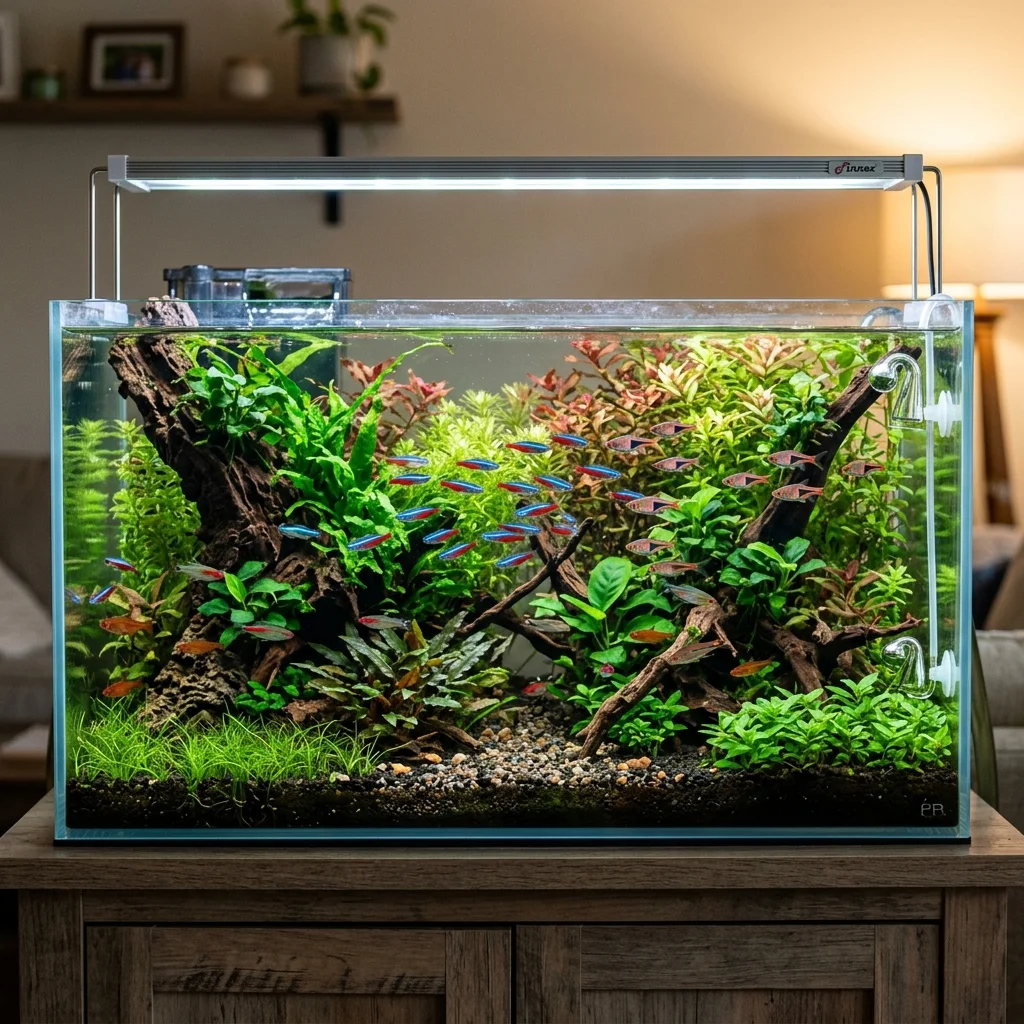
Ember tetras, chili rasboras, harlequin rasboras and neon tetras give you a bright, tight school in the middle of the tank. Aim for 8-10 of one species rather than one each of many.
Livebearers (and the breeding warning)
Guppies and platies are hardy and colourful, but they breed constantly. A mixed-sex group will multiply quickly, so keep males only or plan for the fry.
Corydoras and bottom dwellers
Corydoras, kuhli loaches and bristlenose plecos use the floor space a 20 long provides. Keep corydoras in groups of six or more and use sand or smooth fine gravel so their barbels stay healthy.
20 gallon community tank stocking plans (table)
Each plan below is written for a 20-long footprint. The bioload column is a relative rating; use the calculator at the end of this guide to check the exact percentage for your own numbers before you buy.
| Plan | Fish & count | Adult sizes | Bioload (relative) | Filter (rated GPH) | Difficulty | Best for / Avoid |
|---|---|---|---|---|---|---|
| 1. Betta Kingdom | 1 male betta, 6 Sterbai corydoras, 1-2 nerite snails | Betta 2.5-3 in; corydoras 2.5 in; nerite 1 in | Low to moderate | 80-100, gentle flow | Easy | Best: a calm first display tank. Avoid: fin-nippers, and any betta that attacks tankmates. |
| 2. Dwarf Puffer Colony | 3-4 pea puffers (species tank) | About 1 in | Low to moderate (messy live/frozen food) | 80-100, gentle flow | Intermediate | Best: a heavily planted species tank. Avoid: all other fish, snails you want to keep. |
| 3. Apistogramma Pair | 1 male + 1 female Apistogramma, 8 ember tetras | Male 3 in, female 2 in; embers 0.8 in | Low to moderate | 80-100 | Intermediate | Best: planted tank with caves. Avoid: hard, alkaline water; other bottom dwellers. |
| 4. Active Nano Community | 8 ember tetras, 6 kuhli loaches, 3 otocinclus | 0.8 in; 3-4 in; 1.5-2 in | Low | 80-100 | Intermediate | Best: sand-bottom planted tank. Avoid: adding otocinclus to a new tank. |
| 5. Peaceful Planted Community | 2 honey gouramis, 6 cherry barbs, 6 panda corydoras | 2 in; 2 in; 2 in | Moderate | 100-120 | Intermediate | Best: densely planted tank. Avoid: stocking all at once. |
| 6. Soft-Water Classic | 10 neon tetras, 6 harlequin rasboras, 1 bristlenose pleco | 1.5 in; 2 in; 4-5 in | Moderate | 100-120 | Intermediate | Best: soft-water planted tank with driftwood. Avoid: hard, alkaline water. |
| 7. Livebearer Tank | 4 male guppies, 6 peppered corydoras, 1-2 nerite snails | 1.5-2 in; 2.5 in; 1 in | Moderate | 100 | Easy | Best: colour on a budget. Avoid: mixed sexes unless you want fry. |
| 8. Shrimp-Safe Nano | 10 chili rasboras, 6 pygmy corydoras, 10 cherry shrimp | 0.7 in; 1 in; 1 in | Very low | 80 | Intermediate | Best: planted shrimp tank. Avoid: any larger fish that eat shrimp. |
| 9. Cool-Water Minnow Tank | 10 white cloud mountain minnows, 6 peppered corydoras, 2 nerite snails | 1.5 in; 2.5 in; 1 in | Low to moderate | 80-100 | Easy | Best: unheated room-temperature tank. Avoid: tropical tankmates. |
| 10. Hardy Danio Tank | 8 zebra danios, 6 peppered corydoras | 2 in; 2.5 in | Moderate | 100 | Easy | Best: an active, forgiving starter. Avoid: slow, long-finned tankmates. |
Plan 1: Betta Kingdom
One male betta, six Sterbai corydoras and one or two nerite snails. Sterbai are chosen because they enjoy the warm 76-82°F water a betta prefers, where cooler-water corydoras such as pandas would be at the edge of their range. Keep flow gentle and give the betta floating plants to rest under.
Plan 2: Dwarf Puffer Colony
A small group of three or four pea puffers, ideally one male and two or three females, though sexing is notoriously hard. Plant the tank heavily to break sight lines. They are aggressive and will eat snails, so no other fish or snails can be kept with them, and they need live or frozen foods.
Plan 3: Apistogramma Pair
One male and one female Apistogramma with eight ember tetras as dither fish that help the cichlids feel secure. Provide caves and leaf litter, and check that the Apistogramma species you choose suits your water chemistry.
Plan 4: The Active Nano Community
- Middle: 8 ember tetras (bright orange, tight schooling).
- Bottom: 6 kuhli loaches (peaceful, noodle-like scavengers; they need a sand substrate).
- Algae crew: 3 otocinclus. Add them only once the tank is well established with visible biofilm and algae (several months, not weeks), because they starve in new, clean tanks.
Plan 5: The Peaceful Planted Community
- Centrepiece: a pair of honey gouramis (peaceful and yellow, top and mid-level).
- Middle: 6 cherry barbs. Keep them in a full group of six or more; the group helps spread out their occasional mild fin-nipping.
- Bottom: 6 panda corydoras.
This is the heaviest of the three classic combinations, so stock it in stages rather than in one go.
Plan 6: The Soft-Water Classic
- Middle: 10 neon tetras.
- Middle/top: 6 harlequin rasboras, whose deeper body contrasts with the neons.
- Bottom: 1 bristlenose pleco (4-5 inches, unlike common plecos).
Older guides call this the "classic Amazon" tank, but harlequin rasboras come from Southeast Asia, so it is better thought of as a soft-water community than a true biotope.
Plan 7: The Livebearer Tank
Four male guppies with six peppered corydoras and a nerite snail or two. Buy males only, and check the store has not mixed in pregnant females. Guppies prefer harder, more alkaline water than many tetras, so do not combine this plan with soft-water fish.
Plan 8: The Shrimp-Safe Nano
Ten chili rasboras, six pygmy corydoras and ten cherry shrimp make the lowest-bioload plan here. The fish are small enough that adult shrimp are generally safe, though shrimplets may be eaten. Moss and dense planting improve shrimp survival.
Plan 9: The Cool-Water Minnow Tank
Ten white cloud mountain minnows, six peppered corydoras and two nerite snails suit a room-temperature tank with no heater in many homes. These fish prefer cooler water than most tropicals, so do not mix them with heat-loving species.
Plan 10: The Hardy Danio Tank
Eight zebra danios with six peppered corydoras is a forgiving, energetic setup. Zebra danios are fast and can harass slow, long-finned fish, so avoid bettas and fancy guppies here.
Bioload in a 20 gallon tank explained
Stocking is about bioload (how much waste the fish produce) and swimming space, not how many inches of fish you can cram in.
Why inches-per-gallon fails
The "one inch of fish per gallon" rule is the most criticised rule in the hobby. It ignores body shape (a slim neon is not a bulky goldfish), adult size, activity, feeding and territory, so it both over- and under-stocks. Use it only as a warning that a plan is far too large, never as a plan.
Filtration and plants change the maths
A common target for a fully stocked community is a filter that turns over the tank volume about four to five times an hour, which is 80-100 GPH of real flow in 20 gallons. Filter labels quote rated flow, and real flow is lower once media is in and the filter dirties, so a filter rated 100-150 GPH is a reasonable choice. Sponge filters driven by a strong air pump and hang-on-back filters both work. Bettas, gouramis and puffers prefer gentle flow, so use a baffle or sponge pre-filter where needed. Dense live plants take up ammonia and nitrate, which lowers effective load, but they do not make an overstocked tank safe.
Fish that don't belong in a 20 gallon tank
Pet stores frequently sell these fish to beginners with 20-gallon tanks. Do not buy them:
- Common goldfish: they produce heavy waste and grow beyond a foot. They belong in ponds.
- Common plecostomus: sold as 2-inch "algae eaters", they quickly grow to 18 inches or more and produce massive bioloads. Choose a bristlenose or a clown pleco instead.
- Angelfish: adults are too tall for a 20-gallon tank, so they are a poor long-term fit.
- Clown loaches and bala sharks: both grow large, are social and need far bigger aquariums.
How to add fish to a new 20 gallon tank
Cycle the tank first (see our guide to the nitrogen cycle), so that ammonia and nitrite read zero and nitrate is present. Then add fish in stages, a couple of weeks apart, starting with the hardiest and least messy group and adding the heaviest-bioload fish last. Test ammonia and nitrite after each addition, and hold off on the next group if either rises. Algae specialists such as otocinclus go in last, once the tank is mature. A 20-gallon is a great place to learn the cycle, water changes and fish behaviour; those skills scale to a 40-gallon breeder or a 75-gallon display.
Helpful tool: use our Stocking Calculator to check the bioload of any plan before you buy.