
How many fish can you keep in a 5 gallon tank?
A 5-gallon aquarium is best treated as a single-specimen or invertebrate tank, not a conventional community aquarium. For most fish, the practical stocking choice is one appropriately sized fish such as a Betta splendens, while shrimp and small snails can be kept without adding another fish. The small water volume means temperature, ammonia and other water parameters can change quickly, so stocking conservatively matters more than trying to fill every available gallon.
A 5-gallon tank is not simply a smaller version of a 20-gallon community tank. The limited footprint restricts schooling fish, active swimmers and combinations of multiple fish species. Choose the adult size, behaviour, swimming needs and waste production of the species before considering how many animals the tank can physically hold.
What can live in a 5 gallon aquarium?
The most straightforward choices are one Betta fish or an invertebrate-only setup with freshwater shrimp and/or suitable snails. Some very small fish are sometimes kept in 5-gallon aquariums, but the limited footprint makes these arrangements less forgiving than a 10- or 20-gallon aquarium.
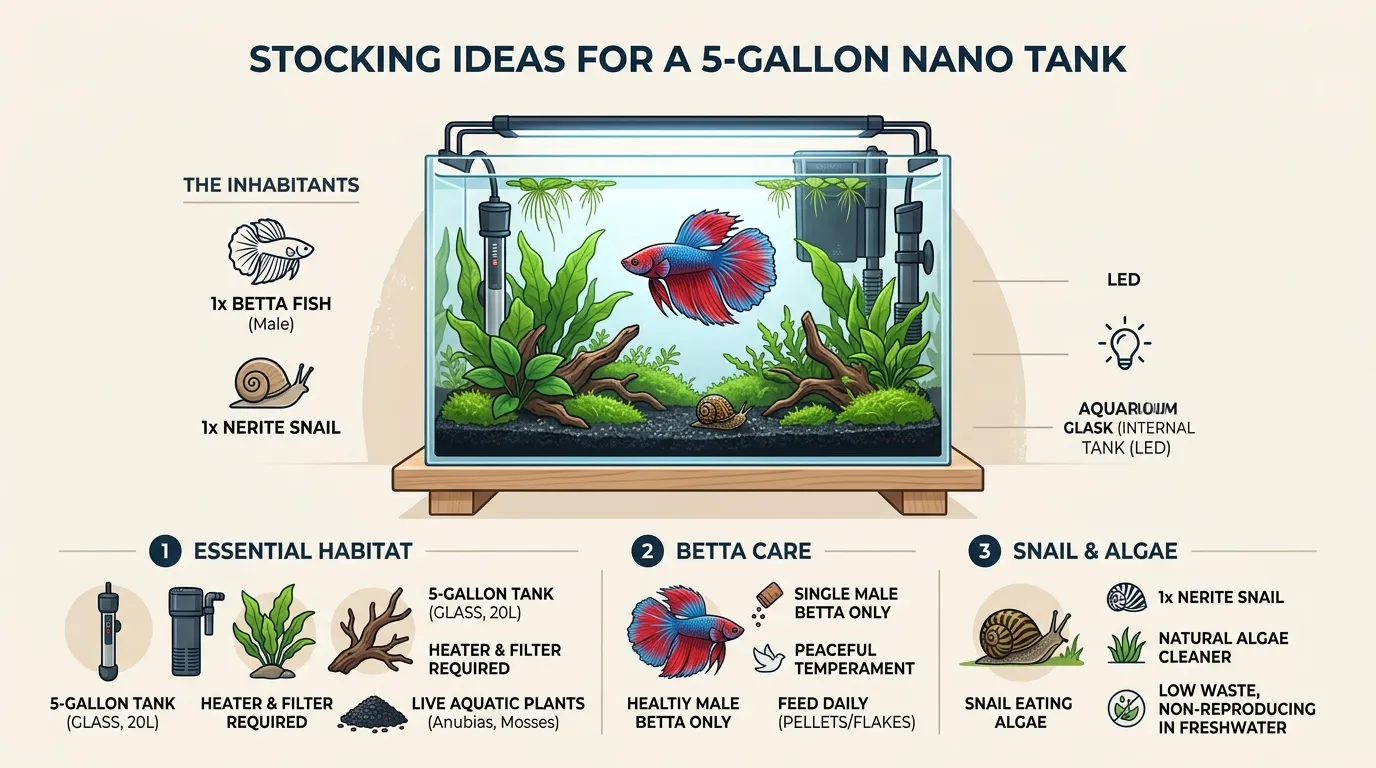
Stocking option 1: Single Betta tank
One Betta splendens is the clearest fish-focused option for a 5-gallon aquarium. A single Betta does not need a school, so the limited footprint can be used for swimming space, cover and resting areas rather than dividing the tank between multiple fish species.
- Stocking: 1 Betta splendens.
- Tankmates: No other fish. A snail may be possible, but individual Betta behaviour varies.
- Temperature: Keep the aquarium within the appropriate tropical range for the Betta and avoid rapid temperature changes.
- Filtration: Use gentle biological filtration. A small sponge filter or a baffled HOB can work well.
- Cover: Provide plants or other safe cover and leave access to the surface because Bettas regularly use surface air.
Stocking option 2: Cherry shrimp colony
A 5-gallon aquarium can work well as a Neocaridina shrimp colony. Starting with a modest group allows the colony to establish without treating the initial number as a fixed stocking limit. As the shrimp reproduce, monitor water quality and avoid allowing the population to outgrow the available food and maintenance capacity.
- Stocking: A small starter colony of cherry shrimp.
- Plants: Mosses and other dense plants provide grazing surfaces and shelter for juveniles.
- Filtration: Use a sponge filter or protect the intake of another filter so young shrimp cannot be drawn in.
- Tankmates: Avoid fish if the goal is maximum shrimp survival, especially survival of juveniles.
Stocking option 3: Shrimp and snails
Shrimp can also be kept with a small number of appropriate freshwater snails. Nerite and some small ramshorn snails can provide additional interest and help consume algae and leftover food, but they still contribute waste and should not be treated as having zero bioload.
Stocking option 4: Very small nano fish — use caution
Some aquarists keep very small species such as chili rasboras in 5-gallon aquariums. The problem is not simply adult size: schooling fish need adequate horizontal swimming space and social groups. A 5-gallon tank provides little margin for error, so a 10-gallon or larger aquarium is generally a better choice for schooling nano fish.
If a species requires a group, do not solve the space problem by keeping fewer fish than the species needs. The aquarium should meet the fish's social and swimming requirements rather than merely keeping the fish alive.
5 gallon Betta tank setup
A Betta-focused 5-gallon aquarium should be designed around gentle flow, stable temperature, cover and easy maintenance. The extra water volume compared with a small bowl gives the fish more usable space and makes the environment easier to manage, but it does not remove the need for filtration and regular water testing.
Betta in a 5 gallon tank
One Betta is a practical stocking choice for a 5-gallon aquarium because the species does not require a school. Give the fish open swimming space as well as broad-leaved plants or other resting areas. Avoid turning the aquarium into a densely packed decoration display that leaves no room to swim.
A Betta can sometimes live with a snail, but compatibility is individual. Shrimp are less predictable because some Bettas will hunt them. If shrimp survival is the priority, use a shrimp-only aquarium instead.
Betta filtration
The filter should provide biological filtration without creating excessive current. A small sponge filter is a simple choice because it offers biological media and gentle circulation. A HOB filter can also work when its flow is reduced or diffused appropriately.
Betta heating
Betta splendens are tropical fish and generally require stable warm water. Use an appropriately sized adjustable heater and an independent thermometer rather than relying only on the heater's built-in setting.
5 gallon tank equipment and setup
- Filter: Choose a small filter that can provide biological filtration while keeping flow gentle.
- Heater: Required for a tropical Betta setup; size it for the actual aquarium and room conditions.
- Thermometer: Use one to verify the real water temperature.
- Substrate: Use a safe substrate appropriate for the plants and livestock you choose.
- Plants: Live plants are useful but not mandatory. They provide cover and grazing surfaces and can contribute to nutrient uptake.
- Lighting: Match lighting intensity and duration to the plants being kept and avoid unnecessarily long photoperiods that encourage algae.
- Lid: A secure lid is useful for reducing evaporation and preventing fish such as Bettas from jumping.
5 gallon tank stocking plans
These plans are intentionally conservative. Unlike a larger community aquarium, a 5-gallon tank has limited space for combining fish species. The goal is to match the livestock to the footprint rather than maximize the number of animals.
| Plan | Stocking | Bioload | Filtration | Difficulty | Best for / Avoid |
|---|---|---|---|---|---|
| 1. Single Betta | 1 Betta splendens | Low to moderate | Small sponge filter or gentle HOB | Easy | Best: a simple fish-focused display. Avoid: adding other fish. |
| 2. Cherry Shrimp Colony | Small starter colony of Neocaridina | Low | Sponge filter or protected intake | Easy to intermediate | Best: planted shrimp aquarium. Avoid: fish that prey on shrimp. |
| 3. Shrimp and Snails | Cherry shrimp with a small number of suitable snails | Low | Sponge filter or protected intake | Easy | Best: low-bioload invertebrate setup. Avoid: excess feeding and overcrowding. |
| 4. Single Pea Puffer | 1 pea puffer, species-focused setup | Moderate for tank size | Strong biological filtration with controlled flow | Intermediate | Best: experienced keeper prepared for specialized feeding. Avoid: treating it as a community tank. |
| 5. Nano Fish — Upgrade Recommended | Very small schooling species only where species requirements are satisfied | Variable | Species-appropriate filtration | Intermediate | Best: experienced keepers with a species that genuinely suits the footprint. Prefer: 10 gallons or larger for schooling fish. |
Plan 1: Single Betta
One Betta is the simplest fish stocking plan. Use gentle filtration, stable warm water, plants or other safe cover, and leave enough open water for swimming. Do not add another fish simply because the aquarium appears to have unused space.
Plan 2: Cherry Shrimp Colony
A planted shrimp aquarium makes efficient use of a small footprint. Dense moss and other plants create surfaces for grazing and hiding. Start conservatively and allow the colony to establish before deciding whether its population needs further management.
Plan 3: Shrimp and Snails
Adding a small number of compatible snails creates an invertebrate community without introducing the swimming-space demands of fish. Feed carefully because uneaten food can deteriorate water quality quickly in five gallons.
Plan 4: Single Pea Puffer
A pea puffer is a specialized choice rather than a beginner community fish. A 5-gallon aquarium may be used for a single specimen by experienced keepers, but the species has demanding feeding and behavioural requirements. It should not be combined with a Betta, schooling fish or ornamental snails in this limited space.
Plan 5: Nano Fish
Very small schooling fish are frequently marketed as suitable for tiny aquariums, but adult size alone does not determine suitability. Schooling behaviour, horizontal swimming distance and group size matter. For most schooling nano fish, moving up to a 10-gallon or larger aquarium provides a much more appropriate environment.
Bioload in a 5 gallon tank explained
Bioload describes the waste burden produced by livestock and the biological filtration needed to process that waste. In five gallons, a relatively small amount of waste can produce a measurable change in water chemistry because there is less water to dilute it.
Why inches-per-gallon fails
The "one inch of fish per gallon" rule is not a reliable stocking formula. It ignores adult body shape, activity, behaviour, feeding, territory and swimming requirements. A small but active schooling fish can need more usable space than its length suggests, while a solitary fish has different requirements.
Why filtration does not make an overstocked 5 gallon safe
Biological filtration helps convert toxic ammonia and nitrite into less toxic nitrate, but it does not create additional swimming space or eliminate the waste produced by excessive stocking. Plants can also help with nutrient uptake, but they should not be used as a justification for overcrowding.
Fish that don't belong in a 5 gallon tank
Many commonly sold aquarium fish are inappropriate for a 5-gallon aquarium because they become too large, require groups, need more swimming space or produce too much waste for such a small footprint.
- Goldfish: They grow large and produce substantial waste. A 5-gallon aquarium is not an appropriate long-term home.
- Common plecos: They become far too large for a 5-gallon aquarium.
- Most guppies and livebearers: Their adult size, activity and reproduction make a 5-gallon a poor long-term community setup.
- Neon tetras: They are schooling fish and need substantially more swimming room than a 5-gallon provides.
- Most corydoras: Corydoras are social bottom dwellers that require group housing and more floor space.
- Angelfish: Their adult size and body height make them unsuitable for a 5-gallon aquarium.
- Large or active community fish: A small tank should not be stocked simply because a juvenile fish currently fits inside it.
How to cycle and stock a 5 gallon tank
Cycle the aquarium before adding fish. The biological filter needs an established bacterial population capable of processing the waste produced by the intended livestock. Test ammonia and nitrite during cycling and do not treat clear-looking water as evidence that the aquarium is biologically ready.
Once the tank is cycled, introduce livestock conservatively. In a 5-gallon aquarium, adding several animals at once can cause a rapid increase in waste production. Monitor ammonia and nitrite after stocking and respond to any abnormal readings rather than assuming the filter will immediately handle the new load.
5 gallon tank maintenance
Small aquariums require consistent maintenance because water chemistry can change quickly. There is no single water-change percentage that fits every 5-gallon aquarium; the appropriate schedule depends on stocking, feeding, plants, filtration and measured water quality.
- Test ammonia and nitrite regularly, especially after adding livestock.
- Monitor nitrate and perform water changes as needed to maintain suitable water quality.
- Remove uneaten food and obvious waste rather than allowing it to accumulate.
- Clean filter media in removed aquarium water when maintenance is required, rather than repeatedly exposing beneficial bacteria to untreated tap water.
- Top off evaporation with appropriately treated water; remember that topping off is not a substitute for a water change.
- Watch livestock behaviour for signs of stress, poor water quality or incompatible conditions.
Common 5 gallon stocking mistakes
- Trying to build a community tank: Five gallons rarely provides enough space for several fish species.
- Using adult-size estimates incorrectly: A juvenile fish that fits today may become completely unsuitable later.
- Ignoring schooling behaviour: Keeping one or two fish from a schooling species does not solve the space problem.
- Overfeeding: Uneaten food decomposes and adds waste to an already small water volume.
- Skipping the nitrogen cycle: A new aquarium does not automatically have the biological filtration needed to process fish waste.
- Using excessive filter flow: Small fish such as Bettas can struggle against strong current.
- Assuming plants solve overstocking: Plants help, but they do not replace appropriate stocking, filtration and maintenance.
When should you choose a 10 or 20 gallon tank instead?
If you want a group of schooling fish, several compatible species, a larger bottom-dweller group or more flexibility when choosing livestock, moving up to a 10- or 20-gallon aquarium is usually the better starting point. More water volume and footprint provide greater flexibility, although every species still needs to meet its own adult size, social and habitat requirements.
A 20-gallon aquarium opens up substantially more community combinations because the longer footprint provides more horizontal swimming and bottom space. See our 20 Gallon Fish Tank Stocking Guide for larger community options.
Use stocking calculations as a cross-check
A stocking calculator can help estimate bioload, but the calculation should be treated as a cross-check rather than a replacement for species-specific requirements. Adult size, behaviour, schooling needs, compatibility and available swimming space still determine whether a stocking plan is appropriate.
Helpful tool: use our Stocking Calculator to estimate the relative bioload of a proposed setup before adding livestock.