
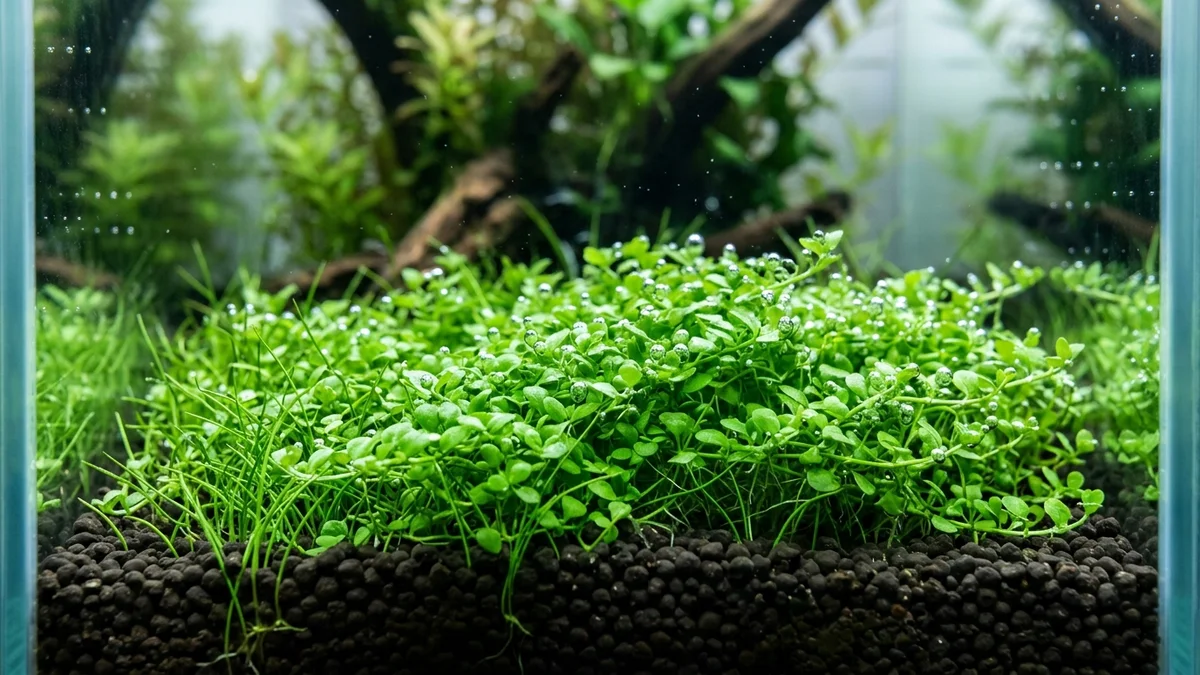
How do you grow a plant carpet in an aquarium? A carpet needs strong light, good access to nutrients and usually CO2 for dense, compact growth, though easier species grow without CO2. Practical Fishkeeping suggests Marsilea hirsuta, Helanthium tenellum 'Green' and dwarf hairgrass for a non-CO2 tank. Monte Carlo forms a fast-growing carpet and will grow without CO2 in a good substrate. The dry start method grows plants emersed before flooding, with some melt expected afterwards.
Requirements for Successful Carpet Growth
Modern Aquarium says carpet plants can grow without CO2 but more slowly and less densely, and that strong light is crucial for spread. Practical Fishkeeping warns that too much light encourages algae while too little can kill plants, and suggests root tabs or nutrition capsules plus liquid fertiliser and starting with in-vitro plants. See CO2 for Aquarium Plants and the Light Duration Calculator.
Best Carpeting Species Compared
Monte Carlo (Micranthemum tweediei)
Tropica describes Monte Carlo as originating from Argentina, with compact, round leaves on creeping stalks that form a fast-growing carpet at the front of the tank. A retailer quoting Tropica information says it can grow in light shade but needs good light and CO2 to become compact, while it will grow without CO2 in a good substrate.
Easier Non-CO2 Options
Practical Fishkeeping suggests Marsilea hirsuta (easiest), Helanthium tenellum 'Green' and dwarf hairgrass, with Cryptocoryne parva slow but low-light tolerant.
Plants With Little Verified Detail
Dwarf Baby Tears (HC 'Cuba') and Glossostigma are common carpet choices, but no verified source on their light or CO2 needs was found in this research, so this draft states none. Add a source before publishing.
Dry Start Method (DSM) vs. Traditional Submerged Planting
A Buce Plant guide describes the dry start method: set up the tank without filling it, dampen a nutrient-rich substrate, plant low carpet species, cover tightly with plastic wrap, mist regularly and lift the wrap briefly each day. Its author suggests about 10-14 hours of light daily (around 12 as a sweet spot), flooding after roughly four to six weeks, and expects some melting after flooding if you do not inject CO2. Large stem plants and epiphytes should wait until after flooding. Traditional planting skips the dry phase but leans on good light and, where needed, CO2 from the start.