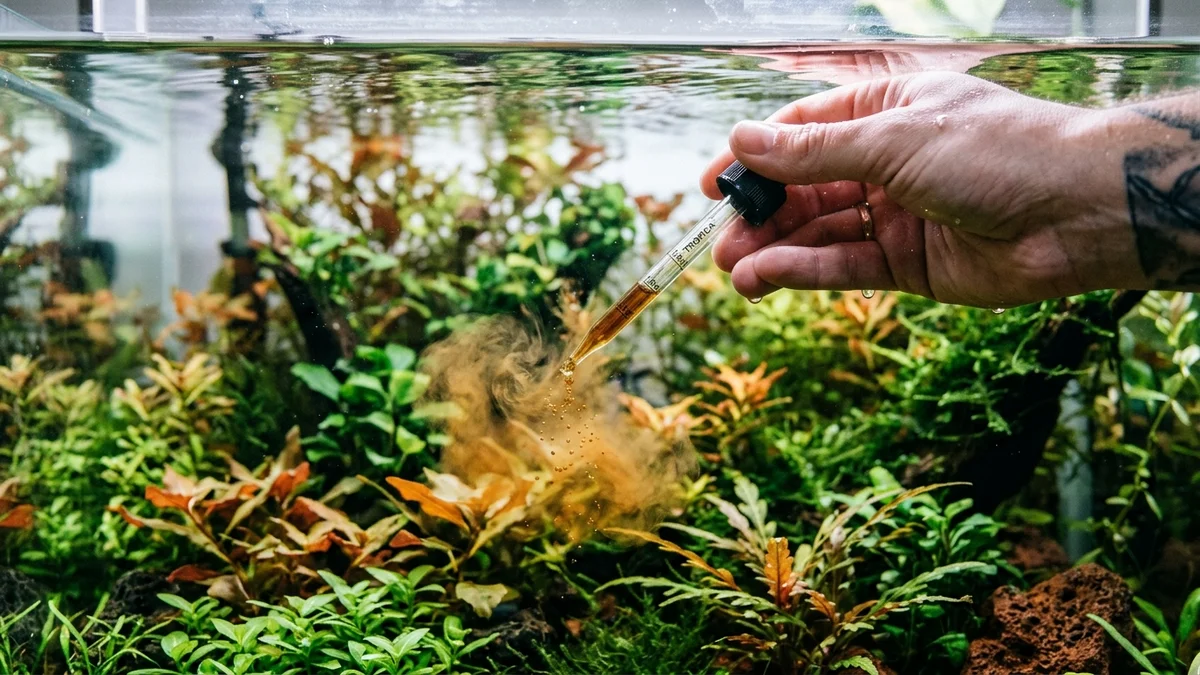
How should you dose liquid fertilizer in a planted aquarium? Plants need macro nutrients (nitrogen, phosphorus, potassium) and micro nutrients (such as iron, magnesium and manganese). The Estimative Index doses generously and resets with a large weekly water change, and was designed for high-light, CO2-enriched tanks. Lean dosing aims to match uptake, starting from roughly a third of an EI dose. In either case, algae usually reflects an imbalance, not fertilizer alone.
Understanding Macro vs. Micro Nutrients
A retailer guide groups nutrients into macros, needed in larger amounts (nitrogen, phosphorus, potassium), and micros or trace elements (iron, magnesium, manganese) needed in tiny amounts. Products differ in what they contain, so read the label to see what a fertilizer adds before dosing. Optional supplementing is covered for specific plants on their profiles, for example Anubias Nana.
Dosing Regimens Compared
Estimative Index (EI) Dosing
EI was described by Tom Barr: dose nutrients regularly so plants never run short, then do a large water change, around 50%, each week so levels do not build up. With a 50% weekly change, levels can build to at most about twice the weekly dose. He designed it for high-light, CO2-enriched tanks and says stable CO2 matters most. His claims about what does and does not cause algae are his own observations. Try the Estimative Index Fertilizer Calculator for amounts.
Lean Dosing
One retailer guide describes lean dosing as supplying roughly what plants use so little builds up for algae, starting at about one-third of an EI dose split into daily or alternate-day additions and adjusting by observation. It is not zero dosing and is not a guarantee against algae, and it needs more attention than a fixed schedule. That guide frames the method around well-lit, CO2-injected tanks. For a low-tech tank, I found no source for a recommended dose, so start with the manufacturer's amount and observe.
Water Changes and Nutrient Reset Strategy
Another retailer guide says most liquid fertilizers are dosed once or twice a week, often after a water change, and advises starting low and increasing gradually. Plan changes with the Water Changes Calculator.
If Algae Appears
That guide says fertilizer alone does not cause algae; imbalance does, usually from excess light or nutrients the plants are not using. Its suggested steps are to cut the dose, improve flow or shorten the lighting period before adding more fertilizer. See Algae on Aquarium Plants.