
How to Identify and Remove Algae on Aquarium Plants
Technical Specifications & Benchmark Matrix
- Problem
- Algae growing on aquarium plants and nearby aquarium surfaces
- Primary Trigger
- Excess light duration and dissolved nutrient imbalance
- First Response
- Manual removal, leaf pruning, and photoperiod reduction
- Treatment Caution
- Sensitive plants (e.g. Vallisneria) and invertebrates require conservative dosing
Identifying Common Algae on Aquarium Plants
Different types of algae have different appearances and may respond differently to control methods. This overview focuses on black beard algae and green spot algae. It does not attempt to cover every aquarium algae type.
Black Beard Algae (BBA)
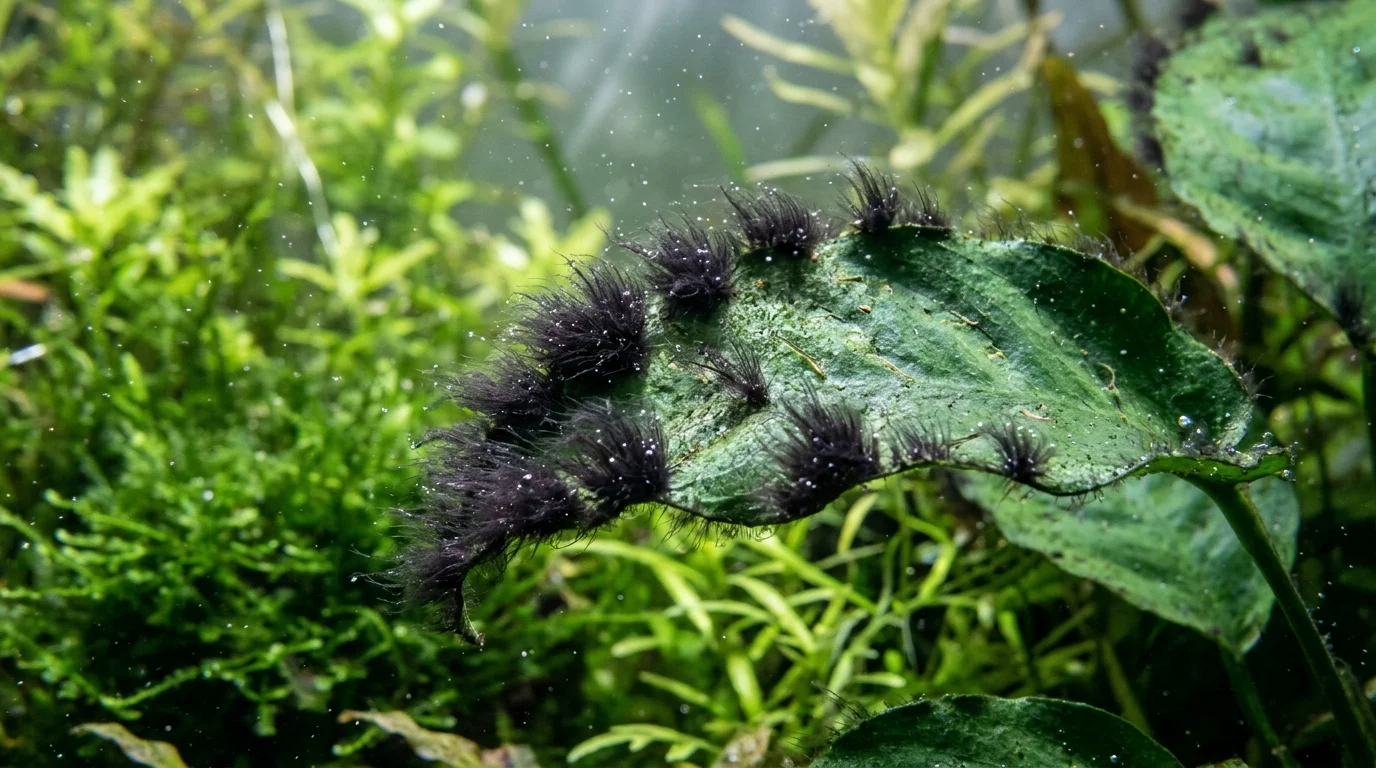
Aquarium Co-Op describes black beard algae as growing in thick, bushy clumps that are usually black or grey, although reddish or brownish appearances can also occur. It can grow on driftwood, aquarium decor and plants. The source notes that BBA can take six to eight months to become established and may take a similarly long period to remove. There is no single treatment that guarantees a quick solution.
Green Spot Algae (GSA)
Aquarium Co-Op associates green spot algae with lighting conditions and phosphate imbalance. It commonly appears as hard green spots on aquarium glass and can also occur on slow-growing plant leaves. The source discusses scraping glass and the use of nerite snails, but these approaches should not be assumed to solve every instance of algae growing directly on plant tissue. For plant-specific context, see Anubias on Driftwood.
Possible Contributing Factors: Light, Nutrients and Plant Growth
Algae growth is influenced by several interacting conditions. Lighting duration and intensity, nutrient availability, plant growth, circulation and accumulated organic waste can all be relevant. A retailer fertilizer guide emphasises that fertiliser alone does not explain every algae outbreak and discusses the importance of balance. Practical Fishkeeping also discusses the relationship between lighting and algae in planted aquariums.
Do not assume that all algae problems are caused by excessive fertiliser or that reducing fertiliser will always help. Plants need adequate nutrients to grow, and an arbitrary reduction can create deficiencies. Review the aquarium's recent changes and plant condition before adjusting the setup. For lighting guidance, use the Light Duration Calculator.
Carbon dioxide stability may also be relevant in aquariums where CO2 is injected. For more context, see CO2 for Aquarium Plants.
Removal and Control Methods
Manual Removal and Trimming
Start with methods that do not require chemical treatment. Remove accessible algae manually, clean affected decor where practical and consider trimming leaves that are heavily covered and unlikely to recover. Avoid damaging healthy plant tissue during removal. Review the aquarium conditions that may be contributing to regrowth.
Hydrogen Peroxide for Black Beard Algae
Aquarium Co-Op describes using a 3% hydrogen peroxide product on exposed BBA-covered plants or decor after lowering the aquarium water level. Its method involves applying the product to the affected algae, allowing a short exposure and then refilling the aquarium. The source advises reducing exposure for more sensitive plants or testing a limited area first. It also notes that weakened algae may change colour and be consumed by some aquarium animals.
This is a source-described treatment, not a universal dosing recommendation. The product concentration alone does not establish a safe dose for every aquarium. Plant species, exposed tissue, livestock and application method all matter. Do not apply the method to an entire aquarium or assume it is safe for delicate plants and invertebrates. Check the original source and relevant product guidance before considering treatment.
Liquid Carbon Products
Some aquarium hobbyists use products marketed as liquid carbon for algae control. These products are not interchangeable, and their formulations may differ. Some formulations can harm sensitive plants, including Vallisneria, and may affect aquarium animals if misused. Do not assume all liquid-carbon products contain the same active ingredient or use the same dosing instructions. Follow the exact product label and avoid unsupported overdose or spot-treatment recipes.
Preventing Recurring Algae Growth
After removing visible algae, review the conditions that may have contributed to its growth. Check whether the lighting schedule is appropriate for the plants, whether circulation reaches the affected areas, whether decaying plant matter or excess food is accumulating, and whether fertiliser dosing matches plant growth and demand.
Make changes gradually and monitor the response of the plants. Avoid making several large adjustments at once, because that makes it difficult to identify which change helped or caused a new problem. Algae may take time to decline, particularly when it has become established.
When to Seek More Specific Guidance
This page is an overview rather than a complete treatment guide for every algae type. Hair algae, green dust algae, staghorn algae and other forms need their own identification and evidence-backed guidance. Identify the growth before choosing a treatment, especially when aquarium plants, shrimp, snails or sensitive fish may be exposed.
Run Precision Calculations For Your Setup
Check species compatibility, volumetric displacement, and filtration turnover benchmarks for your specific aquarium parameters.
⚙ Diagnostic & Sizing Calculators
Common algae on aquarium plants
| Algae | Appearance | Possible contributing factors | Initial response | Source |
|---|---|---|---|---|
| Black beard algae | Dark grey or black bushy clumps on wood, decor and plant leaves; may appear reddish or brownish | Multiple contributing conditions; no single universal cause | Remove badly affected leaves where practical and review aquarium conditions; consider treatment only with appropriate precautions | Aquarium Co-Op |
| Green spot algae | Hard green spots on aquarium glass and sometimes long-lived plant leaves | Lighting conditions and phosphate availability are discussed in the source | Scrape glass and review lighting and nutrient conditions | Aquarium Co-Op |
Frequently Asked Questions
Can fish or shrimp eat algae after a peroxide treatment?
How long can black beard algae take to clear?
Should I cut fertilizer if algae appears?
Does this page cover hair algae?
Can hydrogen peroxide damage aquarium plants?
Is liquid carbon the same as carbon dioxide injection?
Sources & References
- Publisher:Aquarium Co-Op
- Accessed:2026-10-31
- Publisher:Aquarium Co-Op
- Accessed:2026-10-31
- Publisher:Tropical Treasures Wyo LLC
- Accessed:2026-10-31
- Publisher:Practical Fishkeeping
- Accessed:2026-10-31
- Publisher:Gensou Premium Aquascaping
- Accessed:2026-10-31
- Black beard algae
- Source:Aquarium Co-Op
- How to get rid of green spot algae (GSA)
- Source:Aquarium Co-Op
- Aquarium Plant Fertilizer Guide: Dosing, Nutrients & Tips
- Source:Tropical Treasures Wyo LLC
- Are there any easier carpeting plants?
- Source:Practical Fishkeeping
- Glutaraldehyde in Aquariums: Liquid Carbon and Algae Control
- Source:Gensou Premium Aquascaping