
Anubias Nana Care: Don't Bury the Rhizome
Anubias barteri var. nana
A complete care guide for Anubias Nana. Learn how to plant, propagate, and grow this incredibly hardy, low-light aquarium plant.
- Light
- Low
- Growth Rate
- Very Slow
- Difficulty
- Easy
- Placement
- Foreground/Midground
Overview
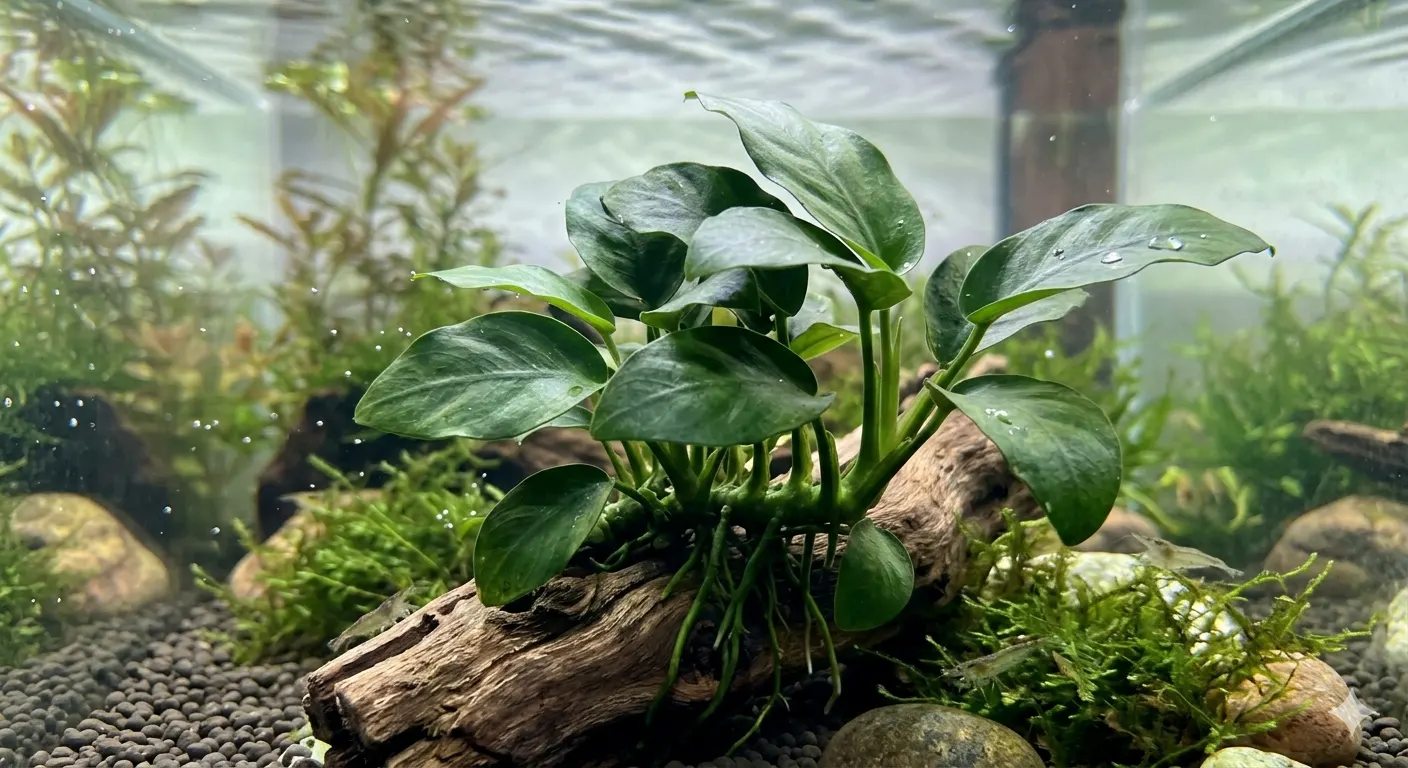
Anubias Nana is arguably the most resilient plant in the aquarium hobby. Its thick, dark green, leathery leaves provide excellent contrast in aquascapes and serve as perfect resting spots for fish like Bettas.
Care Guide
Like Java Fern, Anubias is an epiphyte with a rhizome. It should never be planted directly into the substrate or the rhizome will rot. Instead, wedge it between rocks or attach it to driftwood using cyanoacrylate gel superglue or fishing line. It tolerates temperatures of 72–82°F and a pH of 6.0–7.5, and does best under low to moderate lighting — excess light on its slow-growing leaves usually just invites algae rather than faster growth.
Size And Varieties
Standard Anubias Nana stays compact, typically reaching 3–8 inches tall with leaves fanning out from a slow-creeping rhizome, making it well suited to foreground or midground placement. Several popular cultivars offer different sizes and colors: 'Petite' is the smallest, with leaves often under an inch long, ideal for nano tanks; 'Bonsai' sits between Petite and standard Nana in size; 'Gold' features light green to chartreuse leaves instead of the usual dark green; and 'Coin Leaf' is prized for its unusually round, small leaves. All share the same easy care requirements and rhizome-based growth habit as the standard variety.
Fertilizer And Feeding
Anubias Nana can survive without dedicated fertilizing, often getting by on fish waste and whatever nutrients are already in the water. That said, since it feeds mainly through its leaves and roots rather than the substrate, a liquid water-column fertilizer with iron and micronutrients is more useful than root tabs, which mostly go to waste on a plant attached to wood or rock rather than planted in substrate. Without any fertilization, leaves may eventually turn pale with visible green veins, a sign of iron or micronutrient deficiency. Slightly elevated phosphate levels alongside iron can also encourage flowering and help resist algae.
Plant Data Profile
Taxonomy
- Family
- Araceae
- Origin
- West Africa
Growth
- Growth Rate
- Very Slow
- Emersed Capable
- Yes
- Rhizome Plant
- Yes
- Floating Plant
- No
Water Parameters
| Temperature | Recommended: 22-28 C (Survivable: 20-30 C) |
| Water pH | Recommended: 6-7.5 (Survivable: 5.5-8) |
Lighting
- Requirement
- Low
- PAR Min
- 15 μmol/m²/s
- PAR Max
- 35 μmol/m²/s
Nutrition & Fertilization
- CO₂ Requirement
- None
- Nitrate Demand
- Low
- Phosphate Demand
- Low
- Potassium Demand
- Low
Algae Sensitivity
- Black Beard Algae
- High
- Green Spot Algae
- High
- Diatoms
- Moderate
Companion Plants
- Related
- Excellent broad leaves for Betta resting.
- Related
- Tough, leathery leaves are usually left alone by herbivorous fish like goldfish.