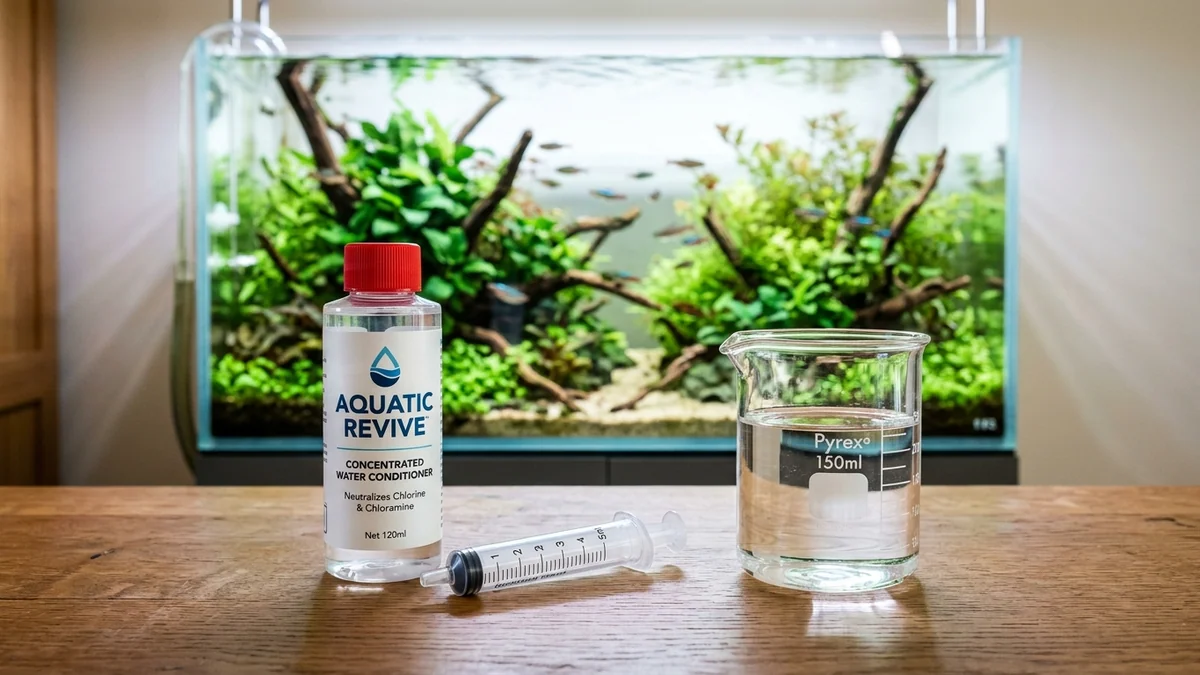
How much Seachem Prime should you use? The label rate is 1 mL per 10 US gallons (5 mL per 50 US gallons, or per 200 L). Use a double dose for exceptionally high chloramine, up to 5x when ammonia or nitrite is above 2 ppm, and a half dose above 30 C (86 F) when chlorine or ammonia is low. Dose new water, or the tank if you add Prime directly.
How much Seachem Prime per gallon?
The label rate is 1 mL per 10 US gallons of new water, which is 0.1 mL per gallon. The metric wording is 5 mL (one capful) per 200 L (50 US gallons), and each cap thread is about 1 mL (Seachem text via LiveAquaria; metric wording).
- Pre-treating new water: dose the volume of new water.
- Adding to the tank: dose the whole tank volume.
- Rounding note: 50 US gallons is 189 L, but the label rounds to 200 L. A 189 L tank takes 5.0 mL by the US rate and 4.7 mL by the metric rate. The 5% gap is smaller than the safety margin, so use the rate that matches your units.
Check your true volume with the true water volume, because substrate and decor take up space. For automatic maths, use the water conditioner dose calculator.
Prime dose chart by tank size
Volumes are the water you treat. The calculation is volume x 0.1 mL for US gallons, or volume / 40 mL for litres.
| Tank size (US gal) | Standard (1x), mL | High chloramine (2x), mL | Emergency (up to 5x), mL | Half dose, mL | Standard in capfuls (5 mL) |
|---|---|---|---|---|---|
| 2.5 | 0.25 | 0.5 | 1.2 | 0.12 | 0.05 |
| 5 | 0.5 | 1 | 2.5 | 0.25 | 0.1 |
| 10 | 1 | 2 | 5 | 0.5 | 0.2 |
| 20 | 2 | 4 | 10 | 1 | 0.4 |
| 29 | 2.9 | 5.8 | 14.5 | 1.5 | 0.58 |
| 40 | 4 | 8 | 20 | 2 | 0.8 |
| 55 | 5.5 | 11 | 27.5 | 2.8 | 1.1 |
| 75 | 7.5 | 15 | 37.5 | 3.8 | 1.5 |
| 125 | 12.5 | 25 | 62.5 | 6.2 | 2.5 |
| Water volume (litres) | Standard (1x), mL | 2x, mL | Up to 5x, mL | Half dose, mL |
|---|---|---|---|---|
| 10 | 0.25 | 0.5 | 1.2 | 0.12 |
| 20 | 0.5 | 1 | 2.5 | 0.25 |
| 40 | 1 | 2 | 5 | 0.5 |
| 60 | 1.5 | 3 | 7.5 | 0.75 |
| 100 | 2.5 | 5 | 12.5 | 1.2 |
| 200 | 5 | 10 | 25 | 2.5 |
| 400 | 10 | 20 | 50 | 5 |
Worked examples
Each row shows the arithmetic. Round to the smallest amount you can measure; a 1 mL syringe is easier than cap threads for small doses.
| Scenario | Water to treat | Calculation | Dose |
|---|---|---|---|
| 10-gallon tank, 50% water change, pre-treat new water | 5 gal | 5 / 10 x 1 | 0.5 mL |
| 55-gallon tank, 25% change, pre-treat new water | 13.75 gal | 13.75 / 10 x 1 | 1.38 mL |
| 55-gallon tank, dose the whole tank directly | 55 gal | 55 / 10 x 1 | 5.5 mL (just over one capful) |
| 20-litre bucket | 20 L | 20 / 40 x 1 | 0.5 mL |
| 55-gallon change (13.75 gal), tank at 31 C, low chlorine | 13.75 gal | 13.75 / 10 x 0.5 | 0.69 mL |
| 20-gallon tank, ammonia 3 ppm, emergency 5x | 20 gal (tank volume) | 20 / 10 x 5 | 10 mL, plus a water change |
How often can you dose Prime?
| Situation | What the Seachem text says |
|---|---|
| Routine water changes | Dose new water each time. Use as often as daily if needed (Seachem FAQ, as quoted). |
| Ammonia or nitrite rising within 24 hours | Re-dose every 24 hours (Seachem FAQ on LiveAquaria). |
| How long it stays bound | Up to 48 hours. Compounds still present after that are released unless you re-dose. |
| Maximum overdose | Up to 5x the recommended amount in any 48-hour period in most systems (Seachem FAQ, as quoted on a forum). |
If ammonia or nitrite keeps appearing, the source is the problem. See ammonia spike troubleshooting and the nitrite toxicity calculator.
What happens at a 5x dose? Oxygen and safety limits
Seachem says Prime is very safe and hard to overdose to the point of harm, but a large enough overdose can start to deplete oxygen. The 5x rule applies when ammonia or nitrite is above 2 ppm. Seachem advises a half dose or extra aeration in tanks that are already low in oxygen, such as those with a high bioload, heat or poor circulation, and about an hour between Prime and other products that reduce oxygen (Seachem FAQ, as quoted on a forum).
Prime's ingredient list says "complexed hydrosulfite salts" (retailer page). Forum members report fish losses after repeated doses of 6x or more. These are anecdotes with unknown causes, so this guide treats 5x in 48 hours as the limit and nothing above it.
- Increase surface agitation or add an air stone before an emergency dose.
- Do not stack Prime with medication within the hour.
- Watch for fish gasping at the surface after dosing.
Why ammonia readings need context
Prime temporarily detoxifies ammonia and nitrite according to the manufacturer, but does not remove compounds from the system. Most test kits report total ammonia, which includes the less harmful ionised form. Seachem notes its MultiTest kit separates free ammonia (the more dangerous form) from total ammonia. How toxic a reading is depends on pH and temperature, so use the ammonia toxicity calculator and the ammonia chemistry page for context. For wider background on pH, hardness and test kits, see the water chemistry guide.
Do ammonia test kits work after dosing Prime?
It depends on the kit. This is based on Seachem's FAQ (LiveAquaria).
| Test method | Effect of Prime (per Seachem FAQ) | What to do |
|---|---|---|
| Nessler-based kit | Reads off scale, muddy brown. Will not work with Prime. | Use another kit. |
| Salicylate-based kit | Prime-ammonia complex breaks down during the test and can give a false ammonia reading. | Read the result right away and treat it with caution. |
| Seachem MultiTest Ammonia (gas exchange) | Not affected by Prime; separates free from total ammonia. | Best option while dosing. |
Common mistakes vs better practice
| Common mistake | Better practice |
|---|---|
| Relying on conditioner to control nitrate | Conditioners do not remove nitrate; monitor nitrate levels and manage them through routine water changes and proper stocking. |
| Dosing for the tank when you only add new water | Dose the new water volume. Dose the whole tank only if you add Prime directly and treat everything. |
| Using 5x as a routine dose | Use 5x only when ammonia or nitrite is above 2 ppm, and fix the cause. |
| Trusting a zero ammonia reading after Prime | Check which kit you use (see below). Prime changes what some kits show. |
| Overdosing in a hot, crowded, low-oxygen tank | Use a half dose or add aeration when oxygen is already low, per Seachem. |
| Using Prime instead of a water change | Prime binds ammonia for up to 48 hours. It does not remove it. Change water and fix the source. |
| Mixing Prime and medication within minutes | Leave about an hour between oxygen-reducing products (Seachem FAQ, as quoted). |
Steps for an ammonia or nitrite emergency
- Test and log. Use a kit that works with Prime (above), track readings with the nitrogen cycle tracker, and check the fish for gasping or lethargy.
- Aerate. Raise surface agitation or add an air stone.
- Change water. Use temperature-matched water already treated with Prime at the standard dose. This removes ammonia, which Prime does not. Plan it with the water change calculator.
- Dose Prime for the tank. If ammonia or nitrite is above 2 ppm, up to 5x the tank dose is within the label guidance (for a 20-gallon tank, up to 10 mL).
- Find the cause. Overfeeding, a dead animal, a filter crash or an uncycled tank. See the nitrogen cycle.
- Retest and re-dose. Re-dose every 24 hours while levels are rising, never exceeding 5x in 48 hours.
After a medication course, see clearing medication residue for the order of steps.