
Fish care calculator
Fish Compatibility & Tankmate Checker | FishZone
Use the Coexistence Lab to cross-reference temperaments, temperature bounds, pH ranges, and swimming depths of freshwater species before adding them to your aquarium. Prevent territorial disputes, physical injury, and chemical shock before you buy.
- Scientific Formula
- Reviewed by Experts
- Updated May 2026
- Instant Results
Type
Risk Assessment
Inputs
3
Difficulty
Beginner
Calculation Time
Instant
Quick Answer
Aquarium species compatibility hinges on five core parameters. Water Chemistry: pH and temperature ranges must overlap — Discus require 82–86°F and pH 5.5–6.5, while Mollies need 72–78°F and pH 7.5–8.5, making them completely incompatible. Behavioral Temperament: peaceful, semi-aggressive, or aggressive — Tiger Barbs will relentlessly fin-nip slow, long-finned fish like Bettas and Guppies. Adult Size: if one fish can fit another into its mouth, it eventually will — a 6-inch Angelfish will consume Neon Tetras. Swimming Layer: surface, mid-water, and bottom zones should be distributed to avoid competition for space and food. Territoriality: cichlids require visual barriers, caves, and sometimes intentional overstocking to disperse aggression. Always introduce new fish through a 2-week quarantine tank, observe behaviour for the first 72 hours, and have a rehoming plan ready for persistent aggressors.
Enter your details
Enter the labeled values below. Results appear without leaving this page.
How to Use This Calculator (Worked Example)
This tool requires 3 key inputs:
- Select Species A: Enter your specific value (e.g., from your tank's test kit or dimensions).
- Select Species B: Enter your specific value (e.g., from your tank's test kit or dimensions).
- Choose Species to Explore: Enter your specific value (e.g., from your tank's test kit or dimensions).
Example: If you input average baseline values, the calculator will immediately process the formula and return the recommended output and safety warnings above.
Method
This tool uses the visible inputs on the page and returns practical aquatics guidance for maintaining your tank.
Knowledge Journey
Recommended Next Steps
Explore other helpful tools for your aquarium.
Guide
The Hard Water Aquarium: Thriving Species for High pH Tap Water
Stop fighting your tap water chemistry. Learn how to select beautiful fish species that naturally thrive in hard, alkaline parameters.
Guide
Aquarium Floor Weight Guide: Is Your Tank Too Heavy for the Floor?
Before upgrading to a large aquarium, understand how water, glass, and stands impact your floor's structural integrity. Learn structural boundaries for apartments.
Guide
Neon Tetras vs. Other Tetras — Which School is Right for Your Tank?
Neon tetras are iconic, but the tetra family has many other dazzling options. Here’s how to choose the right school for your aquarium’s size, water chemistry, and community.
Quiz
Fish Compatibility Quiz
Find beginner-friendly fish that match your tank size, setup, and experience level.
Quiz
Fish Quiz Hub
Choose a guided quiz and get personalized fish care next steps.
Calculator
Ammonia Toxicity Calculator (Free NH3)
Enter your test kit reading (TAN), pH, and temperature — get an instant SAFE or LETHAL verdict for Free Ammonia (NH3). Built for API Master Kit users, cichlid tanks, reef setups, and fish breeders.
The Problem
Fishkeepers regularly purchase fish based on appearance or impulse without verifying whether new additions are compatible with their existing community. The result is avoidable injury, predation, chronic stress, disease, and livestock loss — all of which are emotionally distressing and financially costly. Compatibility information is scattered across forums, books, and species-specific care sheets, making it time-consuming to cross-reference multiple species simultaneously. This calculator centralises that verification into a single, instant check.
When to Use This Tool
Use this calculator before purchasing any new fish — especially when adding a species you have not kept before. Use it when building a stocking list for a new tank from scratch to verify all planned species are mutually compatible. Use it when troubleshooting unexplained aggression, hiding, fin damage, or stress in an existing community, as an overlooked incompatibility is frequently the underlying cause. Use it when advising other hobbyists or gift-buyers on safe species selections.
Who is this for?
- Beginner aquarists planning their first community freshwater tank stocking list
- Intermediate hobbyists adding new species to an established aquarium
- Experienced fishkeepers researching biotope-accurate or species-specific setups
- Cichlid keepers managing aggression in African or South American setups
- Betta owners wanting to build a safe community around a centrepiece fish
- Fish store customers who want to verify compatibility before purchasing
- Parents and hobbyists setting up a first family aquarium and needing beginner-safe species combinations
- Aquascapers selecting species that will not disrupt planted tank aesthetics or root systems
Building a peaceful community aquarium is one of the most rewarding challenges in the fishkeeping hobby — and one of the most common sources of heartbreak when it goes wrong. A fish lost to an incompatible tank mate, a beautiful specimen destroyed by fin-nipping, or an entire school wiped out by a water chemistry mismatch are all preventable with the right information before you buy. This calculator exists to give you that information.
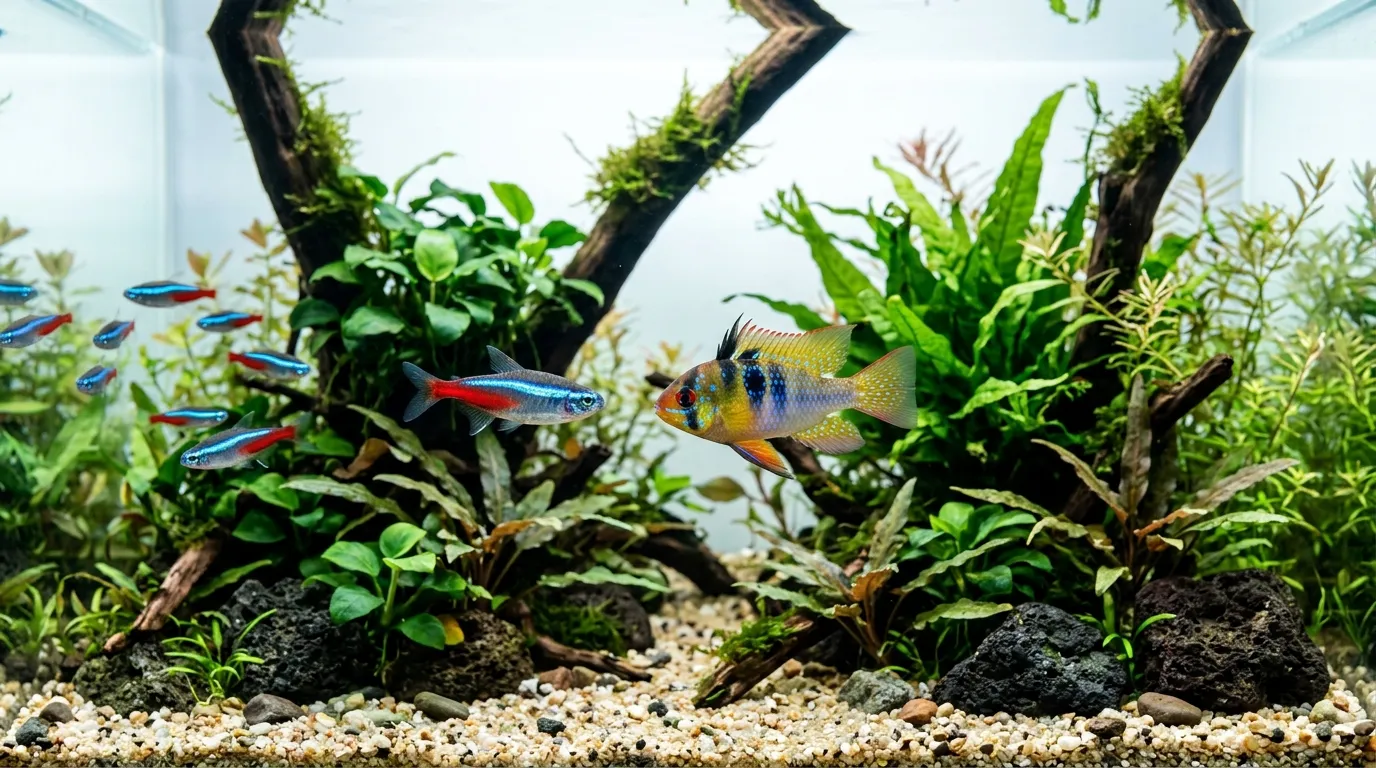
Who Should Use This Calculator?
This tool is for any freshwater aquarium hobbyist planning a new community tank, adding new fish to an established setup, or troubleshooting aggression and stress in an existing aquarium. Beginners will use it to build their first safe community stocking list. Intermediate hobbyists will use it to verify that a new species they spotted at the fish store is actually compatible with what they already have at home. Advanced keepers managing species-specific biotope tanks or cichlid communities will use it to cross-reference water chemistry parameters with precision.
It is equally useful for fishkeepers researching a purchase online at midnight as it is for someone standing in a fish store trying to decide in the moment.
The Five Pillars of Compatibility
Successful cohabitation depends on all five of the following parameters aligning — not just one or two. A fish pair that matches on temperament but clashes on water chemistry will still fail.
1. Water Temperature: The acceptable temperature ranges of two species must overlap by at least 4°F (2°C) to form a viable long-term pairing. Keeping fish outside their preferred range causes chronic immune suppression, making them permanently susceptible to disease even if they are not visibly sick.
2. Water pH: pH ranges must overlap by at least 0.5 units. A mismatch causes physiological stress at the cellular level — affecting osmoregulation, enzyme function, and gill health — often before any visible symptoms appear. Chronic pH mismatch shortens fish lifespans significantly.
3. Temperament: Mixing hyper-aggressive or territorial fish with passive, slow-moving species almost always results in injury, chronic stress, or death. Temperament categories — peaceful, semi-aggressive, and aggressive — are starting points, not guarantees. Individual fish personalities vary, and a fish labelled peaceful in one setup may become a bully in an overcrowded or understimulated tank.
4. Adult Size: The golden rule of fishkeeping: if a fish can fit another into its mouth, it eventually will — even if both fish have lived peacefully together for months. Always research the adult size of every species, not the juvenile size you see in the store. A 1-inch juvenile Angelfish will reach 6 inches within a year.
5. Swimming Layer: Fish naturally occupy one of three vertical zones in the water column: surface, mid-water, or bottom. Concentrating too many species in a single zone creates competition for food, space, and resting areas, driving aggression even between otherwise peaceful species.
Zoning Your Aquarium
To minimise territorial disputes and feeding competition, stock fish that inhabit different vertical zones. Combining surface-dwellers (such as hatchetfish or African butterflyfish), mid-water schoolers (such as tetras and rasboras), and bottom-feeders (such as corydoras catfish and kuhli loaches) creates a balanced, dynamic display while keeping stress levels low. A useful target ratio for a community tank is approximately 30% surface species, 50% mid-water species, and 20% bottom-dwelling species by fish count.
When to Use This Calculator
Use it before purchasing any new fish — ideally while still at home with time to research, not standing in the fish store. Use it when planning a new tank stocking list from scratch to verify all species are compatible before buying any of them. Use it when you notice unexplained aggression, hiding, fin damage, or stress in an existing tank, as an incompatibility you missed may be the root cause. Use it to educate yourself on species before gifting fish or recommending them to other hobbyists.
Common Problems This Calculator Prevents
The most frequent compatibility mistakes in freshwater fishkeeping are: mixing Goldfish with tropical species (temperature and waste incompatibility), housing Neon Tetras with adult Angelfish (size predation), combining African and South American cichlids (water chemistry conflict), adding Tiger Barbs to a tank with Bettas or Guppies (fin-nipping aggression), and mixing multiple bottom-feeding species without adequate space and food distribution. Each of these mistakes is entirely avoidable with a compatibility check before purchase.
A Note on Quarantine
No compatibility check replaces a proper quarantine protocol. Always isolate new fish in a separate quarantine tank for a minimum of two weeks before introducing them to your main display. This prevents the introduction of parasites, bacterial infections, and viral diseases that can devastate an established community regardless of species compatibility. Observe initial interactions carefully for the first 72 hours after introduction, and always have a backup plan — a spare tank or a trusted local fish store willing to take back an aggressor — before adding any new species.
Reference Table
Static Fish Compatibility Calculator Reference
These baseline ratios and decision rules are included directly in the page so visitors can review core guidance before using the interactive calculator.
| Scenario | Baseline Rule | Safety Note |
|---|---|---|
| Inputs used by this tool | Select Species A, Select Species B, Choose Species to Explore | The interactive calculator refines the result from these inputs. |
| Outputs generated | Pair status badge, Pair status desc, Temp pct val, Temp summary text | The static table gives baseline logic; final value depends on entered values. |
| Species Pairing | Temperature Compatible? | pH Compatible? | Temperament Match? | Size Safe? | Overall Verdict |
|---|---|---|---|---|---|
| Neon Tetra + Corydoras | Yes (72–78°F overlap) | Yes (6.0–7.0 overlap) | Yes (both peaceful) | Yes (similar size) | Excellent — classic beginner pairing |
| Betta + Harlequin Rasbora | Yes (74–78°F overlap) | Yes (6.5–7.0 overlap) | Generally yes (rasboras are fast) | Yes (rasboras too large to target) | Good — with dense planting and 20+ gal |
| Angelfish + Neon Tetra | Yes (75–78°F overlap) | Yes (6.5–7.0 overlap) | Risky — Angelfish are predatory | No — Neons fit in adult Angelfish mouth | Avoid — high predation risk at adulthood |
| Goldfish + Tropical community | No — 10°F+ gap | Partial overlap possible | Goldfish outcompete for food | Risky — Goldfish grow large | Avoid — temperature and bioload conflict |
| Mbuna Cichlid + Discus | Partial (78–80°F possible) | No — pH 8.2 vs pH 5.5–6.5 | No — Mbuna are aggressive | Risky — Mbuna will harass Discus | Avoid — water chemistry conflict is critical |
| Tiger Barb + Guppy | Yes (74–78°F overlap) | Yes (7.0 overlap) | No — Tiger Barbs fin-nip constantly | Risky — Guppy fins trigger attacks | Avoid — fin damage and chronic stress guaranteed |
| Corydoras + Kuhli Loach | Yes (72–78°F overlap) | Yes (6.0–7.0 overlap) | Yes (both peaceful bottom dwellers) | Yes (similar size) | Good — different microhabitats reduce competition |
| Oscar + any small fish | Yes (tropical range) | Yes (neutral pH) | No — Oscars are ambush predators | No — Oscars eat any fish under 4 inches | Avoid — predation inevitable as Oscar grows |
Troubleshooting Guide
1 One fish is relentlessly chasing all tank mates
2 New fish are hiding and refusing to eat after introduction
3 Fish developing torn or ragged fins without visible aggressor
Glossary of Terms
- Temperament
- A classification of a fish species' typical behavioural disposition toward other fish. Categories include peaceful (unlikely to initiate aggression), semi-aggressive (may chase or nip but rarely causes lethal harm), and aggressive (regularly attacks and injures tank mates).
- Swimming Layer
- The vertical zone of the water column a fish naturally inhabits. The three layers are surface (top 2–3 inches), mid-water (central 60% of tank height), and bottom (substrate and lowest 20% of tank height). Distributing species across all three layers reduces competition.
- Bioload
- The total volume of waste produced by fish in an aquarium, which directly affects water quality through ammonia, nitrite, and nitrate accumulation. High-bioload species such as cichlids and goldfish require significantly more filtration than their body size implies.
- Quarantine Tank
- A separate, bare-bottom holding tank used to observe and treat new fish before introduction to the main display aquarium. A minimum 2–4 week quarantine prevents the spread of parasites, bacteria, and viruses to established livestock.
- Fin Rot
- A bacterial infection characterised by fraying, ragged, or disintegrating fin edges, sometimes with a white border at the damage zone. Caused by opportunistic bacteria (commonly Aeromonas or Pseudomonas) that exploit fish weakened by poor water quality, physical injury, or stress.
- Drip Acclimation
- A slow acclimation method in which aquarium water is gradually siphoned into the bag or container holding a new fish at a rate of 2–4 drops per second over 45–60 minutes. This minimises osmotic and pH shock during the transition between the source water and display tank water.
- Dither Fish
- Small, active, fast-moving schooling fish added to a tank to reduce the anxiety of shy or reclusive species. Their confident swimming signals to cautious fish that the environment is safe. Common dither fish include Danios and Rainbowfish.
- Territorial Reset
- The practice of rearranging aquascape elements — rocks, driftwood, and plants — before introducing new fish. Disrupting established territory boundaries prevents resident fish from treating the entire tank as claimed space when newcomers arrive.
- Osmoregulation
- The physiological process by which fish maintain a stable internal balance of water and dissolved salts (ions) regardless of the external water chemistry. Fish living outside their preferred pH or salinity range must work harder to osmoregulate, diverting energy from immune function and growth.
- Labyrinth Organ
- A supplementary breathing organ found in Anabantid fish (Bettas, Gouramis, Paradise Fish) that allows them to breathe atmospheric air directly. Fish with a labyrinth organ are highly territorial around the water surface and will aggressively compete with other labyrinth fish for surface access.
- Schooling Fish
- Species that instinctively form tight social groups for safety, navigation, and stress reduction. Schooling fish kept in groups below their minimum number (typically six) experience chronic stress, reduced immunity, and often increased aggression toward tank mates as a displacement behaviour.
- pH Shock
- A rapid, acute stress response caused by a sudden change in water pH, typically defined as a shift of more than 0.3 pH units per hour. Symptoms include erratic swimming, loss of equilibrium, and in severe cases, death within hours. pH shock is preventable through slow drip acclimation.
Scientific References
- Fishbase — Global Species Database for Freshwater and Marine Fish
- Baensch Aquarium Atlas Volume 1
- The Simple Guide to Freshwater Aquariums