
Quick Answer
Aquarium water chemistry revolves around two main pillars: The Nitrogen Cycle (managing toxic ammonia and nitrite produced by fish waste) and Water Hardness/Acidity (managing pH, General Hardness/GH, and Carbonate Hardness/KH). Understanding how these elements interact is the key to preventing tank crashes and maintaining long-term fish health.
Introduction to Water Chemistry
To a beginner, water is just water. To an aquarist, water is a complex chemical soup.
Fish do not interact with their environment the way terrestrial animals do; they are intimately connected to the water around them. Water flows constantly across their gills and through their skin via osmosis. If the chemical makeup of that water is incorrect, the fish's internal organs will fail.
Mastering aquarium water chemistry means understanding two distinct but interacting systems: The Nitrogen Cycle and the Hardness/pH balance.
The Nitrogen Cycle: Managing Toxicity
The nitrogen cycle is the biological engine of your aquarium. It dictates how organic waste is broken down.
### 1. Ammonia (NH3 / NH4+) Everything that breaks down in an aquarium—fish poop, uneaten food, decaying plant leaves—releases ammonia. Ammonia is highly toxic. It burns the gills, preventing the fish from absorbing oxygen, and causes neurological damage. **Target Level:** 0 ppm.
### 2. Nitrite (NO2-) Beneficial bacteria (Nitrosomonas) consume ammonia and excrete nitrite. Nitrite is equally toxic. It binds to the hemoglobin in the fish's blood, turning it brown and preventing it from carrying oxygen, causing the fish to suffocate even in highly oxygenated water. **Target Level:** 0 ppm.
### 3. Nitrate (NO3-) A second type of bacteria (Nitrobacter) consumes nitrite and excretes nitrate. Nitrate is the end product of the cycle. It is relatively safe in low concentrations but acts as fertilizer for algae. **Target Level:** < 20 ppm (managed via water changes or heavy plant growth).
The Acid/Base Balance: pH
pH measures how acidic or basic the water is on a logarithmic scale from 0 to 14. * **pH 7.0:** Neutral * **Below 7.0:** Acidic (common in Amazonian blackwater habitats). * **Above 7.0:** Basic/Alkaline (common in African Rift Lakes and marine environments).
Because the scale is logarithmic, a pH of 6.0 is ten times more acidic than a pH of 7.0. A pH of 5.0 is one hundred times more acidic. This is why rapid pH swings are incredibly stressful to fish.
**The Golden Rule of pH:** Stability is more important than chasing a specific number. Most captive-bred fish will adapt to your local tap water pH, provided it remains stable.
Water Hardness: GH and KH
pH does not exist in a vacuum; it is heavily influenced by water hardness.
### General Hardness (GH) GH measures the concentration of dissolved calcium and magnesium. * **Soft Water (Low GH):** Ideal for Discus, Tetras, and South American cichlids. * **Hard Water (High GH):** Mandatory for livebearers (Guppies, Mollies), African Cichlids, and snails/shrimp (who need calcium to build their shells).
### Carbonate Hardness (KH) KH is arguably the most important parameter that beginners ignore. KH measures the carbonates and bicarbonates in the water.
Think of KH as a "shock absorber" for your pH. The biological processes in your tank naturally produce acids over time. If your KH is high, it absorbs these acids, and your pH stays rock-solid. If your KH is zero, those acids have nothing to absorb them, and your pH will crash rapidly (often overnight), killing your biological filter and your fish.
The Interaction Between pH and Ammonia
Water chemistry parameters are interconnected. The most critical interaction is between pH and ammonia.
Total Ammonia Nitrogen (TAN) exists in two forms in the aquarium: highly toxic free ammonia (NH3) and relatively non-toxic ammonium (NH4+).
* **At a high pH (above 7.0):** More of the TAN exists as toxic ammonia. * **At a low pH (below 6.0):** Almost all of the TAN binds into non-toxic ammonium.
This is why an ammonia reading of 1.0 ppm in an African Cichlid tank (pH 8.2) is a lethal emergency, while a 1.0 ppm reading in a Blackwater tank (pH 5.5) might not show any immediate symptoms. However, if that blackwater tank undergoes a rapid pH spike, the ammonium will instantly convert back to toxic ammonia, causing a catastrophic crash.
Testing Your Chemistry
You cannot manage what you do not measure.
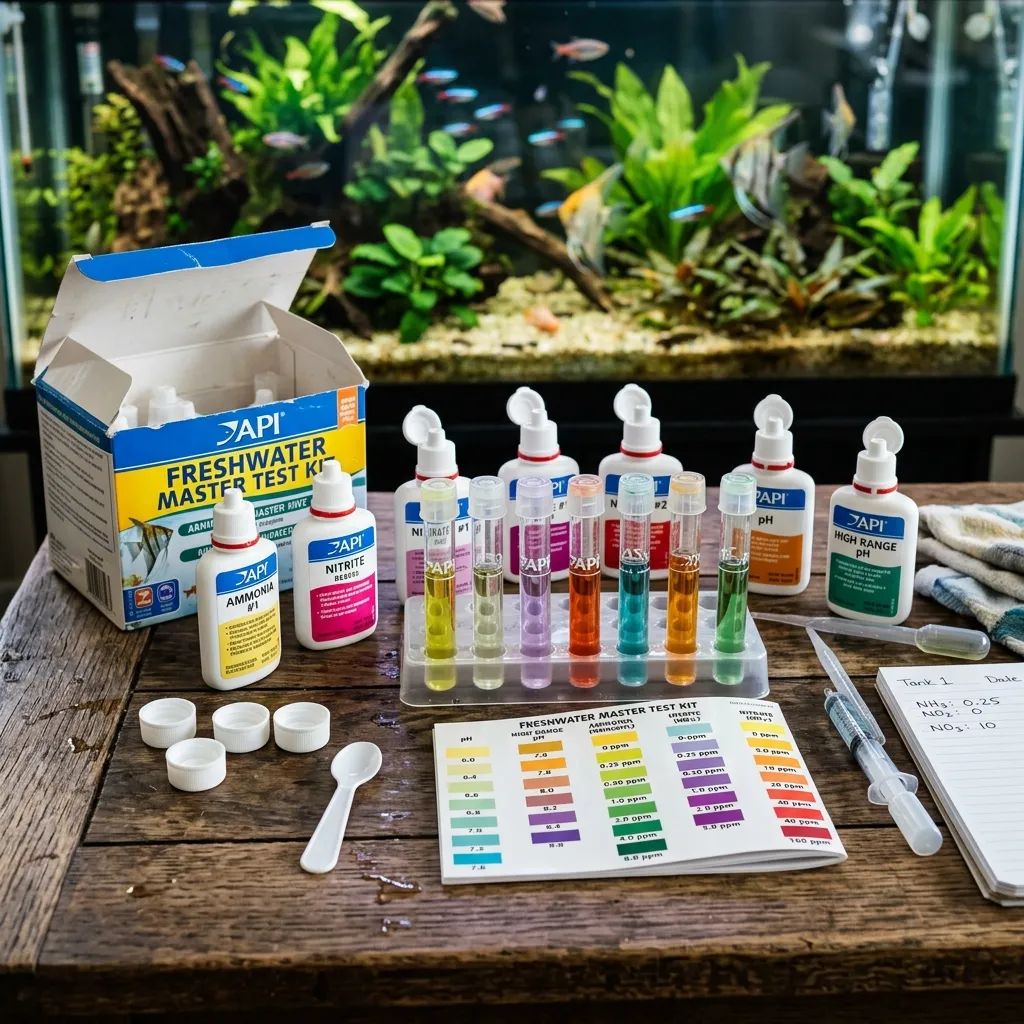
Discard paper test strips, as they degrade rapidly when exposed to humidity and frequently provide false readings. Invest in a high-quality liquid drop test kit (like the API Freshwater Master Test Kit) and a separate GH/KH liquid test kit. Test your water weekly until the tank is mature, and anytime a fish exhibits signs of stress.