
How to Attach and Grow Java Fern on Driftwood
Technical Specifications & Benchmark Matrix
- Plant Type
- Rhizomatous epiphyte
- Critical Rule
- Keep the rhizome uncovered; do not bury it
- Scope
- Attachment only; general care, parameters, varieties and propagation are on the plant profile
Why Java Fern Grows Well on Driftwood
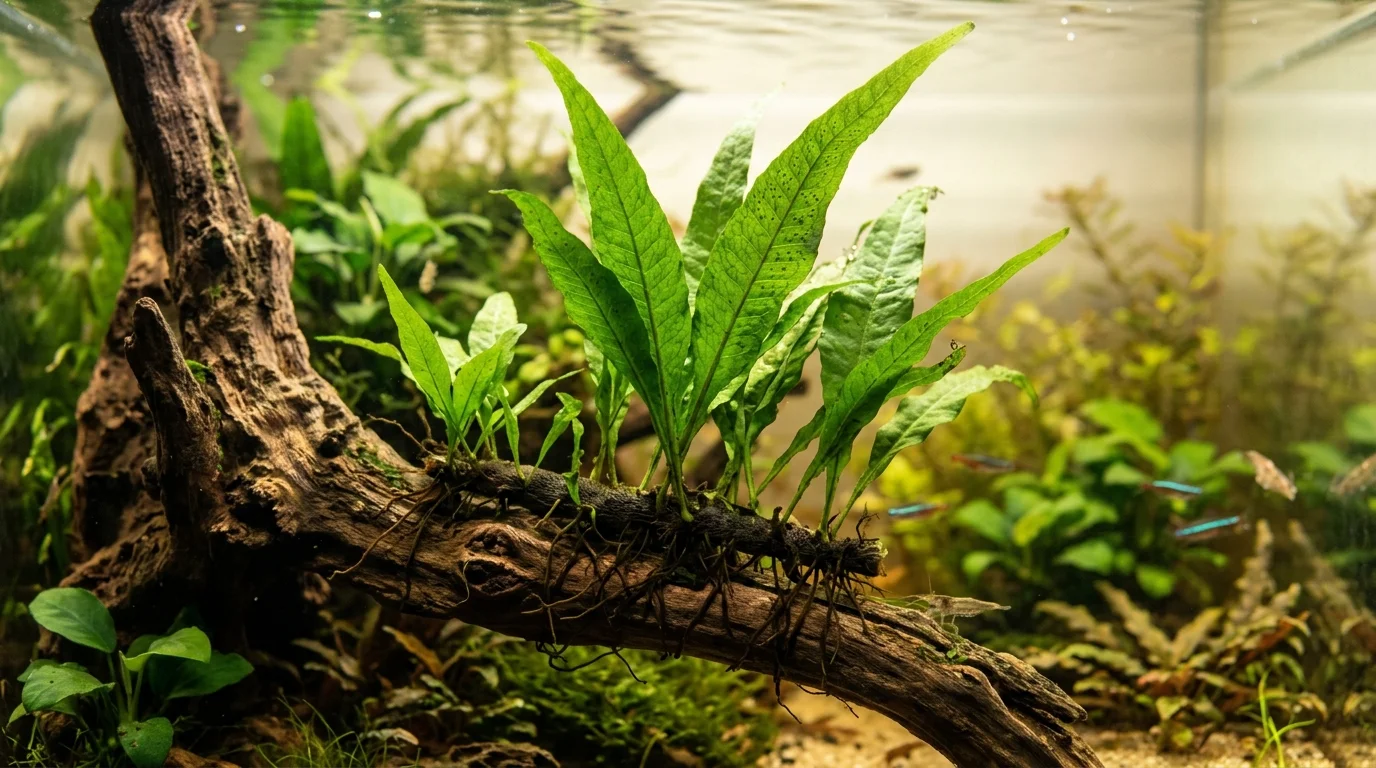
Java fern grows from a horizontal rhizome and does not need to be planted in substrate. Modern Aquarium calls attaching it to hardscape "the preferred method", and says the roots will gradually wrap around and grip the surface. The rule that matters most is that the rhizome stays uncovered: a buried rhizome can rot. For care, lighting, water parameters, varieties and propagation, see the Java Fern plant profile; this guide covers attachment only.
What You Need to Attach Java Fern to Driftwood
You only need the items for the method you choose.
- Always: a Java fern and a stable piece of driftwood.
- If tying: fishing line or cotton thread, and scissors to trim the ends.
- If using glue: a cyanoacrylate gel. Directions differ between products, so read the label (see the glue options below).
- Paper towel (optional): Aquarium Co-Op's glue method dries the bare roots on a paper towel first.
Identify the Java Fern Rhizome Before Attaching It
- Rhizome: the thick, horizontal, stem-like part that the leaves and roots grow from. It is the part that must stay uncovered.
- Roots: the thinner strands growing from the rhizome. These are what grip the wood over time.
- Fronds: the leaves, which spread out from the rhizome. They are not the anchor point, so keep glue and tight ties off them.
Rinse off any growing medium so you can see the rhizome clearly. Aquarium Co-Op notes that a pot of Java fern can hold two or three separate plants, so check what you have before you start.
Choose the Right Position on the Driftwood
Pick a spot where the rhizome can rest against the wood without being covered. Aquarium Co-Op suggests a natural crevice or dip when placing plants on rock; the same idea is a reasonable starting point on wood, but that is practical inference, not a documented Java fern instruction. Check that the piece is stable: Gensou notes that lighter woods such as spider wood may need weighing down or securing until they become waterlogged. Keep the rhizome clear of substrate, because burying it can cause rot.
How to Attach Java Fern to Driftwood: Different Methods
The sources name these methods; the step lists below are general practice built on them, not word-for-word instructions from any one source.
Method 1: Attach Java Fern with Fishing Line
A retailer quoting Tropica's stock description says to grow Java fern on a root or stone attached with fishing line until it grips.
- 1Place the rhizome against the wood, facing the way you want the fronds to grow.
- 2Wrap the line around the rhizome and the wood, passing between fronds rather than across them.
- 3Tie it snugly enough that the plant cannot slide, but not so tight that it presses into the rhizome.
- 4Trim the ends and check the tie from time to time.
Method 2: Attach Java Fern with Cotton Thread
Modern Aquarium names cotton thread as one way to anchor the rhizome. Use the same steps as for fishing line. The sources reviewed give no information on how long cotton thread lasts in an aquarium, so check it periodically and retie if it loosens. Aquarium Co-Op describes thread and line as "not ideal" compared with glue.
Method 3: Attach Java Fern with Cyanoacrylate Gel
Cyanoacrylate products do not all share the same directions. Two documented approaches follow; keep them separate.
Option A: Seachem Flourish Glue
Seachem describes Flourish Glue as a cyanoacrylate gel for attaching moss and plants to rocks, driftwood and gravel. Its directions are to apply a small amount to the plant roots and press against the desired surface for 20 seconds. It says not to use it on glass. Seachem warns that it bonds skin and eyes in seconds and is an eye and skin irritant; if it gets in the eyes, rinse with water for 5-10 minutes.
Option B: Aquarium Co-Op Dry-Hardscape Method
Aquarium Co-Op's guide (written for rock, and covering Anubias and Java fern) works out of the water with an original super glue gel containing cyanoacrylate:
- 1Remove the plant from its pot and strip the growing medium so the roots are bare, then dry the roots on a paper towel.
- 2Find the rhizome and keep it uncovered.
- 3Spread a thin layer of gel on the hardscape, about the length of the rhizome, so it does not run down the sides.
- 4Press the roots into the glue and hold for about a minute or two.
- 5Work quickly; the guide says plants dry out fast and suggests finishing each within about 10 to 15 minutes.
- 6Let it dry fully before putting it in the tank.
The guide warns that covering the rhizome in glue may harm the plant. These steps and the 1-2 minute hold are for that method; they are not Seachem's directions.
Can You Attach Java Fern to Driftwood Underwater?
Fishing line and thread need no glue and can be tied in the water. For glue, it depends on the product. Seachem states that Flourish Glue "can even be used underwater" and "bonds within seconds". Do not assume other cyanoacrylate products are suitable underwater or share its directions. The Aquarium Co-Op method above is done out of the water. This guide makes no claim that any glue is safe for fish or shrimp; the Seachem page does not address it, so check the label of the product you use.
Can You Wedge Java Fern into Driftwood?
None of the sources reviewed describes wedging Java fern. Aquarium Co-Op suggests setting plants in a natural crevice or dip on rock, which is placement, not wedging. Pressing a rhizome into a fork or gap in wood is practical inference. If you try it, do not force or crush the rhizome and keep it uncovered. A loose fit may not hold, so consider a tie as well.
Common Problems When Growing Java Fern on Driftwood
The Java fern keeps sliding off
Retie it, add a second tie, or move it to a spot where the rhizome sits more securely. Roots take time to grip, so support the plant until they do. The sources give no fixed time.
The rhizome is covered
Uncover it and re-attach it so the rhizome rests on top of the surface, since a buried rhizome can rot. Check periodically that substrate or glue has not covered it again.
The tie is too tight
Loosen or replace a tie that presses into the rhizome. Spread the hold over the rhizome and keep ties off the fronds.
The plant has several separate rhizomes
Aquarium Co-Op notes that one pot can contain two or three separate plants. The sources reviewed do not say how to separate them, so handle the roots gently and attach each rhizome so it rests on the surface.
You want to reposition an attached plant
Cut or remove the tie, or lift the plant gently from the surface, avoiding strong pulling on roots that have gripped, and reattach it. The sources reviewed do not cover moving a glued plant, so take care with any bond.
Tips for a Better Java Fern Driftwood Layout
- Choose a stable piece, and secure light wood until it is waterlogged (Gensou).
- Keep the rhizome visible and clear of substrate.
- Leave a tie or glue point on the rhizome and roots, not on the fronds.
- Pick one method and check it after a short while before adding more plants.
For general care, see the Java Fern plant profile. For mounting other leathery-leaf epiphytes, see our guide on attaching Anubias to driftwood.
Run Precision Calculations For Your Setup
Check species compatibility, volumetric displacement, and filtration turnover benchmarks for your specific aquarium parameters.
Java fern attachment methods compared
| Method | Useful when | What to watch | Evidence |
|---|---|---|---|
| Fishing line | Removable attachment | Snug but not constricting; check the knot periodically | Tropica stock description via McMerwe (retailer); Modern Aquarium; Aquarium Co-Op calls line 'not ideal' |
| Cotton thread | Avoiding adhesive | No source on durability or removal; check and retie | Modern Aquarium |
| Cyanoacrylate gel | Direct root-to-hardscape attachment | Product-specific directions and hold times; keep rhizome uncovered; skin and eye warnings | Seachem (manufacturer, Flourish Glue only); Aquarium Co-Op method |
| Natural wood support (fork or crevice) | A suitable natural gap | Do not force or cover the rhizome; may need a tie | Inference; Aquarium Co-Op suggests crevices on rock |
Frequently Asked Questions
Can I glue Java fern to driftwood underwater?
Can I attach Java fern without glue?
Does Java fern have to be attached to wood?
Do I need to remove the line or thread later?
My pot had more than one plant. What should I do?
Sources & References
- Publisher:Gensou Premium Aquascaping (retailer)
- Accessed:2026-10-31
- Publisher:Seachem Laboratories (manufacturer)
- Accessed:2026-10-31
- Publisher:Aquarium Co-Op
- Accessed:2026-10-31
- Publisher:Modern Aquarium (retailer product page)
- Accessed:2026-10-31
- Publisher:McMerwe (retailer quoting Tropica stock description)
- Accessed:2026-10-31