
Java Fern Care: Tie to Wood, Don't Bury It
Microsorum pteropus
Java Fern is an extremely hardy epiphyte that must be attached to wood or rocks. Learn how to grow, propagate, and avoid common beginner mistakes.
- Light
- Low to Moderate
- Growth Rate
- Slow
- Difficulty
- Easy
- Placement
- Midground
Overview
Java Fern is widely considered one of the easiest and most indestructible plants in the aquarium hobby. As an epiphyte, it absorbs nutrients directly from the water column rather than through the substrate, making it perfect for bare-bottom tanks or setups with basic gravel.
Care Guide
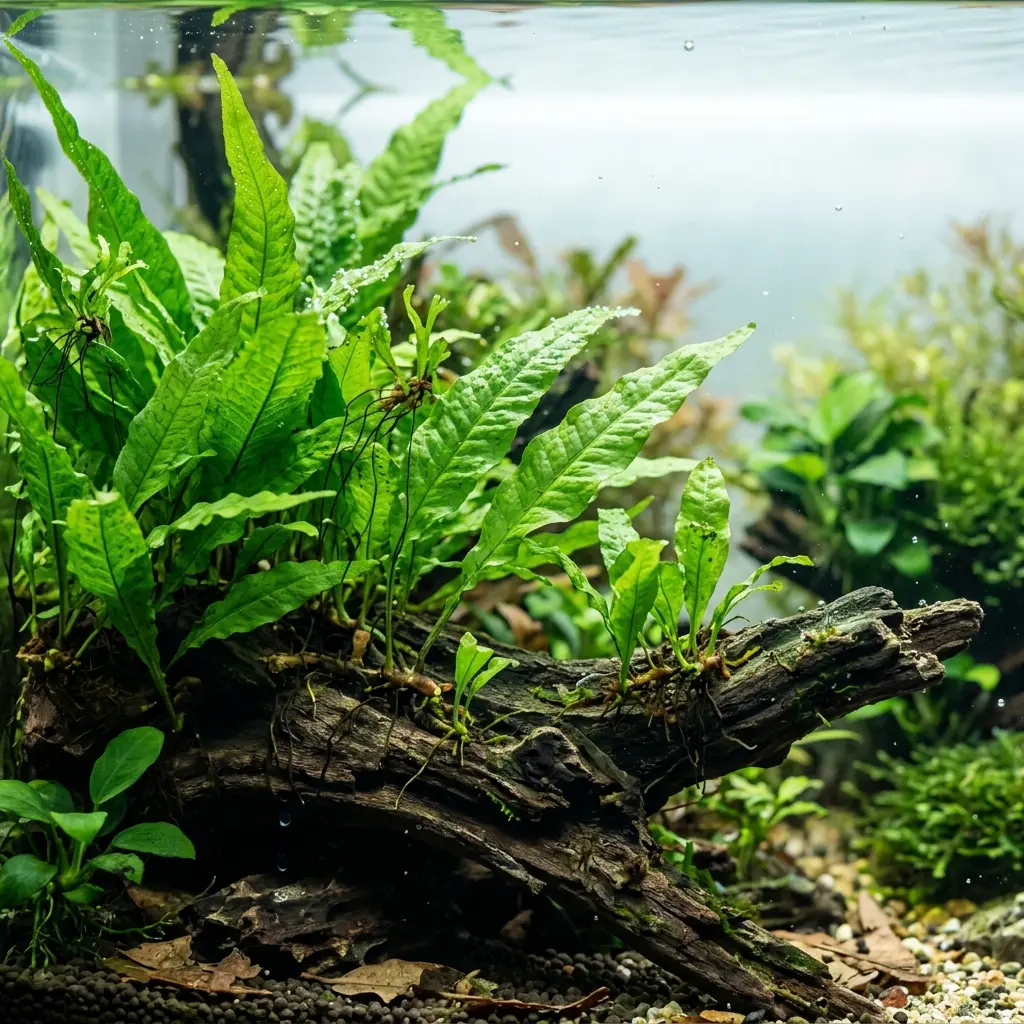
The most important rule for Java Fern is to never bury its rhizome (the thick green stem that roots and leaves grow from). Burying the rhizome will cause it to rot and die. Instead, use superglue gel (cyanoacrylate) or dark cotton thread to attach the rhizome directly to driftwood, rocks, or decorations. It thrives in low light; too much light will cause the leaves to turn brown or attract heavy algae growth.
Size And Varieties
Standard Java Fern has broad, lance-shaped leaves and typically reaches 8–13 inches tall, making it a solid background or midground plant in most tanks. Several cultivars offer different looks and sizes: 'Narrow Leaf' grows long, slender blades and can reach similar or greater height; 'Needle Leaf' is the most delicate variety, with thin, grass-like fronds that usually stay under 8 inches; 'Windelov' (also called Lace or Crested Java Fern) has leaf tips that fork into feathery, antler-like ends; and 'Trident' produces narrow, deeply forked leaves resembling a pitchfork, staying compact enough for foreground use. All varieties share the same low-light, no-CO2, epiphytic care requirements as the standard form.
Plant Data Profile
Taxonomy
- Family
- Polypodiaceae
- Origin
- Southeast Asia
Growth
- Growth Rate
- Slow
- Mature Size Note
- Typically reaches 8-14 inches tall. The long, textured green leaves add excellent mid-level structure to the aquarium.
- Emersed Capable
- Yes
- Rhizome Plant
- Yes
- Floating Plant
- No
Water Parameters
| Temperature | Recommended: 20-28 C (Survivable: 18-30 C) |
| Water pH | Recommended: 6-7.5 (Survivable: 5.5-8) |
Lighting
- Requirement
- Low to Moderate
- PAR Min
- 10 μmol/m²/s
- PAR Max
- 50 μmol/m²/s
Nutrition & Fertilization
- CO₂ Requirement
- Low
- Nitrate Demand
- Low
- Phosphate Demand
- Low
- Potassium Demand
- Low
Propagation
- Method
- Produces tiny adventitious plantlets (with roots) directly on the tips and undersides of older leaves. You can also carefully cut the rhizome to divide the plant.
Algae Sensitivity
- Black Beard Algae
- High
- Green Spot Algae
- High
- Diatoms
- Moderate
Companion Plants
- Related
- compatibleWith