
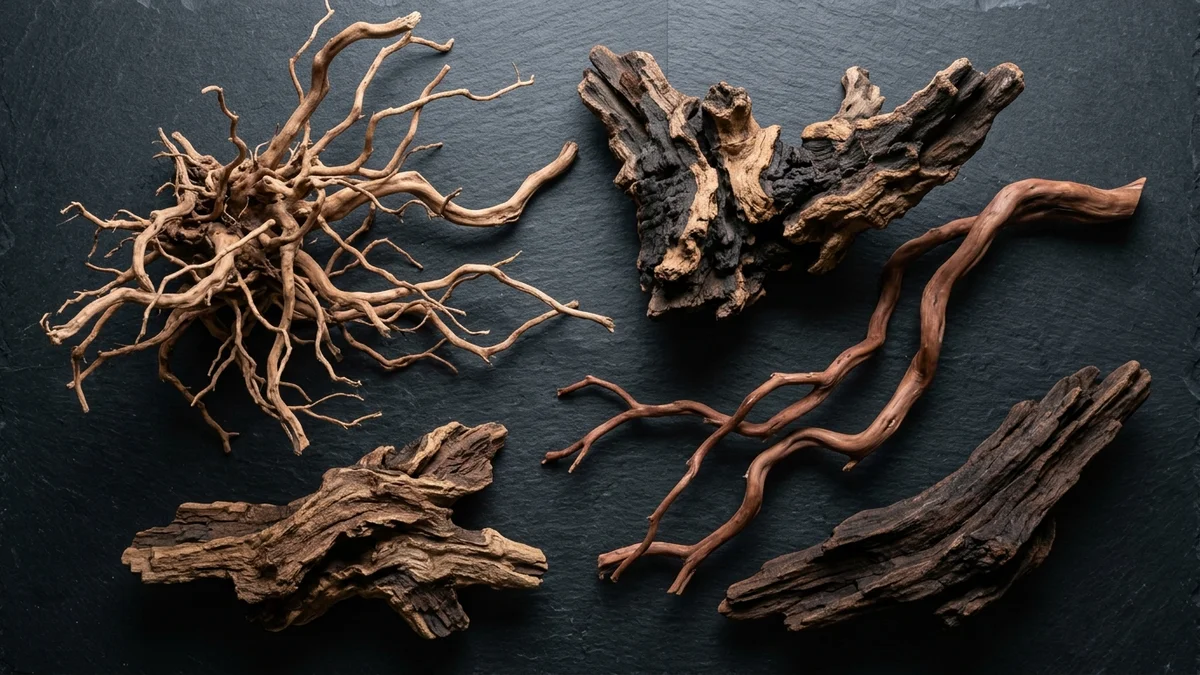
Which aquarium driftwood should you choose? There is no single best aquarium driftwood; the right piece depends on the look, weight and tannin release you want, and retailer descriptions of typical pieces vary. Sources describe spider wood as branching and light, Malaysian driftwood as dense (with sources disagreeing on tannins), mopani as heavy, manzanita as dense and smooth, and cholla as a light, hollow cactus skeleton. Scrub and soak new wood; boiling can help some pieces but is not shown to sterilise. Wood of unknown origin carries uncertainty, so buying aquarium wood from a retailer is the lower-risk choice.
What to Know Before Choosing Aquarium Driftwood
Aquarium driftwood does three jobs: it shapes the layout, gives plants and moss something to grow on, and can release tannins that tint the water. The sources reviewed here are retailer guides, not research, and they sometimes disagree, so treat the descriptions below as typical traits, not guarantees. Individual pieces vary, so read the seller's description.
Spider Wood for Aquariums
Gensou describes spider wood as harvested from azalea roots, with branching tendrils and a light colour. It says the wood is relatively lightweight and often needs weighing down or securing until it becomes waterlogged, and that it releases significant tannins when first submerged and can grow white biofilm in the first few weeks. Light Fish says it floats until waterlogged and Aquarocks says it can be buoyant at first. Gensou says its branching structure gives good attachment points for moss, Bucephalandra and epiphytic plants. These are retailer descriptions of typical pieces; individual pieces vary.
Cholla Wood in Aquariums
Cholla wood is not conventional tree driftwood. It is the dried skeleton of the cholla cactus (Light Fish says it forms after the cactus dies and dries out), hollow and tubular with a lattice of holes. It is covered here because it is sold and searched for as aquarium hardscape. Gensou calls it extremely lightweight, needing soaking to sink, and says it is used mainly in nano and shrimp tanks, where the structure gives baby shrimp hiding spots. Gensou also says it is relatively soft and breaks down over roughly 6 to 12 months, so it treats cholla as semi-disposable; that lifespan is Gensou's statement, not an established figure. Aquarocks calls it better as a supporting element than a focal piece.
Mopani Wood
Descriptions of mopani come from retailers and one manufacturer product page, not independent research. Aquarocks describes two-tone, sculptural wood with substantial mass, durable and sturdy, and known for heavy tannin release early on, with extra soaking and water changes. That suits blackwater looks but not crystal-clear aquascapes. Zoo Med, which sells a product called African Mopani Wood, describes it as a two-colour hardwood that is "one of the hardest and densest woods available" and "sinks immediately", and says all natural wood leaches tannins that discolour water and reduce pH. Those are the manufacturer's marketing claims for its own product. Zoo Med advises soaking in a separate container and changing the water daily until the water colour goes from dark brown to very light. This guide gives no sinking time, tannin quantity or pH change for mopani, because none of the sources reviewed supports one for wood in general.
Malaysian Driftwood
Gensou describes Malaysian driftwood (mangrove root) as dark brown to nearly black, dense and heavy. Its sources on tannins do not agree: Gensou's driftwood-types guide says minimal tannin release, while its separate Malaysian driftwood guide says it releases tannins steadily over months, and Light Fish says its dark colour means it leaches more tannins than some other types. This guide does not assign a tannin level; plan to soak it and watch the water. Aquarocks notes pieces tend to have smoother contours and less fine branching. Individual pieces vary.
Manzanita Wood for Aquariums
Gensou describes manzanita as dense, hard wood from a North American shrub that it says sinks more readily than spider wood, though large pieces may need securing. Its smooth surface does not hold moss as readily as rough woods, so Gensou says it is often used as a standalone structural piece, and it says manzanita releases fewer tannins than spider wood. Aquarocks describes clean, refined branching and warns that sparse pieces can look like "sticks in a box" without stone, substrate and plants to balance them. No source reviewed gives tannin or sinking data for manzanita beyond these retailer descriptions, and pieces vary.
Bonsai Driftwood: Building a Miniature Tree
Bonsai driftwood is a layout style, not a distinct wood species or driftwood type, so it has no row in the comparison table. Gensou suggests a single upright piece, with spider wood or manzanita working best, that has a clear trunk and branching crown, with moss such as Christmas moss, weeping moss or mini pellia attached densely to the upper branches. It calls this popular for nano tanks.
Aquarium Driftwood Types Compared
The comparison table summarises what the sources say. Use it to narrow your choice, not to rank the woods.
How to Prepare Driftwood: Soaking, Boiling and Scrubbing
These are retailer recommendations, so also follow any instructions from the seller. For step-by-step equipment inspection and troubleshooting buoyancy, follow our detailed guide on how to prepare aquarium driftwood.
- Scrubbing: Gensou advises scrubbing under running water with a stiff brush to remove loose dirt, bark and debris.
- Soaking: Gensou describes changing the water daily, or every two to three days at minimum, and stopping when the water stays clear after 24 hours and the wood sinks on its own. It says soaking alone takes about 1 to 4 weeks, and Zoo Med gives its own soaking advice for its mopani product. Times vary by piece.
- Boiling: some retailers use boiling to help release soluble compounds such as tannins and to waterlog suitable pieces. This guide does not describe boiling as sterilisation, because no source reviewed shows that it eliminates bacteria, parasites, fungi, spores or contaminants. Sources also differ on whether to boil: Gensou's Malaysian driftwood guide says not to boil Malaysian wood because most pieces are too large and dense. Use a dedicated pot if you boil, because tannins stain.
- Large pieces: if a piece will not fit a pot, soaking and scrubbing are the options sources describe. This guide does not treat pouring hot water over a piece as equivalent to boiling it.
Tannins, Water Colour and pH
Tannins tint water a tea-like amber. Gensou says this suits blackwater setups but looks wrong in a clear, bright aquascape, and that heavy staining can reduce light reaching carpet plants. It suggests activated carbon or Seachem Purigen and regular water changes to reduce it, and says release diminishes over weeks to months. Zoo Med says tannins from natural wood discolour water and reduce pH. To learn more about the underlying carbonate hardness buffering and filtration mechanisms, read our comprehensive guide on tannins in fish tanks and water chemistry. Gensou reports a modest pH drop of about 0.2 to 0.5 units in its Singapore tap water at pH 7 to 8. That figure depends on local water and the piece, so test your own tank if your livestock need stable pH.
Choosing Natural Driftwood for an Aquarium: Buy or Collect?
Wood from an unknown source carries uncertainty. Gensou says it may carry pesticides, parasites, harmful bacteria or fungal spores, that beach wood may contain salt residue, and that park wood may have been exposed to pesticides or herbicides. That does not mean every collected piece is unsafe, but none of the sources reviewed gives a reliable way to test one, so this guide gives no collection method. Gensou describes shop-bought wood as specifically selected for aquarium use and far less risky; no source reviewed shows that shop-bought wood is free of contaminants, so scrub and soak it too. Light Fish adds that grapewood must have all its bark removed or it will rot, and Aquarocks says grapewood is often less durable underwater than specialty aquarium woods.
Driftwood Aquascaping: Layout and Securing
Gensou describes three layouts: a branching canopy using several spider wood pieces in taller tanks, a fallen tree with a horizontal piece along the bottom of a long tank, and an exposed root system with carpet plants at the base. For securing wood, Gensou lists methods including stainless-steel screws into a buried slate or acrylic base plate (which it describes as the most secure method for large pieces), wedging against rocks, aquarium-safe gel superglue, line or thread, and temporary suction cups that are removed once the wood sinks. Note that Gensou does not specify fastener grades; not all stainless-steel hardware is suited to prolonged immersion, so ensure any hardware used is aquarium-safe. Stable placement matters most: check that a piece cannot tip or roll before adding plants.
Plants That Grow on Driftwood
Plants for driftwood have their own care requirements. Rhizome plants such as Anubias and Java fern can be attached to the wood with the rhizome kept uncovered. For species-by-species hardscape mounting techniques, review our curated guide to the best aquarium plants for driftwood, alongside the Anubias Nana and Java Fern profiles for detailed plant care information.