
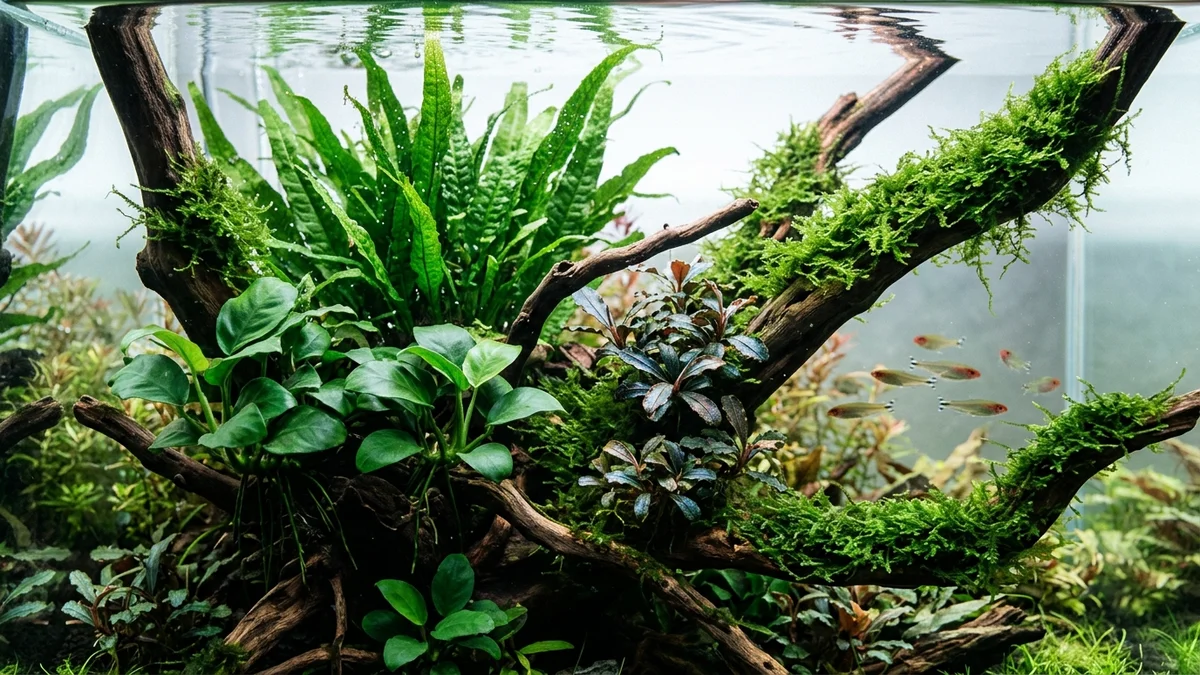
Driftwood can provide a natural surface for growing certain aquarium plants. Instead of planting every plant in the substrate, aquarists can attach suitable plants to wood and arrange them around branches, crevices and exposed surfaces. The most useful choices include Anubias, Java fern and aquatic mosses. The right choice depends on the plant's growth habit, the available attachment surface and the conditions in the aquarium.
Which Aquarium Plants Grow Well on Driftwood?
Plants commonly used on aquarium driftwood are generally epiphytes or plants that can be grown attached to hardscape. They do not need to be buried in substrate in the same way as conventional rooted aquarium plants. Their roots or rhizomes can be secured to a suitable surface while the plant establishes itself.
1. Anubias
Anubias is a popular choice for driftwood because it can be attached to wood rather than planted in the substrate. Its rhizome should remain exposed. Burying the rhizome can cause problems, so position the plant with the rhizome visible and secure the roots to the wood.
Smaller varieties can fit into narrow branches and gaps, while larger plants can create a more prominent focal point. Choose a plant size that suits the scale of the driftwood instead of covering every available surface.
2. Java Fern
Java fern is another commonly used plant for aquarium wood. It can be attached to driftwood, allowing its roots to establish around the surface. Keep its rhizome exposed rather than burying it in the substrate or wedging it tightly beneath the wood.
Java fern can work well on branches and upright pieces of wood. For detailed mounting methods using thread or gel adhesive, see our step-by-step guide on attaching Java fern to driftwood. Leave room for the leaves to develop without being trapped against the hardscape.
3. Bucephalandra
Bucephalandra is often used in planted aquascapes as an attached plant. Its compact growth can suit smaller pieces of driftwood and detailed layouts. Attach it carefully and keep its rhizome exposed. Select a placement that gives the plant enough room to grow.
4. Aquarium Mosses
Aquatic mosses can be attached to driftwood to create a softer, more natural appearance. They can be used on branches, textured surfaces and selected sections of a wood arrangement. Avoid applying an unnecessarily thick layer, which can make it harder to maintain the desired shape.
Moss growth and appearance vary with the species and aquarium conditions. Do not assume that every moss has identical light, flow or maintenance requirements.
Plants That Should Not Be Treated as Driftwood Epiphytes
Not every aquarium plant is suited to being attached to wood. Many common aquarium plants are grown with their roots in substrate and should not be treated as interchangeable with Anubias or Java fern.
Before attaching an unfamiliar plant, check its growth habit. A plant that depends on substrate for root anchoring or nutrient access may not establish properly when simply tied to a piece of driftwood.
How to Attach Aquarium Plants to Driftwood
The attachment method depends on the plant and the shape of the wood. The goal is to hold the plant in position while avoiding damage to its rhizome, roots and growing points.
- Choose a suitable, aquarium-safe piece of prepared driftwood.
- Rinse the plant as appropriate and inspect it for damaged or decaying material.
- Select a position where the plant has room to grow.
- Place the plant against the wood without burying its rhizome.
- Use aquarium-appropriate thread, fishing line or a suitable aquarium-safe cyanoacrylate gel where appropriate for the plant and application.
- Avoid covering growing points or constricting the plant with tight bindings.
- Monitor the plant after placement and adjust the attachment if it becomes loose or damaged.
Choosing Where to Place Plants on Driftwood
Plant placement affects the overall appearance of a driftwood aquascape. Use the natural shape of the wood as a guide. Smaller plants can be placed in selected crevices, while larger plants may be better suited to thicker branches or the base of the arrangement.
Avoid covering the entire wood surface. Leaving some exposed wood creates contrast and helps preserve the shape of the hardscape. Consider the mature size of each plant, not just its appearance when first attached.
Common Mistakes When Growing Plants on Driftwood
- Burying the rhizome of Anubias or Java fern.
- Choosing plants without checking whether they can grow attached to hardscape.
- Using too much adhesive or binding material.
- Attaching plants so tightly that their growing points are damaged.
- Placing plants where their mature leaves will be obstructed.
- Covering the entire driftwood arrangement and losing its natural shape.
- Assuming every attached plant has identical light, flow and nutrient requirements.
Can You Attach Plants to Any Aquarium Driftwood?
Plant attachment does not make unsuitable wood safe for an aquarium. Compare hardscape densities and branch textures in our aquarium driftwood types guide, and ensure you follow proven steps for pre-soaking and preparing aquarium driftwood before mounting living epiphytes. Use wood intended for aquarium use when its history or treatment is uncertain.
The surface and shape of the wood also matter. A stable piece with suitable branches or textured areas may provide better attachment positions than a smooth or unstable piece.
Building a Natural Driftwood Aquascape
A balanced arrangement does not need many plant species. Start with one or two suitable attached plants, position them to complement the shape of the wood, and leave open areas around the hardscape. Add more plants only where they improve the composition without overcrowding the arrangement.
Quick Checklist
- Choose plants that can grow attached to hardscape.
- Keep the rhizomes of Anubias and Java fern exposed.
- Use an attachment method appropriate for the plant.
- Leave room for mature growth.
- Do not overcrowd the driftwood.
- Prepare the driftwood before placing it in the aquarium.
- Check the plant's care requirements rather than assuming all epiphytes are identical.