
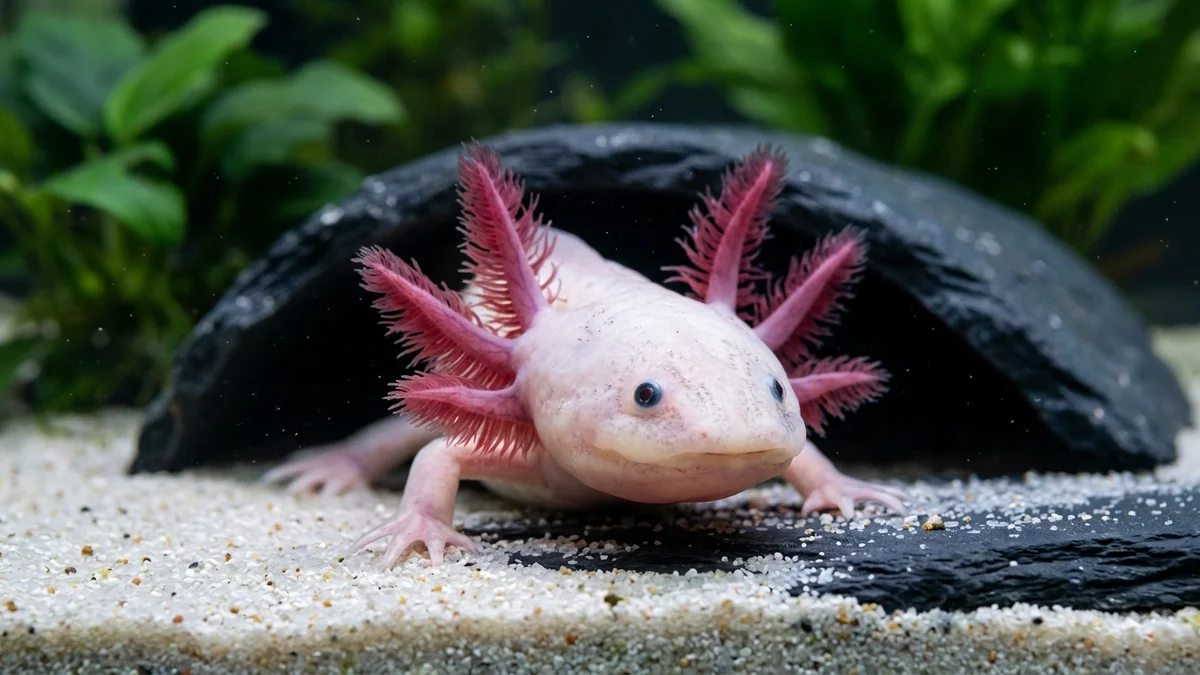
Can axolotls live with other animals? The safest published approach is a species-only tank. Sources disagree on whether two axolotls can share one, and none gives a validated list of safe fish, shrimp or snails.
Should Axolotls Be Kept Alone?
Two questions are easy to confuse: whether an axolotl should share its tank with other species, and whether it should share with other axolotls. OATA, LafeberVet and NSW Education recommend a species-only tank, so there is broad agreement on the first. On the second, OATA and LafeberVet allow groups of adults, while SPCA NZ advises against housing axolotls together. Keeping a single animal is the most cautious choice because it removes tank-mate risks altogether; that is our inference, not a rule stated by one source. This page is general husbandry information and does not replace veterinary advice. For tank size see the axolotl tank size guide, and for the full list of needs the complete axolotl care guide.
Benefits of Species-Only Housing
Housing only axolotls removes the predation and gill-nipping risks that OATA and LafeberVet describe. Fewer animals also generally means less waste to manage, although no source quantifies this.
Reducing Injury and Feeding Competition
The American Axolotl Organization says hungry axolotls may nip because they cannot see well. OATA advises removing uneaten food after about 15 minutes.
Can Two Axolotls Live Together?
Size Compatibility
OATA says animals kept in groups should be of similar size and have adequate space to avoid conflict. The American Axolotl Organization says pairs should be the same size and sex. NSW Education says cannibalism is common when different-sized axolotls are kept together, and LafeberVet recommends housing young axolotls separately because of cannibalism.
Feeding Competition
Offer food in more than one spot and check that each animal eats. This is a general husbandry practice, not drawn from the sources above.
Nipping and Injury Risks
Watch for missing gills or limbs and bite marks; OATA lists loss of body parts and reduced gill tissue among the signs to watch for. LafeberVet says owners should be prepared to separate feuding adults. SPCA NZ advises against housing axolotls together because they can be aggressive to their own species.
Breeding and Separation Considerations
This guide does not cover breeding, but OATA notes that axolotl parents will eat their young and that fry must be separated by size because cannibalism is common. Have a spare container ready in case animals need to be separated; OATA lists ammonia and nitrite at zero as the water-quality requirement. The axolotl tank setup guide explains cycling.
Can Axolotls Live With Fish?
Fish That May Nip External Gills
OATA says axolotl gills are likely to be nipped by fish too large to eat, and LafeberVet says larger or more aggressive fish can damage the exposed gills. The American Axolotl Organization also lists gill-nipping among the risks from fish.
Fish That May Be Eaten
OATA says axolotls will eat any fish they can fit in their mouths, and LafeberVet says small fish may easily be consumed. The American Axolotl Organization also lists fish bones and thiaminase as risks. No source reviewed gives a safe fish list.
Temperature and Habitat Incompatibility
Axolotl sources describe cool water, slow flow and dim light: OATA gives 10-22 C, LafeberVet prefers 15.6-17.8 C, and NSW Education gives an optimum of 15-18 C. A fish that needs warmer water or stronger flow would not match those conditions, so check any species' own requirements. See the axolotl water temperature guide.
Can Axolotls Live With Shrimp or Snails?
Predation Risk
Axolotls are carnivores. LafeberVet describes them as eating a variety of invertebrate prey, and SPCA NZ lists small fish and crustaceans among their food. The American Axolotl Organization rates shrimp low risk and snails and algae eaters hazardous.
Potential Injury and Ingestion Risks
LafeberVet says anything small enough to fit in an axolotl's mouth is usually swallowed, and SPCA NZ notes that axolotls cannot chew and swallow food whole. LafeberVet and VCA describe swallowed objects blocking the gut, which LafeberVet says can be fatal if the item is not passed or removed. Whether a particular shrimp or snail shell would do this is not established by these sources. See the substrate section of the axolotl tank setup guide.
Why Compatibility Is Not Guaranteed
Another keeper's good result does not predict yours, because animal size, appetite and tank layout differ.
How to Reduce Injury and Stress
Monitoring Behaviour
Check animals daily for bite marks and appetite changes. NSW Education's school guidance calls for daily inspection and lists loss of appetite and injuries to limbs, gills or tail among signs of illness. Contact an exotic-animal veterinarian about injuries.
Providing Adequate Space
Give each animal hides and floor space. Sources disagree on how much space is enough, so use the tank size comparison.
Separating Animals When Necessary
Keep a spare container with suitable, tested water so animals can be separated quickly. LafeberVet also recommends a quarantine aquarium for any new axolotl before it joins an established animal.