
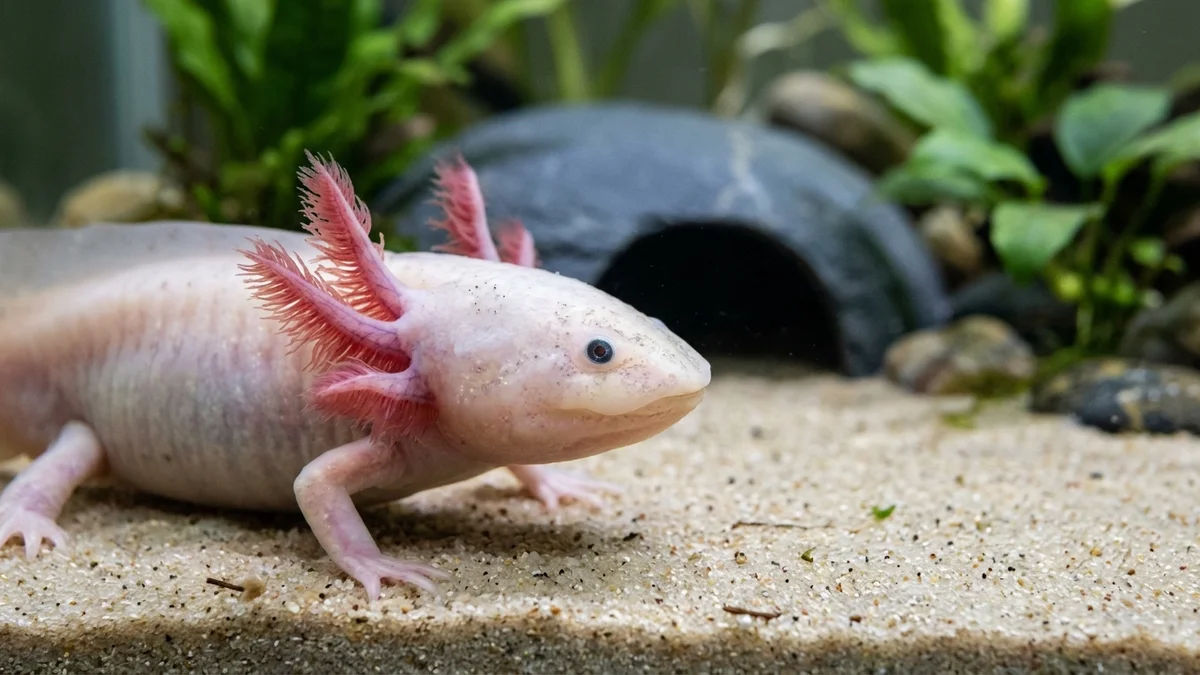
How do you care for an axolotl? Keep one in a cycled, filtered tank with cool, dechlorinated water, gentle flow, dim light, hides and a bottom it cannot swallow. The Royal Veterinary College recommends an optimum water temperature of 16–18 C and says it should never exceed 24 C. Test the water weekly, change about a quarter to a third of it regularly, and feed a carnivore diet in small portions. Published tank-size recommendations differ, so consider adult size, floor space and water quality rather than relying on one number.
What Is an Axolotl?
An axolotl (Ambystoma mexicanum) is an amphibian, not a fish. It is a salamander that stays aquatic for its whole life and keeps its external gills and tail fin as an adult (VCA; LafeberVet). This guide is general husbandry information. It is not veterinary diagnosis or treatment advice.
Axolotl Species and Natural Habitat
Axolotls are native to Lake Xochimilco (and, according to VCA, Lake Chalco) in Mexico City. They are critically endangered in the wild because of habitat loss, and the animals in the pet trade are captive bred (LafeberVet; OATA).
Why Axolotls Need Specialised Aquarium Conditions
Their needs resemble a fish tank in some ways (filtration, cycling and testing) but differ in important ways: cool water, gentle flow, dim light and a bottom they cannot swallow. They are also sensitive to aquarium treatments. OATA advises half doses for scaleless amphibians unless the label says otherwise, so ask an exotic-animal veterinarian before using any medication.
What to Know Before Keeping an Axolotl
- Lifespan: VCA and LafeberVet say 10–15 years; SPCA NZ says up to 20. Plan for more than a decade.
- Size: VCA describes adults at about 23–25 cm; RVC advises allowing for an adult size of up to 35 cm.
- Handling: SPCA NZ advises never handling them unless essential.
- Local rules: keeping and selling rules for axolotls vary by region. Check yours before buying. This guide does not list them.
- Veterinary care: SPCA NZ recommends check-ups every 6–12 months with a vet experienced in amphibians. For acute issues like floating, forward-curled gills, or fungal tufts, refer to our axolotl health and disease troubleshooting guide.
Axolotl Tank Requirements at a Glance
The table shows what each published source says. Published recommendations differ. This page shows each source's figure instead of selecting one. Each topic has a full guide linked in the sections below.
Aquarium Footprint and Available Space
OATA says to make the tank as long and wide as possible. The American Axolotl Organization asks for a footprint of at least 4 sq ft. RVC does not give a numerical tank-volume minimum; it advises allowing for an adult size of up to 35 cm and says axolotls are best housed alone. Details are in the axolotl tank size guide, or you can verify dimensions directly with our axolotl tank size and floor footprint checker.
Water Temperature
Axolotls are cool-water animals. RVC recommends an optimum environmental temperature of 16–18 C and says it should never exceed 24 C. Other sources give narrower preferred ranges or lower upper limits. See maintaining a safe axolotl water temperature, or evaluate your setup's tank cooling and chiller requirements based on ambient summer temperatures and evaporative limits.
Water Quality
Ammonia and nitrite should read zero. pH and nitrate guidance differs between sources. See ideal axolotl water parameters.
Filtration and Water Movement
A filter is important for biological waste control, but the flow must stay gentle. RVC warns that strong filter flow can cause severe stress and says filtration should be controlled rather than excessive. A high turnover rating is not a goal for this species.
Substrate and Hiding Places
RVC identifies fine aquarium sand as the best choice because axolotls can occasionally eat gravel, which can cause a fatal obstruction. A bare bottom is another practical option; avoid small gravel and pebbles. Add hides. Equipment details are in the axolotl tank setup guide.
Choosing the Right Axolotl Tank
Tank Size for One Adult Axolotl
The lowest numerical recommendation among the home-care sources reviewed is LafeberVet's 78 L (20 US gal) for an adult. OATA suggests at least 100 L for a small group, and the American Axolotl Organization recommends 40 US gal (151 L), nothing smaller. RVC does not specify a numerical minimum; it says to consider an adult size of up to 35 cm when choosing accommodation and that axolotls are best housed alone. Because the figures and contexts differ, a larger tank with generous floor space is the more conservative choice. Read axolotl tank size requirements.
Planning Housing for Multiple Axolotls
Sources disagree on whether to keep axolotls together. OATA and LafeberVet say groups or adult pairs are possible with enough space and similar size. RVC says axolotls are best housed alone and that any tank sharing carries some risk. SPCA NZ also advises against housing them together. The American Axolotl Organization suggests another 30 US gal per extra animal, with plenty of floor space. There is no single formula, so plan for separation if animals injure each other or cannot be safely housed together.
Why Floor Space Matters
Axolotls spend much of their time on the bottom. Floor area gives room to move and settle. A longer, wider footprint is more useful than choosing a tank based only on its height or nominal capacity.
Gross Aquarium Volume Versus Actual Water Volume
The volume printed on a tank is its gross capacity. Water level, substrate and decor reduce it. Use the true water volume or the tank size calculator to find numbers for your tank. These calculators give volume only; they do not tell you whether a tank suits an axolotl.
Equipment and Layout Basics
An axolotl tank needs a long, covered aquarium, a gentle filter with real biological capacity, a bottom the animal cannot swallow, several hides and dim light. Cycle the tank before adding the animal. For the equipment checklist, filter comparison and step-by-step order, see our full axolotl tank setup guide.
Axolotl Water Parameters
Temperature
RVC recommends an optimum environmental temperature of 16–18 C (60.8–64.4 F) and states that the water should never exceed 24 C (75.2 F). This is distinct from the lower preferred ranges given by some other sources. See the temperature guide.
pH and Hardness
Domestic-care sources give differing pH ranges. LafeberVet identifies 7.4–7.6 as ideal, and the RVC care sheet also gives an ideal pH of 7.4–7.6. Other sources provide broader ranges. NSW advises against extremely soft or distilled water. Measure your tap water before changing it, and avoid making abrupt changes to established aquarium conditions.
AGSC's 2024 guide describes a separate research-facility water-preparation protocol. Its Axolotl Rearing Water (ARW) is made using reverse-osmosis water as a purified base, then reconstituted with specified salts and buffered with sodium bicarbonate to pH 7.1–7.6. The guide reports approximately 4,200 µS/cm conductivity for 100% ARW. This is a controlled laboratory formulation, not a standard domestic aquarium recipe or an instruction for hobbyists to compound ARW. The important distinction is between purified RO water that is subsequently remineralized for the research system and untreated, unmineralized RO water.
Ammonia and Nitrite
Both should read zero. A mature biological filter helps process waste and maintain water quality. RVC advises leaving a newly set-up aquarium empty to mature for several weeks before adding animals. Do not add an axolotl simply because the water looks clear.
Nitrate
OATA allows up to 20 mg/L above your tap-water level. LafeberVet says below 10 ppm. Water changes are the usual way to control it. These are source-specific recommendations, not a single agreed threshold.
Testing and Recording Water Quality
OATA advises weekly testing with a liquid test kit and recording results. The full parameter reference explains each value, and the water change calculator helps plan water changes.
Axolotl Feeding and Nutrition
Suitable Foods
Axolotls are carnivores. Sources list earthworm pieces, blackworms, frozen bloodworms, frozen brine shrimp and salmon pellets. The American Axolotl Organization treats earthworms as the staple and warns against wild-caught or dyed worms.
Feeding Juveniles and Adults
VCA and LafeberVet say young animals are fed daily and adults every 2–3 days. Other sources give different schedules. The feeding guide compares them, and our feeding cost breakdown estimates monthly earthworm and pellet expenses.
Removing Uneaten Food
Remove leftovers promptly, because rotting food adds ammonia (OATA, VCA, NSW).
Axolotl Aquarium Maintenance
Routine Water Testing
Test at least weekly, and more often during the first weeks (OATA).
Water Changes
OATA and NSW recommend about 25% weekly, and LafeberVet about 30%. Use our dedicated water change planner for axolotls to model steady-state nitrate levels for your specific routine. Use conditioned water at a similar temperature to the aquarium water, and avoid sudden temperature or chemistry changes.
Filter Maintenance
Rinse filter media in water removed from the tank, not under the tap, because chlorine or chloramine can kill beneficial bacteria (OATA). Do not clean all media at once.
Removing Waste and Uneaten Food
Siphon solid waste from the bottom. NSW also notes that bacterial scum can affect the skin and cause toe loss.
Can Axolotls Live With Other Animals?
Keeping Axolotls Together
OATA says axolotls can be kept singly or in groups if all individuals are similar in size and have enough space. LafeberVet says juveniles should be separate because they can be cannibalistic. RVC says axolotls are best housed alone and that any tank sharing carries some risk. SPCA NZ also advises against keeping them together. The American Axolotl Organization says pairs should be the same size and sex, and that hungry axolotls may nip because they cannot see well. For detailed pairing criteria and multi-axolotl requirements, see our axolotl tank mates and cohabitation guide.
Why Fish Tank Mates Can Be Risky
OATA and LafeberVet recommend a species-only tank. Small fish may be eaten, and larger or more active fish can bite the gills.
Risks to Gills, Skin and Smaller Animals
The American Axolotl Organization lists swallowing risks from fish bones, snails and algae eaters, and judges shrimp low risk. Compatibility is not guaranteed for any animal, so do not assume that one species will be safe because another keeper reports success.
Common Axolotl Care Mistakes
Overheating the Aquarium
RVC recommends 16–18 C as the optimum environmental temperature and says the water should never exceed 24 C. VCA and LafeberVet also warn of illness-related problems above 24 C.
Adding an Axolotl Before Cycling Is Complete
OATA and LafeberVet advise adding the animal only after ammonia and nitrite read zero and parameters are stable. Follow our axolotl tank cycling guide to verify that biological filtration can completely process waste before introducing an animal. RVC also advises leaving a newly set-up aquarium empty to mature for several weeks before adding an axolotl.
Using Unsafe Substrate
Gravel and small pebbles can be swallowed and cause blockages. RVC recommends fine aquarium sand as the best choice but does not specify a particle-size measurement. A bare bottom is another option.
Excessive Water Flow
Strong water flow can cause severe stress, according to RVC. VCA also warns that strong flow can damage gills. Use controlled filtration with gentle outflow rather than maximizing current.
Poor Feeding and Waste Management
Overfeeding causes obesity and water-quality problems. VCA describes obesity as common. Remove uneaten food and waste promptly to help prevent deterioration in water quality.