
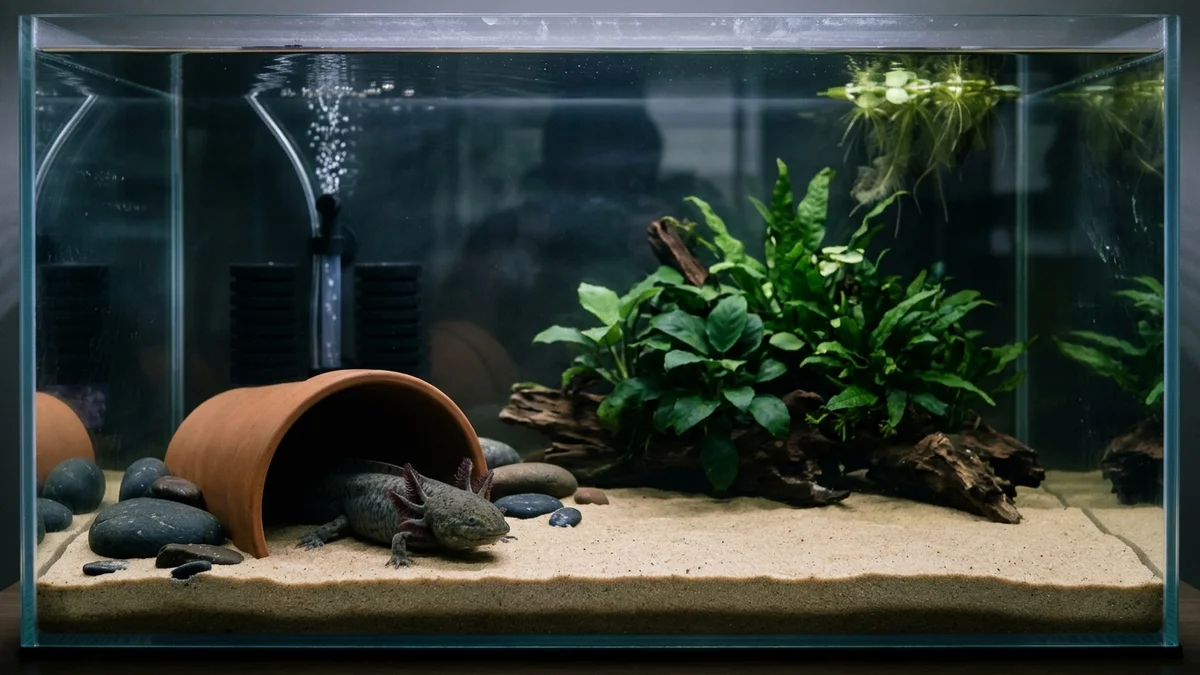
What do you need to set up an axolotl tank? A long tank with a cover, a gentle filter with real biological capacity, a bottom the animal cannot swallow (fine aquarium sand, bare bottom or large stones), hides, dim light, a thermometer, a liquid test kit and conditioner. Cycle the tank before adding the animal.
Last updated 12 November 2026.
What You Need for an Axolotl Tank
The equipment list is short. What matters is how each item is used. Details of each item are in the table.
| Item | Why it is needed | Notes and sources |
|---|---|---|
| Aquarium with cover | Long, wide tank; stops escape | Lid advice differs: OATA and LafeberVet recommend a cover; NSW says unnecessary with 7 cm freeboard |
| Filter | Biological filtration and waste removal | OATA: always essential; VCA, NSW, LafeberVet: keep flow gentle; RVC: strong flow and over-filtration can cause stress |
| Thermometer | Cool water is critical | OATA and SPCA NZ advise close monitoring; RVC: never above 24 C |
| Liquid test kit (ammonia, nitrite, nitrate, pH, hardness) | Water quality is only visible by testing | OATA: test kits are a necessity, weekly testing |
| Water conditioner | Removes chlorine and chloramine | OATA, NSW, VCA |
| Hides and decor | Shelter from light and from other animals | VCA, LafeberVet, NSW; choose smooth items without sharp edges |
| Siphon and bucket | Remove waste and change water | OATA: siphon removes solid waste from sand |
Aquarium
Choose a long, wide tank rather than a tall one, because axolotls spend most of their time on the bottom. See the tank size guide before buying, since published minimums differ between sources.
Filter
Choose by flow and biological capacity, not by turnover rating. The filter must be large enough for the tank (LafeberVet) and gentle enough not to push the animal around. The filter section below compares the common types.
Thermometer
Use a digital probe thermometer in the water, not a stick-on strip on the glass. RVC recommends an optimum of 16–18 C and says water should never exceed 24 C, and OATA and SPCA NZ advise close monitoring, so check the reading daily in warm weather.
Water Test Kit
Liquid kits are generally more precise than test strips. OATA calls test kits a necessity and advises weekly testing. Choose a kit that covers ammonia, nitrite, nitrate and pH, and add hardness if your tap water is unknown.
Water Conditioner
Needed for every fill and water change to remove chlorine and chloramine (OATA, NSW, VCA). NSW also advises against extremely soft or distilled water.
Hides and Decorations
Provide more than one hide so the animal can choose where to rest. OATA suggests pipes, caves, wood and large rounded pebbles. Place hides at different points in the tank, including one away from the filter outlet.
Cleaning Equipment
Use a siphon, bucket and net only for this tank to avoid carrying soap or chemicals in. OATA also advises washing hands and rinsing off all soap before and after working in the tank.
Choosing the Aquarium
Suitable Tank Footprint
Choose length and width first. OATA says to make the tank as long and wide as possible, and RVC says to allow for an adult size of up to 35 cm. See the axolotl tank size requirements for the figures each source gives, the tank size calculator for volume, and use our axolotl tank size checker to compare benthic floor space against guidelines.
Secure Lid and Ventilation
Sources differ: OATA and LafeberVet recommend a cover or glass top; NSW says a lid is not needed if the water surface is at least 7 cm below the rim. Choose a cover if there is any risk of escape or of other animals reaching the tank, and leave air gaps for gas exchange.
Aquarium Placement and Sunlight Exposure
OATA says to avoid draughts, heat sources, direct sunlight, noise and vibration. NSW also warns against direct sun to avoid overheating. Choose a stable, shaded spot before filling the tank, because a full tank is heavy and hard to move. Read about keeping an axolotl aquarium cool.
Choosing a Filter for an Axolotl
Why Biological Filtration Matters
Axolotls produce ammonia. Bacteria in the filter convert it to nitrite and then nitrate. This biological filtration is separate from circulation, which is only the movement of water. A filter can have a high flow rating and poor biological capacity, or the reverse.
Sponge Filters
Air-driven sponge filters provide a large biological surface with gentle flow, which suits a species that dislikes current. Check that the air bubbles do not create a strong current across the tank.
Canister Filters
They hold more media but produce stronger flow. LafeberVet suggests a spray bar and large decor as a buffer.
| Filter type | What suits axolotls | Cautions |
|---|---|---|
| Sponge filter (air-driven) | Produces gentle flow and gives biological surface area | Uses an air pump; check the bubbles are not creating strong current |
| Canister filter | Strong mechanical and biological capacity | LafeberVet: use a spray bar or place large decor in front of the outlet to break up the current |
| Any filter | Must be sized for the tank (LafeberVet) | Filtration never replaces water changes (LafeberVet); RVC: over-filtration can also cause stress |
Managing Excessive Water Flow
RVC warns that strong flow can cause severe stress and that filtration should be controlled rather than excessive. VCA says forceful flow can damage the external gills. Aim for the lowest flow that keeps the water clean.
How to Recognise Excessive Current
Look for an animal being pushed around the tank, avoiding the outlet or hiding in a corner. Damaged or curled gills are also a warning sign. If you see any of these, lower the flow with a baffle, spray bar or decor, or move the outlet.
Choosing Safe Axolotl Substrate
Axolotls gulp their food, and anything small enough to fit in the mouth is usually swallowed, including gravel (LafeberVet).
| Option | What sources say | Concern |
|---|---|---|
| Fine aquarium sand | RVC: the best choice; OATA and SPCA NZ also accept sand. LafeberVet: very small, but can still be consumed | No source gives a grain size. Check droppings, especially with small animals. |
| Bare bottom | Slick surface, easy to clean (LafeberVet); OATA: bare or sand | Waste is easy to see and siphon. Some animals may slip; check behaviour. |
| Large smooth stones | Larger than the animal's head (LafeberVet); smaller than the head will be eaten (SPCA NZ) | Waste and food collect between stones; entrapment. |
| Small gravel or pebbles | VCA and LafeberVet: avoid; RVC: can cause a fatal obstruction | Swallowed objects can block the gut and may be fatal. |
Fine Aquarium Sand
The Royal Veterinary College's 2024 care sheet says fine aquarium sand is the best substrate choice because axolotls can occasionally eat gravel, which can cause a fatal obstruction. OATA and SPCA NZ also accept sand. LafeberVet notes that sand can still be swallowed, so no substrate is completely risk-free. RVC gives no sand-grain size, so choose a genuinely fine aquarium sand and check your animal's droppings.
Bare-Bottom Aquariums
Easy to keep clean, and sources accept it (OATA, LafeberVet). A bare bottom removes the risk of swallowing substrate and makes waste easy to see and siphon. It is a sensible option if you want the lowest ingestion risk, but it is one option and not a requirement for home tanks.
Large Smooth Stones
OATA says pebbles must be too large to swallow. LafeberVet says larger than the head. Make sure the animal cannot become wedged between stones.
Why Small Gravel Is Dangerous
VCA, LafeberVet and RVC describe gut blockage from swallowed objects. If the item is not passed or removed, the animal can die.
What Research Colonies Show About Swallowing Risk
The Ambystoma Genetic Stock Center (AGSC) describes laboratory housing that includes substrate-free containers and filtered aquaria. Its 2024 guide notes that axolotls can ingest rocks and gravel during suction feeding, particularly when there is water current. This supports the point that loose, swallowable material is a hazard. It describes research-facility practice, so it is not a rule that every home tank must be bare-bottom.
Hides, Plants and Decorations
Choosing Smooth Hides
OATA suggests pipes, caves, wood and large rounded pebbles for cover. Check that the animal can enter and leave a hide easily and cannot become trapped.
Creating Shaded Areas
NSW and LafeberVet say dark refuges are essential if lighting is brighter. Position hides so part of the tank is always in shade.
Live Plants and Artificial Plants
OATA says plants can be included but should be secured to decor so they are not uprooted. Plants are optional.
Avoiding Sharp Edges and Unsafe Materials
Run a hand over any new decor. Rinse everything in plain water before use and avoid items that can break into swallowable pieces.
Lighting an Axolotl Aquarium
Why Subdued Lighting Is Preferred
OATA warns that bright light may cause stress. LafeberVet and NSW say ambient room light may be enough.
Managing Light Exposure
Use a timer for a normal day-night cycle (OATA and NSW say a dark period is needed).
Choosing Plants That Tolerate Low Light
Hardy low-light plants such as java fern and anubias are commonly used in aquariums. Attach them to decor rather than planting them in substrate.
How to Cycle an Axolotl Aquarium
What the Nitrogen Cycle Does
Waste becomes ammonia, then nitrite, then nitrate. Ammonia and nitrite are harmful. Follow our step-by-step axolotl tank cycling guide to safely establish biological filtration before introducing an animal. See also the general nitrogen cycle guide and the nitrogen cycle calculator.
Beneficial Bacteria and Biological Filtration
The bacteria grow on filter media and surfaces. Rinse media in tank water, not tap water (OATA).
Testing Ammonia, Nitrite and Nitrate
Test regularly during cycling. Readings are expected to be high at first and then fall as bacteria develop (LafeberVet).
How to Confirm That the Aquarium Is Cycled
Sources do not give a single test. OATA requires ammonia and nitrite to read zero, and LafeberVet says to wait until parameters have stabilised, with the time varying by tank. RVC advises leaving a newly set-up aquarium empty to mature for several weeks before adding an axolotl. The American Axolotl Organization says the tank should be cycled with an ammonia source before the animal is added. A practical check is that, with an ammonia source present, ammonia and nitrite fall to zero between tests and nitrate appears.
Setting Up the Aquarium Step by Step
- Position and inspect. Choose a stable, shaded spot away from draughts. Check the tank for leaks with water before adding anything else.
- Add substrate and decorations. Rinse them in plain water. Arrange hides before filling.
- Install and start the filter. Check the outflow and reduce flow with a spray bar, baffle or decor.
- Condition the water. Treat the water for chlorine and chloramine. Do not use distilled or extremely soft water (NSW).
- Cycle and test. Use an ammonia source and test until the pattern above is reached. RVC advises several weeks for the tank to mature before adding the animal.
- Verify temperature and water quality. Check the thermometer and a full test. Compare the numbers with the axolotl water parameters.
- Introduce the animal. OATA describes acclimatising with the lights off, floating the bag, and adding small amounts of tank water over at least 30 minutes. Before feeding, review the axolotl feeding guide for suitable foods and feeding frequency.
Common Axolotl Setup Mistakes
Using a Heater Without a Temperature Need
The sources focus on keeping water cool. A heater is rarely needed, and a faulty one can overheat the tank. In warm climates, use our axolotl cooling calculator to assess whether evaporative fans or a dedicated chiller are required instead.
Creating Strong Filter Currents
A high-flow filter or air stone aimed at the animal causes stress. RVC warns that strong flow can cause severe stress.
Using Unsafe Substrate
Gravel and small pebbles can be swallowed and cause blockages. Use fine aquarium sand, a bare bottom or stones too large to swallow.
Insufficient Hiding Places
Provide more than one hide, plus shade under any light.
Introducing an Axolotl Before Cycling Is Complete
OATA warns that overstocking or stocking too quickly can cause unhealthy ammonia and nitrite, making animals ill or killing them. Return to the axolotl care guide for the other requirements.