What is the ideal axolotl water temperature? Preferred values in the sources are about 15-18 C (59-64 F). OATA and NSW set 22 C (71.6 F) as the upper limit, and two veterinary sources warn of illness above 24 C (75 F). Keep the tank cool, measure it daily and have a cooling plan before summer.
What Is the Ideal Axolotl Water Temperature?
The sources agree that axolotls are cool-water animals, but their numbers differ. Published recommendations differ. This page shows each source's figure instead of selecting one.
| Source | Temperature (C) | Temperature (F) | Type |
|---|---|---|---|
| OATA (trade association) | 10-22 | 50-71.6 | A range for axolotls (group care sheet) |
| NSW Education (school standard) | Optimum 15-18; never above 22 | 59-64.4; max 71.6 | Institutional standard |
| LafeberVet (veterinary) | Preferred 15.6-17.8; above 24 high probability of illness | 60-64; above 75 | Veterinary care sheet |
| SPCA NZ (welfare) | 17-18 | 62.6-64.4 | Advice page |
| VCA (veterinary) | Above 24 sluggish, floating, infections | Above 75 | Veterinary handout; no preferred range |
Preferred Temperature Range
Preferred values are 15-18 C (NSW), 15.6-17.8 C (LafeberVet) and 17-18 C (SPCA NZ). Those overlap at 17-17.8 C. This overlap is arithmetic on three published values, not a tested optimum.
Lower and Upper Temperature Limits
OATA's range is 10-22 C, and NSW says never above 22 C. LafeberVet and VCA describe problems above 24 C (75 F). The figures differ, so 22 C is better read as an upper boundary than as an ideal. The sources do not give a clear lower limit other than OATA's 10 C.
Why Temperature Stability Matters
OATA and LafeberVet say that larger tanks are more stable. Place the tank away from sun, draughts and heat sources (OATA). The axolotl water parameters are also affected, because warm water holds less oxygen (general physics, not from the cited sources).
What Happens When an Axolotl Tank Gets Too Warm?
Heat Stress
VCA says that water above 24 C (75 F) makes axolotls sluggish and makes them float uncontrollably, and that they become susceptible to bacterial and fungal infections. LafeberVet says such animals have a high probability of becoming ill, and calls this hyperthermia.
Changes in Behaviour and Appetite
LafeberVet lists loss of appetite and uncontrolled floating. SPCA NZ lists bloat as a common problem that can be linked to inappropriate temperature. See what axolotls eat and appetite problems.
Why Prolonged Overheating Is Dangerous
The sources describe disease risk, not a time limit. If the water has been warm for more than a short period, contact an exotic-animal veterinarian. This page cannot diagnose a problem.
How to Measure Aquarium Temperature
Digital Thermometers
Use a probe thermometer in the water. Stick-on strips can be inaccurate (editorial caution).
Monitoring Daily Fluctuations
Check at the coolest and hottest times of day. A minimum-maximum thermometer records both.
Checking Temperature During Hot Weather
Check more often in hot weather, including overnight if the room stays warm.
How to Cool an Axolotl Aquarium
No single method works in every climate. The table lists the options with their limits.
| Method | How it works | Limits | Evidence |
|---|---|---|---|
| Room cooling or air conditioning | Lowers air temperature, which sets the tank's baseline | Only works if the room is cooled for the full day; running cost | Editorial |
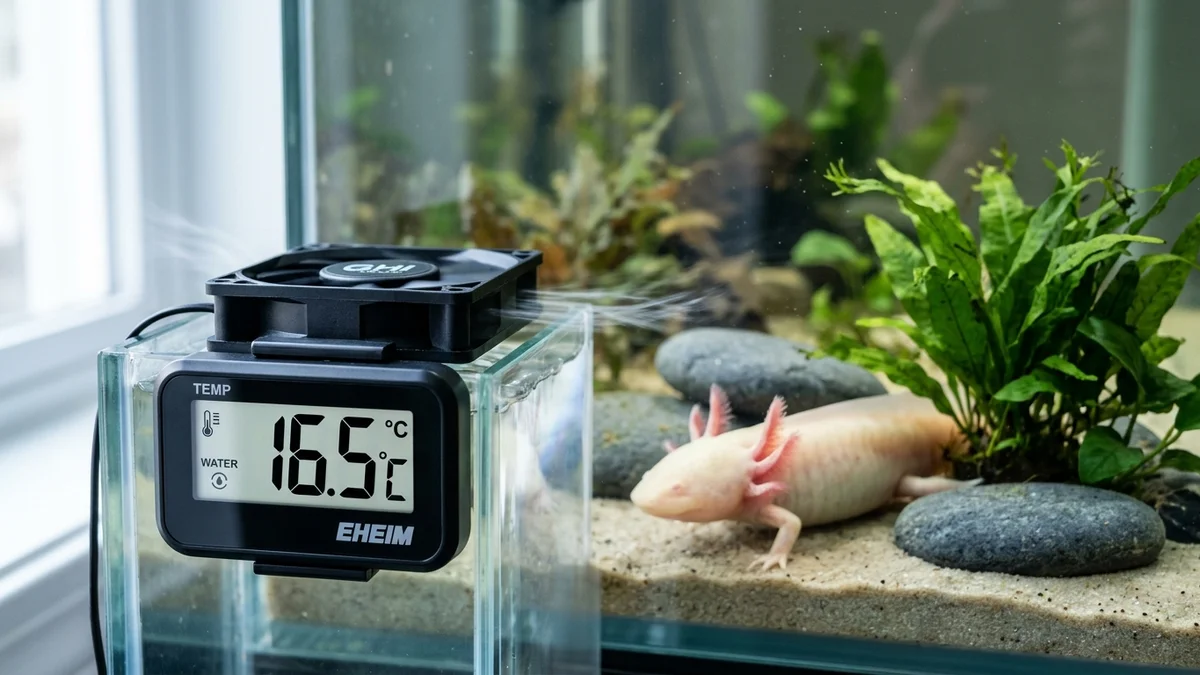
| Fan across the water surface | Evaporation cools the water | Raises water loss; top up with conditioned water; cooling is limited by humidity and room temperature | NSW describes a damp towel with a fan during heat waves |
| Aquarium chiller | Actively removes heat | Cost, size, noise, power; needs correct sizing | Editorial |
| Frozen bottles | Ice absorbs heat as it melts | Short-lived; can cause temperature swings if used carelessly; does not solve sustained heat | Editorial inference |
| Placement and shade | Avoids sun, draughts and heat sources | Does not help if the room itself is hot | OATA, NSW |
| Larger water volume | Changes more slowly | Not a cooling method | OATA, LafeberVet |
Aquarium Fans and Evaporative Cooling
Aquarium cooling fans work by blowing air across the water surface, accelerating the rate of evaporation that carries latent heat away from the aquarium. In practical aquarium guidance (such as JBL and Aquasabi), fans are often described as capable of achieving an indicative temperature reduction of approximately 1–4°C (frequently cited as 2–4°C under favorable conditions). However, this temperature drop is not a universal or guaranteed outcome. Physically, evaporative cooling is fundamentally governed by the ambient air's relative humidity and is bounded by the local wet-bulb temperature (ASHRAE Handbook; University of Florida IFAS Extension). High ambient relative humidity severely diminishes the psychrometric potential, meaning water cannot be cooled below the room's wet-bulb boundary. Actual cooling performance also depends on the tank's exposed surface area, airflow velocity, ongoing heat inputs from submersible filters and lighting, and ambient room temperature swings. Furthermore, accelerated evaporation removes pure water vapor while leaving dissolved minerals behind, causing mineral concentrations and general hardness to rise over time if topped off with ordinary tap water. To prevent this progressive mineral concentration, evaporative losses should generally be topped off using suitable low-mineral or demineralized water (such as RO/DI or distilled water), as explicitly recommended in aquarium cooling guidance by Aquasabi, while routine water parameters are monitored. Crucially, evaporative top-offs must not be confused with routine water changes: actual water changes remove accumulated nitrates and dissolved organic wastes, and replacement water must be prepared to maintain suitable aquarium parameters. While tap water typically requires conditioning and dechlorination, pure RO/DI water contains negligible mineral content and little or no buffering capacity; using it without appropriate remineralization or blending can lower or destabilize GH, KH, and pH relative to the axolotl's required parameters (such as the 7–14 dGH, 3–8 dKH, and pH 7.4–8.0 baseline in our axolotl water parameters guide, or the 7–14° GH, 3–7° KH, and 7.2–8.4 pH range reported by Axolotl Central). Use the Axolotl Tank Cooling & Chiller Calculator to evaluate your room's psychrometric limit and determine whether active refrigeration is necessary.
Room Air Conditioning
Cooling the room is effective if it runs through the hottest hours.
Aquarium Chillers
A chiller is the most controllable option. Choose one rated for your tank volume and climate.
Frozen Bottles: Limitations and Risks
Sealed bottles of ice can lower the temperature briefly, but the temperature then rises as the ice melts. Add them only if the thermometer shows the change is gradual (editorial inference).
Preventing Sudden Temperature Changes
Do not add large amounts of cold water at once. The water change guidance in the axolotl care guide says to match replacement water temperature.
Does an Axolotl Need an Aquarium Heater?
Why Tropical Fish Heater Advice Does Not Apply
Tropical fish advice sets a warm target. The axolotl sources set a cool ceiling, and warm water is the stated hazard.
When Heating Might Be Necessary
OATA's general list says a heater may be needed for some species, and its axolotl range starts at 10 C. A heater is relevant only if your measured water falls below the range you are following. Most of the cited sources focus on overheating instead.
How to Avoid Overheating
If you use a heater, use a thermostat with a separate thermometer to confirm the real temperature.
Seasonal Temperature Management
Preparing for Summer
Choose a cool room, away from windows, before the hot season. Decide on a cooling method in advance and test it.
Managing Heat Waves and Power Failures
Plan for a power cut that stops fans, chillers and filters: a battery air pump and a stock of conditioned water are common precautions (editorial). Elevated temperatures above 24°C cause acute physiological stress, increase oxygen demand, and trigger opportunistic infections—review our guide on identifying heat stress, fungal tufts, and floating symptoms for emergency supportive care. If water reaches the sources' limits, contact an exotic-animal veterinarian or a specialist for advice.
Monitoring Overnight Fluctuations
Record the maximum and minimum for several days after you start a cooling method. For the full list of needs, see the axolotl aquarium setup guide and the guide to choosing the right axolotl aquarium.