
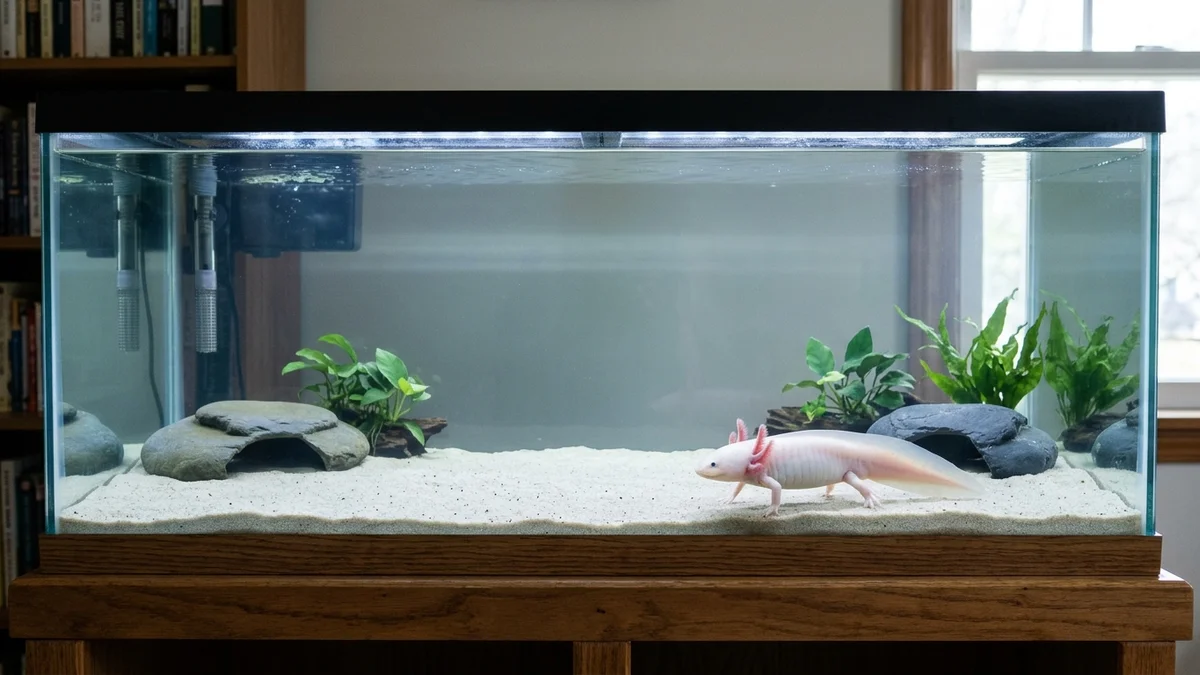
What size tank does an axolotl need? There is no single agreed answer. For one adult, sources range from 78 L (20 US gal) to 40 US gal (151 L), and floor area matters more than height. This page compares the figures, explains why they differ and shows how to calculate your real water volume.
What Size Tank Does an Axolotl Need?
There is no single agreed minimum. For one adult, published figures range from 78 L (20 US gal) to 40 US gal (151 L). Published recommendations differ. This page shows each source's figure instead of selecting one.
| Source | Tank size or footprint | Notes |
|---|---|---|
| LafeberVet (veterinary care sheet, 2021) | Young: 38 L (10 US gal). Adult: minimum 78 L (20 US gal) | Larger is better for stability. Adults can often share if volume is large; be ready to separate. |
| OATA (UK trade association) | At least 100 L (26 US gal) for a small group | Make the tank as long and wide as possible. |
| American Axolotl Organization (specialist group) | 40 US gal (151 L) recommended; 30 US gal (114 L) only with 2+ weekly 50% changes; footprint at least 4 sq ft | Cohabiting: about 30 US gal more per extra axolotl, with plenty of floor space. |
| NSW Education (school standard) | 60 x 30 x 30 cm per adult pair (54 L gross); water 20-25 cm deep | A minimum for animals in schools, not a home-pet recommendation. |
| SPCA NZ (welfare charity) | No volume given; 'the bigger the tank the better' | Advises against housing axolotls together. |
Minimum Tank Size for One Adult Axolotl
The lowest figure from a veterinary home-care source is LafeberVet's 78 L (20 US gal) for an adult. Note that 20 US gal is 75.7 L, so the rounded litre figure is slightly above it. OATA and the American Axolotl Organization ask for more. The NSW figure applies to school housing and is not a home recommendation.
A More Generous Long-Term Aquarium
If your space allows, the larger recommendations leave room for error. The American Axolotl Organization says a 30 US gal tank can work only with at least two 50% water changes a week.
Why a Larger Aquarium Can Be Easier to Maintain
OATA and LafeberVet say that larger tanks keep temperature and water quality more stable. LafeberVet also says filtration should never replace regular water changes. Read the complete axolotl care guide for the other requirements. Once you have chosen a suitable footprint and capacity, use the axolotl tank setup guide to plan filtration, substrate, hides and cycling.
Axolotl Tank Size by Number of Animals
Tank Planning for One Axolotl
Plan for the adult size, about 23-25 cm and up to 30 cm (VCA, OATA), not the juvenile size you bring home.
Tank Planning for Two Axolotls
Sources conflict. The American Axolotl Organization suggests about 30 US gal more for each additional animal, which would make 70 US gal for two on its 40-gallon baseline. NSW sets 60 x 30 x 30 cm as a school minimum for a pair. SPCA NZ advises against housing them together. Treat these as reported figures, not a rule. Review our detailed cohabitation and tank mate guidelines before planning multiple housing.
Planning Housing for Three or More Axolotls
OATA allows groups of similar-sized animals with adequate space. LafeberVet recommends being ready to separate fighting adults. Keep a spare tank available.
Why Tank Capacity Is Not a Simple Per-Animal Formula
Waste output depends on the animal's size, feeding and the filter. Only one source gives a per-animal figure, and it is not supported by a study in the sources reviewed, so this guide does not turn it into a formula.
Axolotl Tank Dimensions: Length, Width and Height
Why Floor Area Matters
Axolotls spend most of their time on the bottom. OATA recommends tanks that are as long and wide as possible, and the American Axolotl Organization specifies a footprint of at least 4 sq ft (3,716 cm2).
Long Versus Tall Aquariums
Height adds volume without adding floor space, and axolotls do not use the upper water. NSW specifies water 20-25 cm deep, so depth beyond that has no stated benefit in these sources.
Comparing Aquarium Footprints
The table is arithmetic on example dimensions. Tank A and Tank B hold the same 160 L, but Tank B has half the floor area and fails the 4 sq ft footprint.
| Example tank (illustrative) | Internal L x W x H (cm) | Gross volume | Floor area | Meets 4 sq ft? |
|---|---|---|---|---|
| A. Long | 100 x 40 x 40 | 160 L (42.3 US gal) | 4,000 cm2 (4.31 sq ft) | Yes |
| B. Tall | 50 x 40 x 80 | 160 L (42.3 US gal) | 2,000 cm2 (2.15 sq ft) | No |
| C. NSW pair minimum | 60 x 30 x 30 | 54 L (14.3 US gal) | 1,800 cm2 (1.94 sq ft) | No |
| D. Wide | 90 x 45 x 45 | 182 L (48.1 US gal) | 4,050 cm2 (4.36 sq ft) | Yes |
Measuring Internal Tank Dimensions
Measure inside the glass, not outside. Glass thickness can reduce each dimension by one or two centimetres, which matters for volume.
Axolotl Tank Size in Gallons and Litres
US Gallons to Litres
One US gallon is 3.785 litres. A UK gallon is larger (4.546 L), so check which one a listing uses.
| US gallons | Litres |
|---|---|
| 10 | 37.9 |
| 20 | 75.7 |
| 30 | 113.6 |
| 40 | 151.4 |
| 55 | 208.2 |
Common Aquarium Sizes
Labels give nominal capacity, and the same number of gallons can have different dimensions. Check length and width as well as the volume.
Gross Volume Versus Actual Water Volume
Water level, sand, rocks and hides reduce the volume of water. Dosing, medication and water-change maths use the water volume, not the label. See the section on calculating it below.
Does an Axolotl Need a Bigger Tank as It Grows?
Juvenile Housing Considerations
LafeberVet says a young axolotl can live in 38 L (10 US gal) and recommends housing young animals separately because of cannibalism.
Adult Housing Requirements
LafeberVet's adult minimum is 78 L (20 US gal). Moving to a bigger tank later means another cycled tank, so many keepers buy the adult tank first. This is a practical suggestion, not a source claim.
Planning for Long-Term Growth
Axolotls live 10-15 years or longer (VCA, LafeberVet, SPCA NZ). Choose a tank you can maintain for the whole period.
How Tank Size Affects Water Quality
Waste Accumulation
The same amount of waste dilutes more in more water. LafeberVet says water-quality parameters become more stable as volume increases.
Biological Filtration
A larger tank offers more room for filter media. See axolotl water quality requirements for target values.
Temperature Stability
OATA says larger tanks keep conditions more stable. For cooling, see maintaining a cool axolotl aquarium.
Water Changes and Maintenance
Smaller tanks need more frequent changes. The water change calculator helps you plan the volume to replace.
How to Calculate Actual Axolotl Aquarium Water Volume
Volume calculators give numbers; they cannot tell you whether a tank is suitable for an axolotl. Use the calculate aquarium volume from dimensions for gross volume and the estimate your actual aquarium water volume for displacement. To check benthic floor area and compare dimensions against published guidelines, use our dedicated Axolotl Tank Size & Benthic Area Checker.
| Step | Example (90 x 45 x 45 cm internal tank) | Result |
|---|---|---|
| Gross internal volume | 90 x 45 x 45 / 1000 | 182.3 L |
| Volume at the waterline (40 cm water depth) | 90 x 45 x 40 / 1000 | 162.0 L |
| Subtract substrate and decor displacement (assume 8 L) | 162.0 - 8 | 154.0 L |
Measuring Internal Dimensions
Measure length, width and water depth in centimetres, then divide the product by 1,000 to get litres.
Accounting for Substrate and Decorations
Fill a bucket to a known volume and see how much water a rock or hide displaces, or use a calculator estimate.
Why Actual Water Volume Matters for Dosing
Conditioner and treatment doses are set per volume of water. A 10% error in volume is a 10% error in dose. For treatments, ask an exotic-animal veterinarian, because OATA advises half doses for scaleless amphibians.