
Algae Bloom
Technical Specifications & Benchmark Matrix
Overview
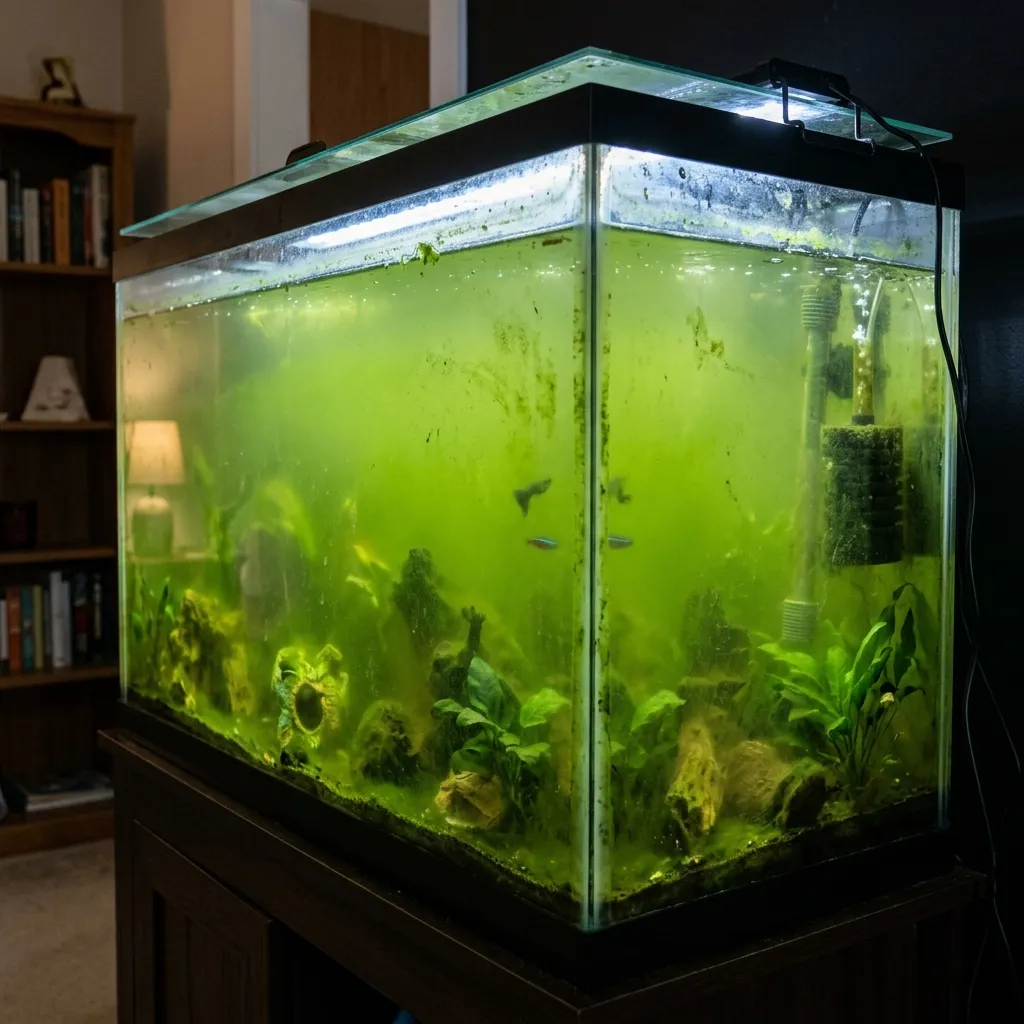
You walk past the tank you checked yesterday and it looks like pea soup. No warning, no gradual change — just an overnight shift from crystal clear to a green haze you can barely see through. Algae bloom is a rapid population explosion of free-floating, single-celled algae, most commonly Chlorella or Euglena, that suspends throughout the water column rather than growing on surfaces. It's one of the most common water-quality complaints I see in freshwater tanks, and it's almost never actually sudden. The conditions build for days before the bloom becomes visible. Unlike diatom bloom, which coats the glass and substrate in a brown dusty film, or cyanobacteria, which forms slimy blue-green mats on rocks and decorations, green water algae bloom clouds the entire tank uniformly. Fish are rarely in immediate danger from the algae itself, but a severe die-off afterward can crash dissolved oxygen fast enough to matter.
Causes
Algae bloom happens when light and dissolved nutrients are both available in excess at the same time, and free-floating algae exploit that combination faster than almost anything else in the tank. Photoperiods longer than 8-10 hours give algae more energy than they need. Nitrate above 20 ppm or phosphate above 1 ppm supplies the fuel. Overfeeding is the single most common root cause I encounter — uneaten food breaks down into ammonia, converts to nitrate, and directly feeds the bloom within days. New tank syndrome contributes too: a tank cycling for the first time often has nutrient spikes before biological filtration catches up, and hobbyists who add fish too early see green water as a predictable consequence. Infrequent water changes let nitrate and phosphate accumulate past the threshold where algae outcompetes everything else for those nutrients.
Identification
Green water algae bloom is identified by uniform green cloudiness suspended through the entire water column, distinct from surface-growth algae types. Hold a white card behind the glass — if you can't make out the shape through six inches of water, that's a bloom, not surface algae. Diatom bloom, by contrast, appears as a brown dusty coating on glass and decorations while the water itself stays clear. Cyanobacteria, despite the common name blue-green algae, is technically a photosynthetic bacteria, not algae at all, and it forms slimy mat-like colonies on surfaces rather than clouding water — it also often carries a distinct musty odor that green water bloom does not. Getting this identification right matters because the treatments don't overlap: UV sterilizers clear green water bloom efficiently but do nothing for cyanobacteria mats, which usually need reduced light and sometimes antibiotic-class treatment.
Treatment and Fast Fixes
The fastest way to clear an active green water bloom is a UV sterilizer sized to your tank's flow rate, which ruptures algae cell walls as water passes the bulb and typically clears visible green tint within 3-7 days. A 3-4 day blackout — covering the tank completely to cut off light — works nearly as fast and costs nothing, though I don't recommend it past 4 days in a planted tank since your plants stop photosynthesizing right along with the algae. Flocculant or clarifier products clump algae particles so your filter can catch them, and they work within 24-48 hours, but this is the step most beginners stop at: they clear the water and assume the problem is solved, without touching the nutrient load that caused it in the first place. That bloom comes back within a week almost every time. A large water change dilutes algae concentration immediately, which feels like progress, but on its own it doesn't remove the underlying nitrate or phosphate driving regrowth.
Long-Term Prevention
Preventing recurrence means treating the cause, not just clearing the symptom each time it appears. Cut your photoperiod to 6-8 hours and keep it on a consistent timer — inconsistent lighting schedules are an underrated trigger I see in client tanks constantly. Feed only what fish consume within two minutes, once or twice daily; this alone resolves a meaningful share of recurring bloom cases. Test nitrate and phosphate weekly during the first month after a bloom, aiming to keep nitrate under 10-20 ppm through water changes or live plant uptake, which functions as ongoing nutrient export. Live, fast-growing plants like hornwort or water sprite compete directly with algae for the same dissolved nutrients and can meaningfully suppress bloom recurrence over several weeks. If bloom keeps returning despite addressing light and feeding, run a UV sterilizer continuously rather than reactively — it's a maintenance tool as much as a treatment.
Run Precision Calculations For Your Setup
Check species compatibility, volumetric displacement, and filtration turnover benchmarks for your specific aquarium parameters.
🐟 Associated Species Profiles & Susceptibility
Browse All Fish Profiles →
⚙ Diagnostic & Sizing Calculators
Estimate a single water-change percentage and volume to dilute measured nitrate toward a selected target.
Dial in the perfect photoperiod for your aquarium. Enter your tank type, plant density, and viewing schedule to calculate the optimal daily light duration that fuels plant growth, suppresses nuisance algae, and gives your fish a healthy day/night cycle — without guesswork.
Estimate the net usable water volume in your aquarium.
Algae Bloom Treatment Methods Compared
| Method | Effectiveness | Cost | Time to Clear | Side Effects |
|---|---|---|---|---|
| UV Sterilizer | High – continuously ruptures free-floating algae cells | Moderate ($40–120 unit, ongoing bulb replacement every 6-8 months) | 3–7 days | Low – safe for fish and plants, no die-off oxygen crash |
| Blackout method (3-4 days) | High – starves algae of light entirely | Free | 3–4 days | Moderate – stresses live plants, risk of oxygen drop from die-off |
| Flocculant/clarifier products | Moderate – clumps algae for filter removal, doesn't address cause | Low ($8–15 per bottle) | 24–48 hours | Low – but bloom returns fast if nutrients/light untreated |
| Photoperiod reduction + water changes | Moderate-High – treats root cause, slower visible results | Free | 7–14 days | None – safest long-term approach, prevents recurrence |
Frequently Asked Questions
What causes algae bloom in a fish tank?
How fast can green water develop?
Does a UV sterilizer actually clear green water?
Is algae bloom harmful to my fish?
Will adding more fish food make algae bloom worse?
Can I just do a 100% water change to fix green water?
What is the blackout method and is it risky?
How is green water different from a diatom or cyanobacteria bloom?
Sources & References
- Publisher:Springer
- Accessed:2026-10-14
- Publisher:Wiley-Interscience
- Accessed:2026-10-14
- Phytoplankton Population Dynamics in Closed Freshwater Systems
- Source:Journal of Aquatic Plant Management
- UV Sterilization Efficacy Against Suspended Algae in Aquaria
- Source:Aquacultural Engineering Society
- Nutrient Loading and Algal Bloom Thresholds in Ornamental Aquaria
- Source:American Association of Fish Veterinarians