
Otocinclus Catfish (Otocinclus spp.)
Quick Answer
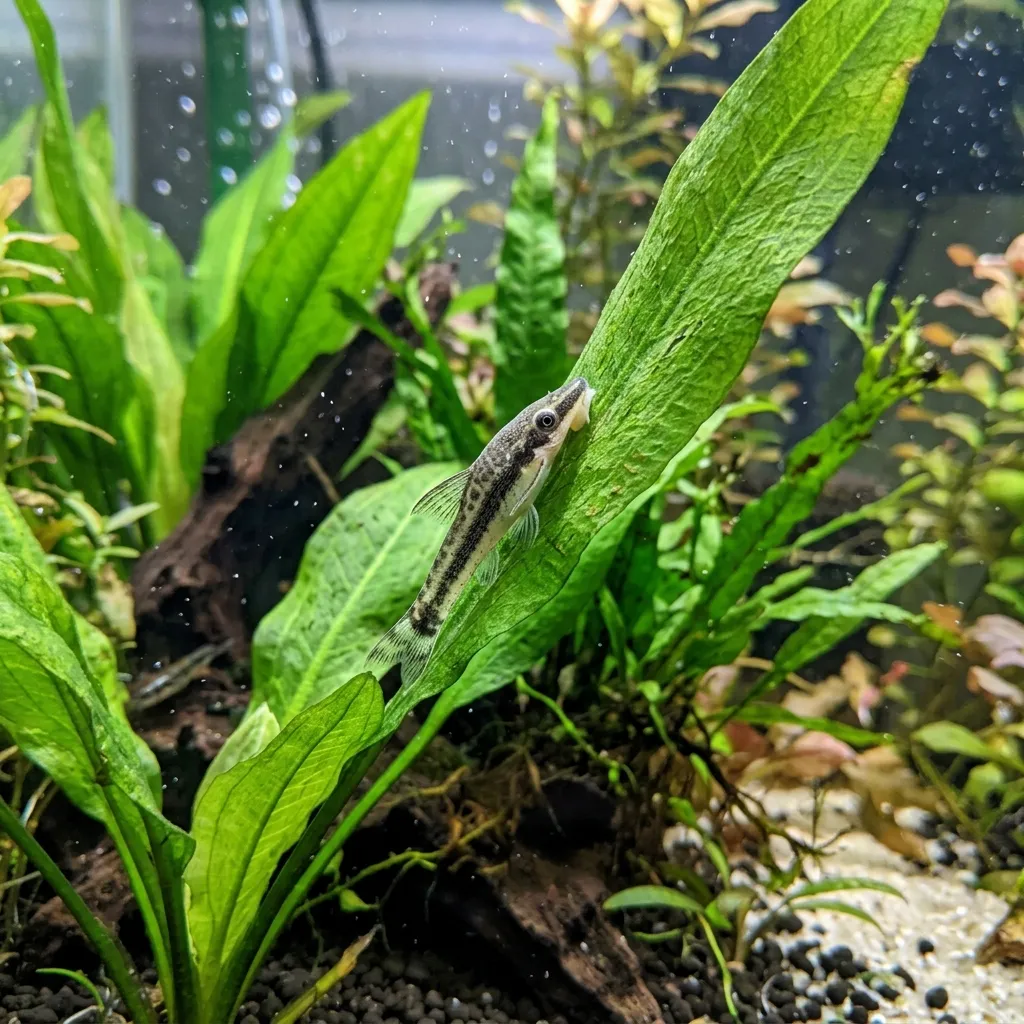
Otocinclus Catfish (Otocinclus spp.) are small, peaceful, schooling herbivores native to South America. They require a minimum 10 gallon (38 liter) aquarium with established algae growth, pH 6.0 - 7.5, and temperature 72 degrees F - 79 degrees F (22 degrees C - 26 degrees C). Keep in groups of 6 or more. They are scaleless and extremely sensitive to copper and medications.
Quick Facts
| Scientific Name | Otocinclus spp. |
|---|---|
| Common Names | Otocinclus Catfish |
| Family | Loricariidae |
| Genus | Otocinclus |
| Type | Freshwater |
| Temperament | peaceful |
| Care Difficulty | intermediate |
| Lifespan | 5 years |
| Maximum Size | Up to 2 in (5 cm) |
| Diet | Herbivore |
| Temperature | 72–79°F (22–26°C) |
| pH | 6–7.5 |
| Hardness | 2–12 dGH |
| Minimum Size | 10 gallons |
Key Takeaways
- Keep in groups of 6 or more to prevent stress and starvation.
- Requires a mature, algae-established tank - never add to new tanks.
- Strict herbivore diet of algae, biofilm, and blanched vegetables.
- Scaleless and extremely sensitive to copper-based medications and fertilizers.
- Use 2-hour drip acclimation to prevent osmotic shock.
- Minimum tank size 10 gallons; recommended 20+ gallons.
- Compatible with shrimp, snails, and peaceful community fish.
Overview
Overview
Otocinclus Catfish, affectionately known as Otos or Ottos, are among the most beloved algae-eating fish in the freshwater aquarium hobby. These tiny catfish belong to the family Loricariidae and are native to the slow-moving, heavily vegetated streams and rivers of South America, ranging from northern Venezuela to northern Argentina.
Despite their diminutive size of just 1.5 to 2 inches (4 to 5 cm), Otocinclus are powerhouse algae grazers. Their specialized sucker mouths are perfectly adapted for scraping soft algae and biofilm (aufwuchs) from plant leaves, driftwood, and aquarium glass. In the wild, they form massive schools numbering in the hundreds or even thousands, a behavior they retain in captivity.
However, Otocinclus have a reputation for being challenging to keep. The vast majority available in the aquarium trade are wild-caught, often stressed, underfed, and exposed to harmful capture chemicals. Their survival depends entirely on proper acclimation, established algae growth, stable water parameters, and appropriate group sizes. This guide provides the expert-level knowledge you need to keep these remarkable fish thriving.
Diet
Diet and Feeding
Otocinclus are obligate herbivores. In the wild, they consume algae, biofilm (aufwuchs), and periphyton growing on submerged surfaces. Their digestive systems are specifically adapted for this diet. Providing the correct nutrition is one of the biggest challenges in keeping Otos successfully.
Health
Health and Disease Management
Otocinclus are notoriously fragile when first introduced to aquariums. Their scaleless bodies and wild-caught origins make them particularly susceptible to disease and medication toxicity. Proactive health management is essential.
Starvation and Sunken Belly
The most common cause of death in Otocinclus. Wild-caught specimens often arrive malnourished and fail to recognize prepared foods.
- Hollow, concave belly; lethargy; hiding; loss of color; refusal to graze.
Insufficient algae in new tanks; refusal to eat prepared foods; competition from other algae eaters; organ damage from capture chemicals.
Only add to established tanks with visible algae. Grow an algae farm as backup food. Drip acclimate properly. Maintain groups of 6 or more to reduce stress-related appetite loss.
Osmotic Shock
Rapid changes in water chemistry during transport or acclimation cause fatal physiological stress.
- Sudden death within 24-48 hours of introduction; clamped fins; erratic swimming; gasping at surface.
Floating bag acclimation only; failure to match pH, temperature, and hardness between transport water and tank water; exposure to chlorinated water.
Use 2-hour drip acclimation minimum. Match water parameters closely. Never add directly from bag to tank. Test transport water parameters if possible.
Copper Toxicity
Otocinclus are scaleless and extremely sensitive to copper, which is found in many medications, fertilizers, and fish foods.
- Rapid breathing; loss of coordination; darkening of skin; death within 48 hours at concentrations as low as 0.575 mg/L.
Copper-based medications (e.g., copper sulfate); copper-containing plant fertilizers; some commercial fish foods; untreated tap water with copper pipes.
Use only copper-free fertilizers and medications. Quarantine with praziquantel or metronidazole (half-dose) instead of copper treatments. Use RO water if copper pipes are suspected.
Ich (White Spot Disease)
Common parasitic infection triggered by stress from transport and poor acclimation.
- White salt-like spots on body and fins; rubbing against objects; rapid gill movement; clamped fins.
Stress-induced immune suppression; introduction via infected tank mates; poor water quality.
Quarantine all new fish for 2-3 weeks. Maintain stable water parameters. If treatment is necessary, use heat (86 degrees F / 30 degrees C) combined with half-dose formalin or aquarium salt (less than 2 ppt). Avoid standard copper-based ich treatments.
Bacterial Infections
Secondary infections often following starvation, injury from rough substrate, or poor water quality.
- Bloated or unusually distended belly; red streaks on fins or body; fin rot; ulcers; lethargy.
Injury from sharp gravel; high ammonia or nitrite; organ damage from capture chemicals; overcrowding.
Use smooth substrate only. Maintain 0 ppm ammonia and nitrite. Perform weekly 25 percent water changes. Quarantine new fish. Treat with broad-spectrum antibiotics (e.g., kanamycin) if confirmed.
Nitrate Poisoning
Otocinclus are highly sensitive to nitrate accumulation, which damages their gills and immune system.
- Lethargy; gasping at surface; red or inflamed gills; loss of appetite; increased susceptibility to disease.
Infrequent water changes; overstocking; overfeeding; inadequate filtration.
Maintain nitrates below 20 ppm (ideally below 10 ppm). Perform weekly 25-30 percent water changes. Use live plants to absorb nitrates. Test water parameters weekly.
Breeding
Breeding Otocinclus Catfish
Breeding Otocinclus in captivity is challenging but achievable with dedication. Success requires pristine water conditions, proper conditioning, and simulation of natural breeding triggers.
Compatible Tank Mates






Species Comparison
| Feature | Otocinclus Catfish | Siamese Algae Eater | Bristlenose Pleco | Amano Shrimp |
|---|---|---|---|---|
| Adult Size | 1.5 - 2 inches (4 - 5 cm) | 5 - 6 inches (13 - 15 cm) | 4 - 5 inches (10 - 13 cm) | 2 inches (5 cm) |
| Temperament | Peaceful, schooling | Semi-aggressive, territorial | Peaceful, solitary | Peaceful, scavenging |
| Minimum Tank Size | 10 gallons (38 L) for 6+ | 30 gallons (114 L) | 20 gallons (76 L) | 5 gallons (19 L) |
| Primary Diet | Herbivore (algae, biofilm) | Omnivore (algae, pellets) | Herbivore (algae, wood) | Omnivore (algae, detritus) |
| pH Range | 6.0 - 7.5 | 6.5 - 7.5 | 6.5 - 7.5 | 6.5 - 7.5 |
| Shrimp Safe | Yes - 100% shrimp safe | No - may harass shrimp | Yes - generally safe | N/A - is a shrimp |