
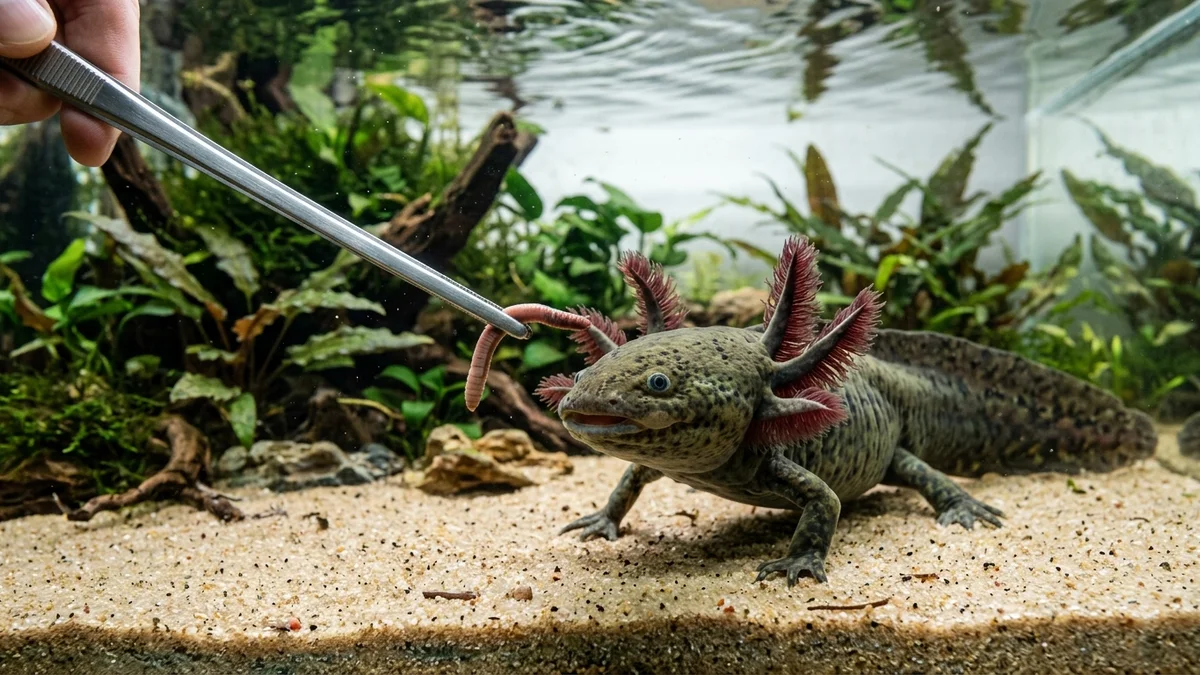
What do axolotls eat and how often? Axolotls are carnivores. Sources list earthworm pieces, blackworms, frozen bloodworms, brine shrimp and salmon or carnivore pellets. Juveniles are fed daily, and adult schedules range from daily to 2-3 times a week. Feed only what is eaten in a few minutes and remove leftovers. If you are wondering what to feed an axolotl, start with earthworm pieces, blackworms or carnivore pellets, cut to a size the animal can swallow. For the wider habitat, water-quality and husbandry requirements, see our complete axolotl care guide.
What Do Axolotls Eat?
Axolotls are carnivores that eat invertebrate prey (VCA, LafeberVet, OATA). Sources differ on some foods, so the table lists the source for each.
| Food | What sources say | Cautions |
|---|---|---|
| Earthworms (nightcrawlers, red wigglers) | American Axolotl Organization: staple. LafeberVet: portions of nightcrawlers. NSW: earthworms. | AAO: avoid dyed or wild-caught worms. Cut to a swallowable size. |
| Blackworms | VCA and LafeberVet list fresh or frozen blackworms | Source from a reliable supplier. |
| Frozen bloodworms and brine shrimp | VCA and LafeberVet list them; OATA suggests them for smaller animals | Use as a supplement; the AAO does not treat them as a staple. |
| Salmon or carnivore pellets | VCA, LafeberVet, NSW, OATA (specialist pellets) | Some animals take time to accept them. LafeberVet example: about 5 salmon pellets per adult. |
| Prawns, mussels, cockles | OATA for larger animals | Cut to a swallowable size. |
| Small feeder fish | VCA lists them | AAO warns of thiaminase and fish bones. LafeberVet and OATA do not list fish as food. Not recommended here. |
| Strips of lean beef, chicken or fish | NSW lists them | AAO warns that mammal and land-animal meat is high in fat and unsuitable. Not recommended here. |
Earthworms
The American Axolotl Organization treats earthworms as the staple. Cut them into pieces your animal can swallow. LafeberVet lists nightcrawler portions.
Suitable Aquatic Invertebrates
Blackworms, frozen bloodworms and frozen brine shrimp are listed by VCA and LafeberVet. OATA lists prawns, mussels and cockles for larger animals.
Commercial Axolotl and Carnivore Pellets
NSW says most axolotls eventually learn to take pellets and usually prefer softer ones; OATA says weaning can take time. Introduce them alongside live or frozen food.
Foods That Should Be Limited or Avoided
Feeder fish carry thiaminase and bone risks (AAO). Mammal and poultry meat is not recommended. Nutritional percentages and calcium ratios vary by source and are not given here. SPCA NZ advises a calcium or multivitamin supplement, while others do not mention it. Ask an exotic-animal veterinarian before supplementing.
How Often Should You Feed an Axolotl?
Frequency and meal length differ. Published recommendations differ. This page shows each source's figure instead of selecting one.
| Source | Juveniles | Adults | Meal length |
|---|---|---|---|
| VCA (veterinary) | Daily | Every 2-3 days | 2-5 minutes |
| LafeberVet (veterinary) | Daily | 2-3 times a week | 2-3 minutes |
| SPCA NZ (welfare) | Not stated | Every second day | Not stated |
| NSW Education (school) | More often than adults | 3 times a week | About 1 hour |
| OATA (trade association) | Not separated | Once a day (group guide for aquatic frogs and axolotls) | About 15 minutes |
Feeding Juveniles
VCA and LafeberVet say young animals are fed daily. Cut food to a size they can swallow.
Feeding Adults
Adult schedules range from daily (OATA group guide) to 2-3 times a week. A less frequent schedule with portions the animal finishes is the lower-risk end, because VCA calls obesity common and says overfeeding shortens life.
Adjusting Portions to Appetite and Body Condition
No source gives a body-condition score. Watch for leftover food and for a visibly rounding body, and cut portions if either appears. Ask a veterinarian if weight changes quickly.
How Much Food Should an Axolotl Eat?
Portion Size
LafeberVet gives an example of about 5 salmon pellets per adult for a 2-3 minute meal. VCA says to offer only what can be eaten in 2-5 minutes. NSW allows about an hour. Begin with less, then adjust. To calculate monthly feed quantities and budget ongoing food expenses, refer to our axolotl feeding cost breakdown.
Recognising Overfeeding
Signs are uneaten food, rising ammonia or nitrate, and weight gain. VCA and LafeberVet list obesity as a risk.
Removing Uneaten Food
Remove it promptly (OATA, VCA, NSW). Decaying food releases ammonia. See maintaining good axolotl water quality.
How to Feed an Axolotl
Feeding Tongs
Tongs or tweezers let you place food in front of the animal and control the portion.
Target Feeding
SPCA NZ and NSW suggest wiggling food, because axolotls respond to movement. Dropping food in the open lets waste collect.
Reducing Food Waste
Offer small amounts and remove leftovers after a few minutes. Siphon the bottom during water changes. OATA also advises washing hands before and after contact with the tank.
Swallowed Substrate
Axolotls can swallow material from the tank bottom. VCA advises avoiding small rocks and pebbles. LafeberVet says sand can still be swallowed and suggests either rocks larger than the animal's head or a bare bottom. SPCA NZ says anything smaller than the head is eaten. If you suspect your animal has swallowed something, or it stops eating or looks bloated, contact an exotic-animal veterinarian.
Why Is My Axolotl Not Eating?
Loss of appetite is a symptom, not a diagnosis. VCA lists poor water quality, intestinal parasites and bacterial or fungal infections as possible causes.
Temperature-Related Appetite Changes
LafeberVet says water above 24 C can cause loss of appetite. Check the thermometer first. See checking axolotl water temperature.
Water-Quality Problems
Test ammonia, nitrite and nitrate. If you need the broader husbandry context behind those readings, see the axolotl care guide.
Stress and Environmental Changes
OATA says new animals are easily stressed by light, noise, movement and temperature.
When to Contact an Exotic-Animal Veterinarian
Contact one if the animal refuses food persistently, floats, looks bloated or shows other changes—consult our emergency axolotl diagnostic checklist to evaluate curled gills, floating, or impaction signs before seeking medical care. SPCA NZ recommends check-ups every 6-12 months. This page does not replace veterinary assessment.