
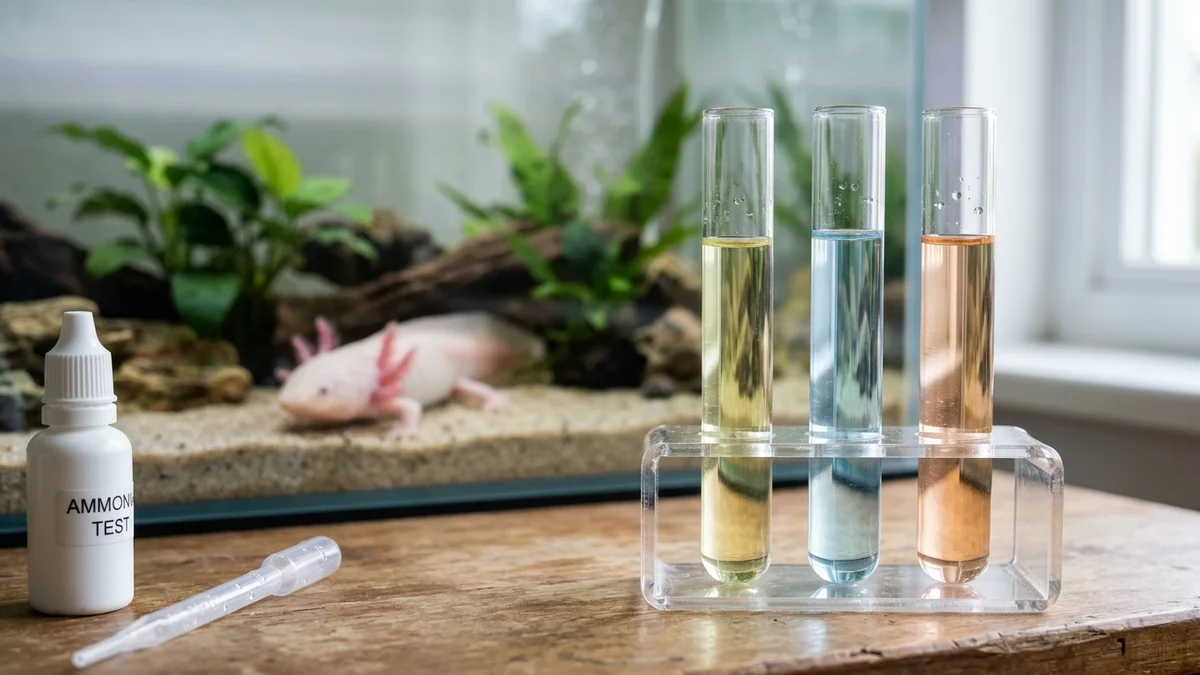
What water parameters does an axolotl need? Zero ammonia and zero nitrite are agreed. Temperature, pH, nitrate and hardness figures differ between sources, so this page shows each one. Test weekly with a liquid kit and avoid sudden changes. For the wider husbandry picture, see the complete axolotl care guide.
Ideal Axolotl Water Parameters
Published values differ, so the table shows each source rather than one set of numbers. OATA's ranges are described as a general guide for aquatic frogs and axolotls. NSW is a school standard. All figures are in mg/L (the same as ppm).
| Parameter | Published values | Note |
|---|---|---|
| Temperature | OATA 10-22 C; NSW 15-18 C (never above 22 C); LafeberVet 15.6-17.8 C; SPCA NZ 17-18 C | OATA and NSW give ranges, LafeberVet and SPCA NZ give preferred values; two sources warn about 24 C |
| pH | OATA 7.0-8.0; NSW 6.5-8.0; LafeberVet 7.4-7.6 ideal; SPCA NZ 6.5-7.5 | Overlap of the three ranges: 7.0-7.5 (arithmetic) |
| Ammonia | 0 mg/L (OATA, LafeberVet) | Needs a cycled tank |
| Nitrite | 0 mg/L (OATA, LafeberVet) | VCA: excess nitrite may cause bulging eyes |
| Nitrate | OATA: not above 20 mg/L over tap water; LafeberVet: below 10 ppm | Depends on tap nitrate |
| General hardness (GH) | OATA: 8-18 dH (143-321 mg/L as CaCO3); NSW: not extremely soft or distilled | OATA's figure is for aquatic frogs and axolotls as a group |
| Carbonate hardness (KH) | OATA: 10-15 dKH (178-268 mg/L as CaCO3) | Only one source gives a KH range |
Temperature
Temperature has its own guide: ideal axolotl water temperature. Convert: 15 C = 59.0 F, 18 C = 64.4 F, 22 C = 71.6 F, 24 C = 75.2 F.
pH
The ranges overlap at 7.0-7.5. LafeberVet's ideal of 7.4-7.6 sits mostly in that overlap. This is an inference from four published values, not a tested optimum. Learn how pH affects water chemistry in the aquarium pH guide.
Ammonia
Zero. OATA says even small amounts of ammonia and nitrite can stress these animals and may lead to disease.
Nitrite
Zero. VCA says excess nitrite may make the eyes bulge.
Nitrate
Nitrate builds up between water changes. OATA allows up to 20 mg/L above your tap water, and LafeberVet says below 10 ppm. Check whether your kit reports nitrate as nitrate (NO3) or as nitrate-nitrogen (NO3-N), as the two numbers are not the same.
General Hardness and Carbonate Hardness
Only OATA gives numbers (GH 8-18 dH, KH 10-15 dKH, as a group guide). NSW only says not to use extremely soft or distilled water. Test your tap water first. Do not change hardness unless a measurement shows a need. See general hardness, carbonate hardness and the GH/KH remineralization calculator to understand the chemistry.
Why Ammonia and Nitrite Must Be Controlled
How Ammonia Enters the Aquarium
Ammonia comes from the animal's waste, uneaten food and decaying matter.
Why Biological Filtration Matters
Bacteria turn ammonia into nitrite and then nitrate. OATA calls the result of too few bacteria 'new tank syndrome'. See our dedicated guide on how to cycle an axolotl aquarium.
Signs of a Water-Quality Problem
OATA lists hanging at the surface, sitting on the bottom, erratic swimming, colour changes, hiding, breathing changes, white spots or fluffy growths, and reduced appetite. These signs are not a diagnosis. For symptom checklists and emergency care, consult our axolotl health and disease troubleshooting guide. Test the water and contact an exotic-animal veterinarian if symptoms continue.
How to Test Axolotl Aquarium Water
Liquid Test Kits Versus Test Strips
OATA recommends testing kits for ammonia, nitrite, nitrate, pH and hardness. Liquid kits are generally considered more precise than strips (not from the cited sources).
How Frequently to Test
OATA says at least once a week, and especially during set-up and after adding livestock.
Keeping a Water-Quality Log
OATA advises recording results so changes are visible quickly. Record the date, temperature and each value.
How to Correct Poor Water Parameters
Do not treat this as veterinary advice. If an animal looks unwell, contact an exotic-animal veterinarian.
What to Do When Ammonia Is Detected
Confirm the reading, remove uneaten food and waste, and do a partial water change with conditioned water at the same temperature. The ammonia toxicity calculator uses measured values to explain toxicity. It is not a substitute for veterinary care or an immediate water change. Ammonia toxicity depends on pH and temperature, so enter the correct units.
What to Do When Nitrite Is Detected
The approach is the same: water changes and removal of waste while the filter catches up. Do not add livestock.
Managing Elevated Nitrate
Water changes reduce nitrate. Use the Axolotl Nitrate and Water Change Planner to model weekly accumulation against tap water nitrate levels and determine necessary water exchange volumes. The table shows an example of dilution with 5 mg/L nitrate in the tap water.
| Water change | Nitrate after one change (start 40 mg/L, tap 5 mg/L) | Arithmetic |
|---|---|---|
| 25% | 31.2 mg/L | 40 x 0.75 + 5 x 0.25 |
| 30% | 29.5 mg/L | 40 x 0.70 + 5 x 0.30 |
| 50% | 22.5 mg/L | 40 x 0.50 + 5 x 0.50 |
Correcting pH and Hardness Carefully
Do not chase small pH variations. If your tap pH is within the published ranges, leave it alone. Sudden changes are riskier than a stable moderate value (editorial caution).
Water Changes for Axolotl Aquariums
How Much Water to Replace
OATA and NSW say 25% weekly, LafeberVet 30% weekly. The American Axolotl Organization says a 30 US gal tank needs two or more 50% changes a week. Tank dimensions and displacement affect the actual water volume, so see the axolotl tank size guide before planning a routine. Use the water change calculator to find the volume.
Matching Replacement-Water Temperature
NSW says to use conditioned water at the same temperature.
Conditioning Tap Water
Remove chlorine and chloramine with a conditioner before the water touches the animal (OATA, NSW, VCA).
Avoiding Sudden Parameter Changes
If your replacement water differs a lot in temperature, pH or hardness from the tank, change less water at a time (editorial caution).
Common Water-Quality Mistakes
Adding Untreated Tap Water
Chlorine and chloramine are harmful to the animal and to the filter bacteria.
Cleaning All Biological Filter Media at Once
OATA says to rinse lightly in tank water and not under the tap.
Changing pH Too Quickly
Make changes slowly.
Relying on Clear-Looking Water
Clear water can still contain ammonia, nitrite and nitrate. Only tests show the values.