
Safety warning: Amphibian skin permeability makes medication safety and dosing particularly critical. Avoid unsupervised copper-based treatments, malachite green, harsh chemical dips, general fish medications, and unprescribed antibiotics or antifungals. Some medical treatments may be appropriate for specific conditions when prescribed and supervised by an experienced exotic-animal or amphibian veterinarian.
When an axolotl displays sudden behavioral or physical changes—such as floating at the surface, curling its gills, or developing white patches—keepers require accurate diagnostic guidance. Because axolotls (Ambystoma mexicanum) have delicate, highly permeable skin that produces a protective mucus layer, damage to this biological barrier increases susceptibility to irritation, injury, and infection.
This guide outlines common axolotl symptoms, supporting supportive care safeguards, emergency red flags, and the critical importance of professional veterinary evaluation.
Direct Answer: How Do You Approach Axolotl Health Issues?
Axolotl health problems can involve poor water quality, temperature issues, excessive water flow, injury, infection, parasites, nutritional issues, digestive disorders, or other systemic conditions. Immediate water testing and appropriate supportive care should be combined with professional veterinary diagnosis for persistent or serious symptoms.
Water Parameter Reference for Health Troubleshooting
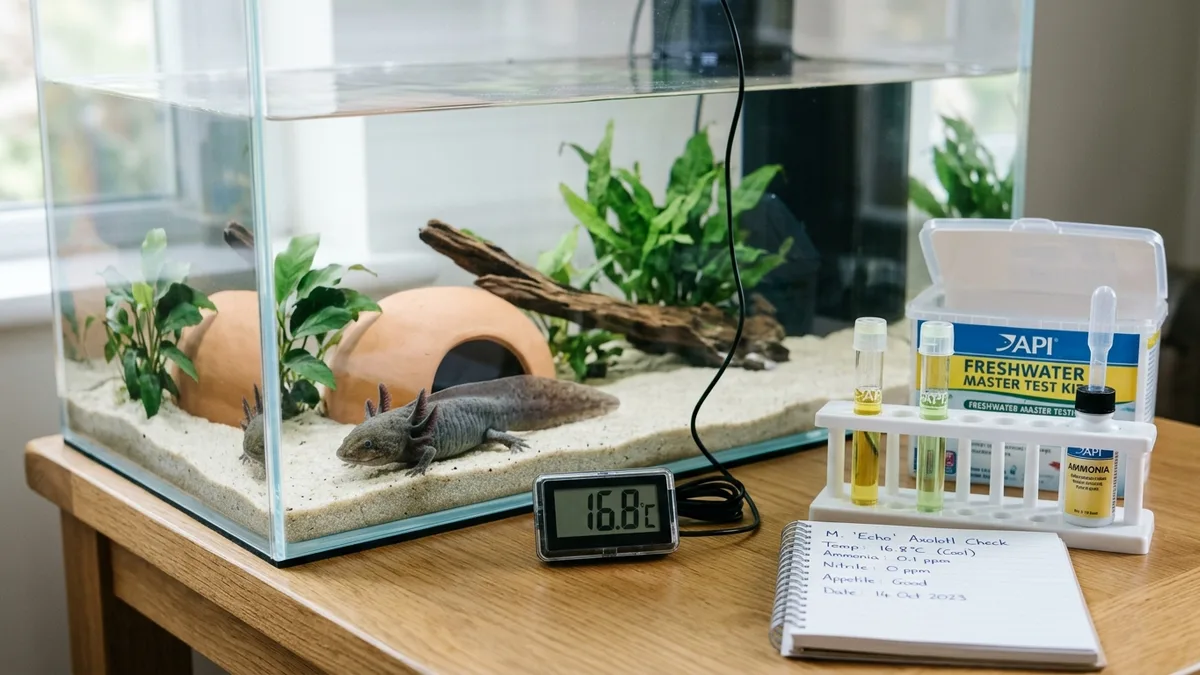
When an axolotl shows symptoms of stress, illness, or abnormal behavior, assessing the aquatic environment is a vital first diagnostic step. The following reference targets serve as general husbandry guidance rather than definitive disease diagnoses:
| Parameter | Reference Target |
|---|---|
| Ammonia | 0 ppm |
| Nitrite | 0 ppm |
| Nitrate | Below 10 ppm preferred |
| Chlorine / Chloramine | 0 ppm |
| Temperature | Approximately 16–18°C |
| pH | Approximately 7.4–7.6 preferred |
Important water management principles: Ammonia and nitrite must remain at zero. Temperature and water chemistry should be kept stable to avoid compounding physiological stress. Keepers should test and record actual measurements rather than guessing parameter values. Replacement water used during partial water changes must be properly dechlorinated and temperature-matched as closely as practical to prevent osmotic or thermal shock. Sudden changes in temperature or water chemistry can severely stress an axolotl. Furthermore, while correcting water parameters is essential, performing a water change does not replace investigating the underlying cause of abnormal readings—such as filtration failure, overstocking, or decaying organic matter. For detailed parameter standards, see our Axolotl Water Parameters Guide.
Common Axolotl Symptoms and Environmental Triggers
1. Floating and Buoyancy Disorders
Visible symptoms: The axolotl floats upward, tilts to one side, or struggles to rest flat on the aquarium floor.
Possible causes: Swallowed air, gastrointestinal gas, constipation, gastrointestinal obstruction or foreign-body ingestion, buoyancy disorders, or systemic illness.
What the keeper should check: Review feeding habits, substrate selection, and water parameters—elevated water temperatures above 22–24°C frequently cause distress and gas accumulation, so verify temperatures using our guide on maintaining safe axolotl water temperature.
Safe immediate action: Ensure stable water quality and monitor. Do not diagnose impaction from floating alone.
When veterinary attention is necessary: If floating persists, or is accompanied by abdominal asymmetry, lethargy, or failure to pass feces.
2. Gill Posture and Gill Deterioration
Visible symptoms: Reduced or shortened gill filaments, pale or discolored gills, damaged or missing sections of the gill structure, or abnormal gill posture (such as stalks bending sharply forward toward the face or rigid positioning).
Possible causes: These physical appearances are nonspecific and cannot independently establish a diagnosis. They must be evaluated alongside water temperature, total ammonia nitrogen, nitrite, nitrate, pH, dissolved oxygen, filter current, appetite, activity, and respiratory behavior.
What the keeper should check: Test all primary water parameters, measure filter outflow turbulence, and observe respiratory effort.
Safe immediate action: Baffle high-flow filter outputs and perform conservative partial water changes using properly dechlorinated, temperature-matched water if parameters are elevated.
When veterinary attention is necessary: Veterinary evaluation is recommended for progressive deterioration, bleeding, or abnormal breathing.
3. White Cotton-Like Growth (Water-Mold / Saprolegnia Infections)
Visible symptoms: Fluffy white or gray filamentous tufts clinging to gill filaments, toes, or skin lesions.
Possible causes: White cotton-like growth can be consistent with Saprolegnia or another water-mold infection, but visual appearance alone cannot establish a definitive diagnosis. Other lesions and skin conditions can resemble fungal growth.
What the keeper should check: Evaluate water parameters, temperature, and potential sources of physical trauma from decor or tank mates.
Safe immediate action: Provide clean supportive care via temporary tubbing. Never scrape, pull, or manually remove growth.
When veterinary attention is necessary: Veterinary examination is necessary to confirm etiology and select appropriate medical treatment.
4. Substrate Impaction and Gastrointestinal Obstruction
Visible symptoms: Swollen or asymmetric abdomen, lethargy, loss of appetite, and failure to pass feces.
Possible causes: Ingestion of aquarium gravel, pebbles, or foreign objects leading to gastrointestinal obstruction.
What the keeper should check: Inspect tank substrate for particle sizes smaller than the axolotl's head.
Safe immediate action: Transfer the animal to a bare-bottom monitoring setup. Explicitly avoid abdominal massage, laxatives, oil administration, manual extraction, and force-feeding.
When veterinary attention is necessary: Prompt veterinary examination and clinical imaging (such as radiographs) are required when obstruction is suspected.
5. Additional Clinical Conditions
- Skin Redness and Discoloration: Redness or discoloration may have several causes, including irritation, trauma, inflammation, or infection. Visual appearance alone cannot establish the cause. Recommend water-quality checks and veterinary evaluation, especially if redness occurs alongside ulcers, bleeding, swelling, severe lethargy, or rapid deterioration.
- Excessive Mucus and Abnormal Shedding: Can result from chemical irritation, thermal stress, or osmoregulatory disturbance. Inspect water parameters immediately.
- Persistent Appetite Loss: A non-specific sign of stress, poor water quality, or internal disease. Monitor parameters and animal weight.
- Cloacal or Intestinal Prolapse: Emergency presentation involving tissue protrusion. Do not push exposed tissue back inside; do not manipulate, cut, or attempt to treat the tissue at home. Prevent drying and contamination while arranging immediate veterinary care following the veterinarian's instructions for transport and temporary protection.
- Lethargy and Abnormal Breathing: May indicate hypoxia, severe water-quality toxicity, or systemic illness. Check dissolved oxygen and nitrogen parameters.
- Possible Parasitic Infections: External or internal parasites require microscopic identification by a veterinarian.
When Is an Axolotl Health Problem an Emergency?
Readers should not wait for water changes or tubbing to resolve the following emergency red flags:
- Severe or persistent abnormal breathing (gasping or erratic surfacing)
- Open wounds or rapidly spreading skin lesions
- Significant abdominal swelling or asymmetry
- Cloacal or intestinal prolapse
- Loss of equilibrium or inability to right itself
- Inability to move normally
- Severe lethargy or unresponsiveness
- Rapid physical deterioration
Advise urgent assessment by an experienced exotic-animal or amphibian veterinarian.
Supportive Care: Temporary Tubbing Protocol
Temporary tubbing provides supportive care only and is not a substitute for veterinary treatment. Follow these strict safeguards:
- Use a clean, food-safe plastic container with sufficient space.
- Use appropriately conditioned, dechlorinated water.
- Match replacement water temperature and general water chemistry as closely as practical.
- Keep the container in a quiet location away from direct sunlight and heat.
- Provide appropriate security against escape.
- Remove waste and uneaten food promptly.
- Replace the tub water completely at least every 24 hours during routine temporary tubbing.
- Avoid soap, detergent, and chemical cleaning residues.
- Monitor temperature and animal behavior.
Important safety notes: Do not recommend routine refrigeration. Do not recommend ice packs as a method of forcing rapid cooling. Controlled temperature management is essential. Refrigeration should only be considered under specific veterinary guidance. Persistent or severe symptoms require veterinary evaluation.
Related Resources & Calculators
- Axolotl Tank Cooling Calculator — Estimate required cooling capacity for thermal stability.
- Axolotl Water Temperature Guide — Safe temperature boundaries and strategies for preventing heat stress.
- Axolotl Water Parameters Guide — Review target ranges for nitrogen compounds, pH, and hardness.
- Water Change Calculator — Model theoretical water-change volumes and dilution outcomes.
- Axolotl Care Guide — Explore comprehensive husbandry baselines.
- Axolotl Tank Setup Guide — Review safe substrate, filtration, and habitat design.
Final Thoughts: Prioritizing Welfare and Veterinary Guidance
Maintaining axolotl health relies on diligent husbandry, stable water parameters, and prompt recognition of clinical signs. When illness or injury occurs, safe supportive care combined with qualified veterinary diagnosis ensures the highest standard of animal welfare.