Safety warning: Never add cycling ammonia to an aquarium containing an axolotl. Fishless cycling deliberately creates ammonia and nitrite concentrations that are unsuitable for aquatic animals.
Cycling an axolotl tank means establishing a biological filter that can convert ammonia into nitrite and then nitrate before an axolotl is introduced. The safest approach is fishless cycling, which uses a controlled ammonia source to grow nitrifying microorganisms without exposing the animal to accumulating toxic waste.
Unlike a typical tropical aquarium, an axolotl aquarium must eventually operate at cooler temperatures. Temperature, pH, dissolved oxygen, filtration capacity, and carbonate alkalinity all influence how effectively the biological filter develops.
This guide explains how to cycle an axolotl tank, how to interpret ammonia and nitrite measurements, why KH matters, and how to confirm that your filter is ready.
Direct Answer: How Do You Cycle an Axolotl Tank?
To cycle an axolotl tank, use a fishless cycling method before introducing the animal: set up the complete aquarium with running biological filtration and dechlorinated water, introduce a controlled aquarium-safe ammonia source according to your selected protocol, and regularly test ammonia, nitrite, nitrate, pH, and carbonate hardness (KH). Once microorganisms establish, verify biological filtration by dosing a controlled ammonia challenge under intended operating conditions and confirming that both ammonia and nitrite return to protocol-defined undetectable levels within 24 hours before reducing nitrate via a water change and stocking the axolotl.
What Does Cycling an Axolotl Tank Actually Mean?
Cycling establishes a population of microorganisms that process nitrogenous waste inside an aquarium's biological filtration system.
Axolotls produce ammonia through normal metabolic waste. Uneaten food and decomposing organic material can also contribute to ammonia accumulation.
Without sufficient biological filtration, ammonia can build up in the aquarium. During nitrification, microorganisms oxidize ammonia into nitrite and then nitrate. For a broader explanation of these stages, see our aquarium nitrogen cycle guide.
Nitrogen pathway: Ammonia → Nitrite → Nitrate
- Ammonia: A nitrogenous waste compound that can be harmful to aquatic animals.
- Nitrite: An intermediate product of ammonia oxidation that can interfere with oxygen transport in aquatic animals.
- Nitrate: The final product of conventional aerobic nitrification. It still requires management through water changes and, where appropriate, other nutrient-control methods.
What a completed cycle means: A cycled aquarium has enough biological processing capacity to handle its expected waste load without measurable ammonia or nitrite accumulation under normal operating conditions. Cycling does not mean making the water sterile or removing every nitrogen compound. It means establishing a functioning biological filtration system.
How the Nitrogen Cycle Works in an Axolotl Aquarium
1. Ammonia oxidation: From ammonia to nitrite
Ammonia-oxidizing microorganisms use ammonia as an energy source and convert it into nitrite.
This process requires oxygen and produces hydrogen ions, contributing to acidification.
As the microbial population develops, the aquarium may begin showing a decline in ammonia alongside an increase in nitrite. This is evidence that the first stage of nitrification is developing.
Equation: NH₄⁺ + 1.5O₂ → NO₂⁻ + 2H⁺ + H₂O
2. Nitrite oxidation: From nitrite to nitrate
A second group of nitrifying microorganisms oxidizes nitrite into nitrate.
The two stages work together to process ammonia through the biological filter. Both stages require appropriate environmental conditions, sufficient oxygen, and adequate biological surface area.
Equation: NO₂⁻ + 0.5O₂ → NO₃⁻
3. Why nitrate accumulates
Unlike ammonia and nitrite, nitrate is not normally removed by the two-stage nitrification process. It can accumulate as the biofilter processes nitrogenous waste.
Regular partial water changes help reduce nitrate concentration. Plants and other biological processes can also contribute to nutrient uptake, depending on the aquarium system.
Therefore, nitrate management remains necessary even after the aquarium has completed its initial cycle.
Why Temperature Matters When Cycling an Axolotl Tank
Temperature is an important factor affecting nitrifying microorganism activity and growth.
In veterinary husbandry guidance, the Royal Veterinary College identifies 16–18°C as the optimum environmental temperature for axolotls and cautions against elevated temperatures above 24°C, which can cause severe thermal stress. In contrast, laboratory research-facility guides (such as the Ambystoma Genetic Stock Center) often maintain colonies under standardized institutional protocols that may differ from home-aquarium care targets—so keepers should distinguish veterinary pet-care recommendations from research-facility practices.
Because the aquarium must eventually operate under the cool temperature conditions intended for the animal (see our guide to maintaining safe axolotl water temperature), cycling at 16–18°C can reduce biological reaction rates and microbial growth compared to warmer tropical aquariums, extending the time required to establish sufficient processing capacity.
However, there is no scientifically universal cycling duration that applies to every axolotl aquarium.
Factors affecting cycle development:
- Starting microbial populations
- Water temperature
- Ammonia loading
- Filter media and surface area
- Dissolved oxygen
- pH
- Carbonate alkalinity
- Water chemistry
- The presence of established filter media
Some aquarium guides describe cycling periods of approximately four to eight weeks or longer. These are practical estimates, not guaranteed biological deadlines. The correct way to determine whether cycling is complete is to test the filter's ammonia and nitrite processing capacity under intended operating conditions, not to rely on the number of days the aquarium has been running.
Understanding Total Ammonia, TAN-N, NH₃, NH₄⁺ and Aquarium Ammonia Tests
One important source of confusion in aquarium water chemistry is the difference between total ammonia, nitrogen-basis reporting, and individual ammonia species.
Total Ammonia vs. Total Ammonia Nitrogen (TAN-N)
Total ammonia refers to the combined concentration of both aqueous ammonia species present in water: un-ionized ammonia (NH₃) and ionized ammonium (NH₄⁺).
When expressed strictly on the mass of the nitrogen atom alone, this combined quantity is reported as Total Ammonia Nitrogen (TAN-N). When expressed as an NH₃ or NH₄⁺ ion mass equivalent, the numerical ppm value is higher for the exact same amount of nitrogen because the hydrogen atoms are included in the molecular weight.
These reporting conventions must not be used interchangeably. Identical numerical ppm readings from two different test kits or dosing guides may not represent identical actual ammonia concentrations if one uses a TAN-N basis and the other uses an NH₃/NH₄⁺ ion basis. Always check the test kit manufacturer's documentation.
Why is un-ionized ammonia (NH₃) important?
Un-ionized molecular ammonia (NH₃) is substantially more toxic to aquatic organisms than ionized ammonium (NH₄⁺) because neutral NH₃ diffuses more readily across gill membranes.
The relative proportion of NH₃ increases with rising pH and rising water temperature. Consequently, the same total ammonia reading carries different biological risk depending on water chemistry.
However, a cooler aquarium does not make measurable ammonia acceptable. The operational target for an established axolotl aquarium remains undetectable ammonia (0 ppm on standard hobbyist kits) and undetectable nitrite (0 ppm).
Why reporting basis and water chemistry matter together
Suppose two aquariums show similar numerical readings on different ammonia tests. Differences in reporting basis (TAN-N vs. NH₃/NH₄⁺ equivalent), pH, and temperature mean their actual un-ionized NH₃ concentrations can differ substantially.
Never treat a single isolated ammonia number as a complete assessment of biological safety without accounting for reporting units, pH, temperature, and exposure duration.
The Role of KH and pH During Aquarium Cycling
Carbonate hardness (KH) measures carbonate and bicarbonate ions that provide buffering alkalinity and help resist downward shifts in pH. Because nitrification releases hydrogen ions (H⁺), biological oxidation steadily consumes available carbonate alkalinity. In source water with low buffering capacity, this consumption can cause pH to drop.
How much alkalinity does nitrification consume?
Based on the balanced chemical stoichiometry of complete autotrophic nitrification, oxidizing 1 mg/L of ammonia-nitrogen (TAN-N) to nitrate consumes approximately 7.14 mg/L of alkalinity expressed as CaCO₃ equivalent.
This figure reflects theoretical stoichiometric chemistry and explains why sustained nitrification depletes KH over time. It must not be treated as a direct aquarium chemical dosing formula, because real aquariums also involve heterotrophic bacterial assimilation, gas exchange (CO₂ equilibrium), mineral dissolution, and varying source-water chemistry.
What happens when KH becomes depleted?
- Acid-neutralizing buffering capacity decreases.
- pH becomes unstable and can drop rapidly.
- Nitrifying microorganism metabolic activity declines at low pH.
- Ammonia and nitrite oxidation slow down.
- The cycling process may stall until alkalinity and pH stabilize.
Note: Low pH from depleted KH is a common cause of mid-cycle stalls, though temperature, oxygen, and inhibitory ammonia/nitrite concentrations should also be checked.
How should KH and pH be adjusted safely?
Measure pH, KH, ammonia, nitrite, and nitrate regularly and record trends over time rather than reacting to a single reading.
Do not blindly add sodium bicarbonate (baking soda) or commercial buffers without first testing source-water KH and tank KH. Any water-chemistry adjustment must account for your tap water's baseline mineral profile, current KH, pH stability, and the target freshwater parameters appropriate for axolotls, and should be introduced gradually. See our axolotl water parameters guide for related water-quality guidance.
Step-by-Step: How to Cycle an Axolotl Tank Without Fish
Fishless cycling allows the biological filter to develop without exposing an axolotl or another animal to deliberately elevated ammonia and nitrite.
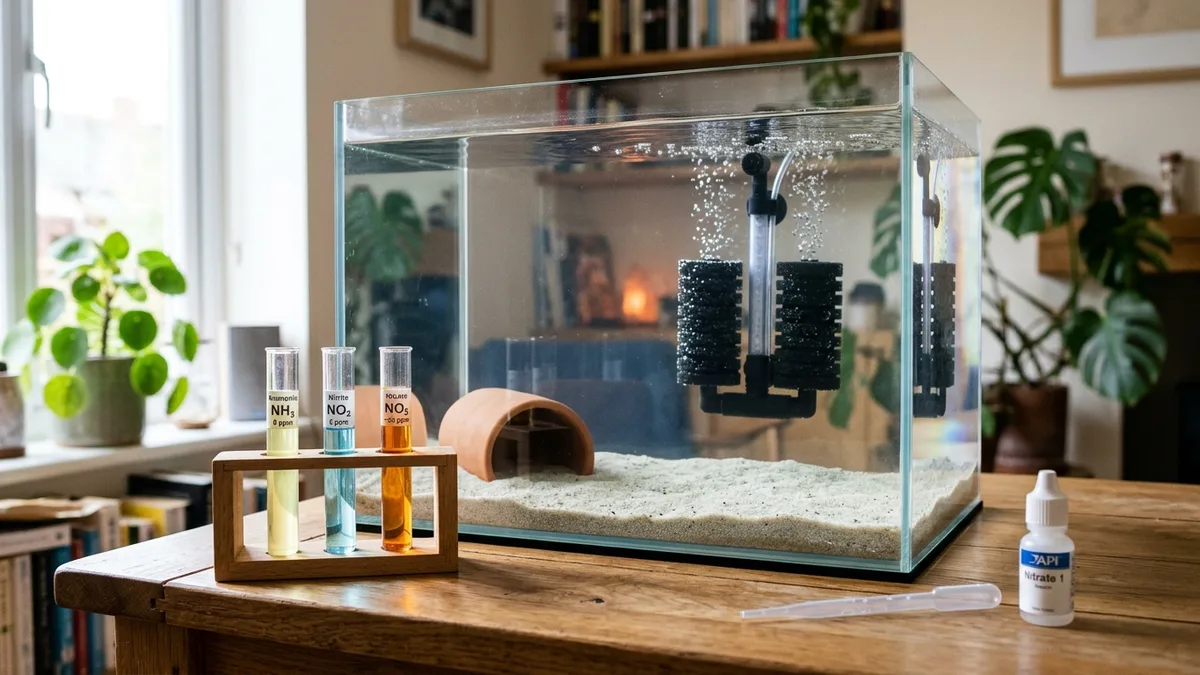
Step 1: Prepare the complete aquarium
- Aquarium
- Biological filter
- Filter media
- Air pump or other appropriate oxygenation equipment
- Thermometer
- Substrate and decorations, if used
Install the equipment that will remain in use after the axolotl is introduced.
Run the filter continuously. The microorganisms responsible for biological filtration primarily establish themselves on suitable surfaces, particularly filter media. Avoid repeatedly replacing or thoroughly cleaning the biological filter during cycling. For equipment and layout considerations, see the axolotl tank setup guide.
Step 2: Condition the source water
Fill the aquarium with an appropriate freshwater source. Treat tap water for chlorine and chloramine using a suitable water conditioner according to its manufacturer's instructions. Chlorine and chloramine can damage the microorganisms needed for biological filtration.
Test the source water and aquarium water for pH, ammonia, nitrite, nitrate, and KH (where possible). Recording these baseline values helps distinguish changes caused by cycling from compounds already present in the source water.
Step 3: Introduce a controlled ammonia source
Use an aquarium product specifically intended for fishless cycling, such as an appropriately labelled ammonium chloride solution free of surfactants, dyes, or fragrances. While many fishless-cycling guides use an initial target concentration around 1–2 ppm, this range is a common protocol convention rather than a universal scientific requirement.
The appropriate starting dose depends on your chosen cycling protocol, the product's label instructions, net aquarium water volume, and your test kit's reporting basis (TAN-N vs. NH₃/NH₄⁺ equivalent). Do not copy drop-per-gallon instructions from a different brand without verifying concentration and reporting units.
If you use our Ammonia Dosing Calculator to estimate dosing, note that it operates on its own defined mathematical assumptions regarding solution concentration and net water volume—it cannot automatically determine dosing for every proprietary ammonium chloride formulation without matching those parameters.
After dosing, allow the water to circulate thoroughly and measure the resulting concentration with your test kit. Avoid adding repeated doses without testing, as excessive ammonia and resulting nitrite buildup can inhibit nitrite-oxidizing bacteria.
Step 4: Monitor ammonia and nitrite
| Stage | What you may observe |
|---|---|
| Early stage | Ammonia remains detectable while the ammonia-oxidizing population develops. |
| Intermediate stage | Ammonia begins to decline, and nitrite becomes detectable. |
| Later stage | Nitrite begins to decline as nitrite-oxidizing microorganisms become established. |
| Established stage | The filter processes the protocol's controlled ammonia challenge, with both ammonia and nitrite returning to protocol-defined undetectable levels within 24 hours. |
| Parameter | What to observe | Why it matters |
|---|---|---|
| Ammonia | Declining after dosing | Indicates ammonia processing |
| Nitrite | Initial increase, followed by decline | Indicates development of the second stage |
| Nitrate | May increase | Supports evidence of nitrogen conversion |
| pH | Monitor changes | Influences ammonia chemistry and nitrification |
| KH | Monitor depletion | Indicates buffering capacity |
Keep a written record of each measurement (and if using our Nitrogen Cycle Tracker for single-snapshot stage assessment, remember it evaluates current readings rather than acting as a multi-week time-series log or proof of cycle completion). Do not redose ammonia automatically every day; base additional dosing on measured ammonia, nitrite, and your chosen cycling protocol.
Step 5: Verify the biological filter's capacity
A single zero-ammonia reading does not prove that an aquarium is cycled. To verify biological filtration, introduce a controlled ammonia challenge matching your selected fishless-cycling protocol and test the water after 24 hours.
Verification procedure: Dose the protocol's specified ammonia challenge, allow the filter to run continuously for 24 hours under the aquarium's intended operating conditions (including target axolotl temperature), and test both ammonia and nitrite to confirm both have returned to the required undetectable levels (0 ppm on standard test kits).
Repeating this 24-hour challenge helps confirm reproducibility. Keep in mind that this 24-hour test is a practical verification benchmark rather than a universal guarantee of biological capacity—one isolated test cannot prove the biofilter will handle every future feeding increase or stocking change without gradual adjustment and ongoing monitoring.
Step 6: Reduce accumulated nitrate
Once the biological filter has passed its verification test, measure nitrate. Perform an appropriate partial water change using replacement water that has been treated for chlorine or chloramine and is suitably matched for temperature and water chemistry.
The objective is to reduce accumulated nitrate without creating unnecessary changes in water conditions. Test the replacement water as well, particularly if the source water already contains nitrate. Our water change calculator can help model theoretical water-change volumes and dilution outcomes.
After the water change, confirm that the aquarium remains stable. Only introduce the axolotl once the aquarium's water quality, temperature, filtration, and overall setup are appropriate.
How Long Does It Take to Cycle an Axolotl Tank?
There is no guaranteed number of days required to establish a functioning biological filter. A practical aquarium cycling estimate is often several weeks. Some axolotl-specific guides describe approximately four to eight weeks, while other setups can take longer.
A tank that has been running for eight weeks is not necessarily cycled. Likewise, a tank that completes the required processing test earlier should not be delayed simply to meet an arbitrary calendar target. Use measured biological performance under target operating conditions as the completion criterion.
Factors affecting cycling time:
- Temperature
- Filter maturity
- Microbial inoculation
- Ammonia concentration
- Oxygen availability
- pH stability
- KH and alkalinity
- Water chemistry
Common Problems During Axolotl Tank Cycling
1. Ammonia is not decreasing
Possible causes:
- Insufficient microbial establishment
- Chlorine or chloramine exposure
- Excessive ammonia dosing
- Inadequate oxygenation
- Unsuitable pH
- Damaged or unsuitable filter media
What to do: First, verify the test kit and its procedure. Then examine the aquarium's water chemistry and filtration conditions before changing the ammonia dose.
2. Nitrite keeps increasing
This can happen when ammonia oxidation develops faster than nitrite oxidation. It does not automatically mean that the cycle has failed. Avoid continually adding ammonia when nitrite is already very high. Monitor the trend and follow a conservative cycling protocol.
3. pH is declining
Investigate KH and alkalinity. Nitrification produces acidity and consumes alkalinity. Water with limited buffering capacity may experience a substantial pH decline. Do not assume that adding baking soda is always the correct solution. First establish the source-water chemistry, the current KH, and the extent of the pH change.
4. The cycle appears stalled
Possible causes:
- Temperature
- pH
- KH
- Ammonia concentration
- Nitrite concentration
- Oxygen supply
- Filter operation
- Water conditioner exposure
- Recent medication or disinfectant use
What to do: Make one justified adjustment at a time where possible, and monitor the results.
5. Bottled beneficial bacteria do not produce immediate results
Commercial bacterial products may help introduce microorganisms, depending on their formulation, storage, handling, and viability. However, they cannot guarantee that a complete biological filter will develop within a specified number of days. Continue testing the aquarium. Do not use a product's advertised timeline as proof of successful cycling.
Can You Cycle an Axolotl Tank at a Warmer Temperature?
Some aquarists consider temporarily running an empty cycling aquarium at a warmer room temperature to encourage faster initial microbial growth. While temperature influences nitrification reaction rates, cycling at a higher temperature does not guarantee a faster or problem-free cycle, and it must never be attempted with an axolotl inside the tank.
Crucially, completing a cycle at a warm temperature does not prove that the biofilter will maintain the same oxidation capacity once chilled down to axolotl temperatures, because microbial metabolic rates decrease as water cools.
If you cycle at a warmer temperature, lower the water temperature gradually to the intended operating range and re-verify the 24-hour ammonia and nitrite processing test under those final coldwater conditions before introducing the animal. The Royal Veterinary College recommends 16–18°C as the optimum environmental temperature for axolotls and notes that temperatures above 24°C cause severe heat stress—never compromise axolotl welfare to speed up cycling.
Final Thoughts: Patience and Testing Are Essential
Cycling an axolotl tank is not simply a matter of waiting for several weeks. It is the process of establishing and verifying a biological filtration system that can handle the aquarium's expected nitrogenous waste load.
Understanding ammonia oxidation, nitrite oxidation, nitrate accumulation, temperature, pH, and carbonate alkalinity makes the process easier to monitor and troubleshoot.
The most reliable approach is fishless cycling, consistent water testing, and final verification under the aquarium's intended operating conditions. Do not rush the process or rely on a product claim, calendar estimate, or isolated test result. A properly established biological filter is an important part of preparing a suitable aquarium environment for an axolotl. For broader husbandry topics, see our axolotl care guide.