
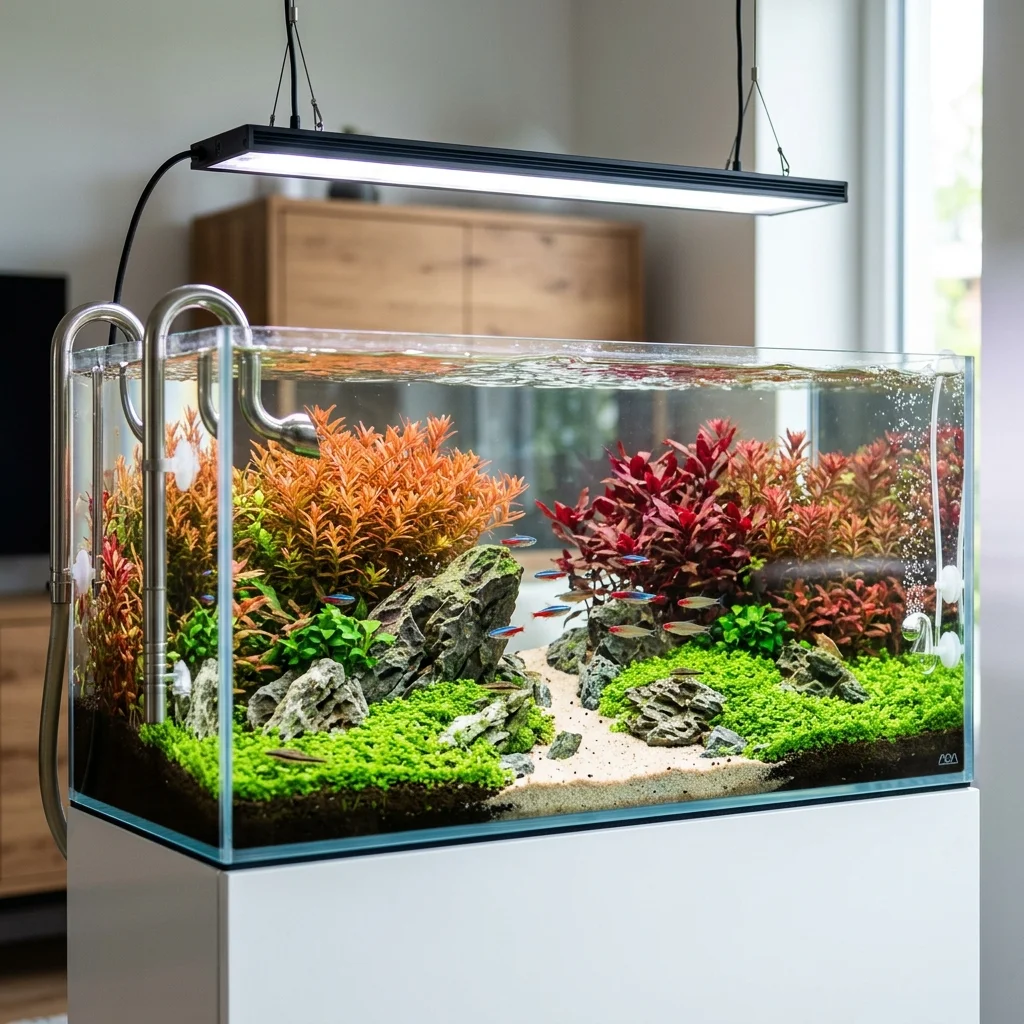
Quick Answer: Live aquatic plants act as a natural secondary biological filter that purifies water and reduces toxic nitrogen compounds. For beginners, the most stable path to success is a low-tech setup: hardy plants like Java Fern and Amazon Sword, moderate full-spectrum LED lighting limited to 6-8 hours daily, and no pressurized CO2 injection.
Key Takeaways
- Drastically improve water quality and reduce toxic ammonia by replacing plastic decorations with live aquatic plants.
- Prevent algae blooms by strictly limiting full-spectrum LED lighting to 6 to 8 hours daily on a digital timer.
- Never bury the rhizomes of epiphytes (Java Fern, Anubias) in substrate—attach them to wood or stone.
- Feed heavy root feeders (Cryptocorynes, Amazon Swords) with active aqua soil or root tabs inserted into inert sand.
- Overcome the month-two diatom and algae bloom with patience and regular 25-30% weekly water changes.
Why Live Plants Are Better Than Plastic
Throwing away plastic neon-colored plants and upgrading to a live planted aquarium is the biggest step you can take to improve your tank's long-term health. Live plants act as an active secondary biological filter. They absorb toxic ammonia, ammonium, and nitrates directly from the water column, produce dissolved oxygen for your fish, and create natural physical breaks that reduce territorial stress and fin-nipping.
High-Tech vs. Low-Tech: Choosing Your Path
Before purchasing hardware, determine which system matches your experience level and time commitment. Low-tech setups are recommended for every beginner due to their forgiving margins of error.
| Feature | Low-Tech Setup (Recommended) | High-Tech Setup |
|---|---|---|
| CO2 Addition | None (Ambient surface exchange) | Pressurized injection (20-30 ppm) |
| Lighting Level | Low to Moderate (PAR 20-40 at substrate) | High / Intensive (PAR 50-100+ at substrate) |
| Substrate | Inert sand/gravel + root tabs, or aqua soil | Active nutrient-rich aqua soil |
| Trimming Frequency | Once every 3 to 6 weeks | Weekly to bi-weekly |
| Algae Volatility | Low; slow to react, easy to stabilize | High; imbalances cause rapid blooms |
| Plant Selection | Hardy species (Ferns, Anubias, Crypts) | Any aquatic species, including delicate carpets |
The Holy Trinity: Light, Substrate, and Nutrients
A planted aquarium relies on equilibrium among three inputs: light energy, carbon/nutrients, and substrate binding. If you run intense lighting without sufficient carbon or nutrients, algae consumes the surplus. If you provide heavy substrate nutrients under dim lights, plants decay.
1. Substrate Options
- Inert Substrate (Coarse Sand or Fine Gravel): Cost-effective and durable, but contains no biological plant nutrition. If you use sand, insert concentrated root tabs near plant roots every 2 to 3 months.
- Active Aqua Soil: Baked clay granules packed with organic matter and macro-elements. These lower and buffer carbonate hardness (KH) and pH while directly nourishing deep-rooting plants for 12-24 months.
2. Lighting and Photoperiod
Plants need a stable daily light cycle to grow, but too much light without CO2 will quickly cause algae blooms. In a low-tech tank, keep your light on a digital timer set to run 6 to 8 hours maximum per day. For detailed advice on selecting fixtures, understanding PAR, and managing color spectrums, read our complete aquarium lighting guide.
3. Nutrients and Dosing
While fish waste provides organic nitrates and phosphates, plants require potassium, magnesium, iron, and trace minerals to prevent leaf chlorosis and pinholes. For low-tech aquariums, a single dose of an all-in-one liquid fertilizer once per week after a water change satisfies these baseline needs.
Bulletproof Beginner Plants
Start with resilient varieties categorized by their feeding habits:
- Epiphytes (Do not bury the rhizome): Java Fern (Microsorum pteropus) and Anubias Nana. Attach them directly to hardscape using aquarium-safe cyanoacrylate superglue or cotton thread. Burying the horizontal rhizome causes tissue rot within weeks.
- Heavy Root Feeders: Cryptocoryne Wendtii and Amazon Sword (Echinodorus bleheri). These draw the majority of their nourishment through roots embedded in aqua soil or sand boosted by root tabs.
- Fast Stem Plants: Water Wisteria (Hygrophila difformis) and Pearl Weed (Hemianthus micranthemoides). These species rapidly uptake inorganic compounds directly from the water column, stabilizing newly cycled tanks.
The Inevitable "New Tank" Algae Phase
Between weeks 3 and 8, newly set up planted aquariums typically experience brown diatom film or soft green thread algae. This phase occurs while nitrifying colonies stabilize and plants switch from greenhouse emersed foliage to submersed leaf forms. Do not overdose chemical algaecides. Instead, keep your light cycle capped at 7 hours, siphon debris during weekly water changes, and let the plant mass expand to outcompete nuisance algae for dissolved nutrients.
Plan Your Planted Tank Parameters
Calculate proper fertilizer dosages, target substrate depth, and water renewal ratios with our interactive tools:
Frequently Asked Questions
Should I start with a high-tech or low-tech planted tank?
Every beginner should start with a low-tech planted tank. They are far more stable, affordable, and forgiving than high-tech setups, which require pressurized CO2 and intense lighting that often lead to massive algae blooms if unbalanced.
How long should I leave my aquarium lights on for plants?
Put your full-spectrum LED light on a timer for 6 to 8 hours maximum per day. Leaving lights on for 12 or more hours is the number one cause of frustrating algae blooms in beginner planted tanks.
What substrate is best for a beginner planted tank?
Active aqua soil like Fluval Stratum or ADA Amazonia is ideal for heavy root-feeders. If you choose sand or gravel for aesthetic or budget reasons, you must insert root tab fertilizers near plant roots every 2 to 3 months.
Why are my new aquarium plants melting?
Cryptocorynes and many commercial plants melt when adjusting to new water parameters or transitioning from emersed (grown out of water) to submersed growth. As long as the root system and rhizome remain firm and healthy, fresh submerged leaves will sprout in a few weeks.
Sources & References
- Walstad, D. (1999). Ecology of the Planted Aquarium: A Practical Manual and Scientific Treatise for the Home Aquarist. Echinodorus Publishing.
- Pedersen, O., Colmer, T. D., & Sand-Jensen, K. (2013). Underwater Photosynthesis of Submerged Plants: Recent Advances and Methods. Frontiers in Plant Science, 4, 140.
- Barr, T. (2005). The Estimative Index of Dosing for Aquatic Planted Aquariums. The Aquatic Gardener, 18(3), 14-22.