
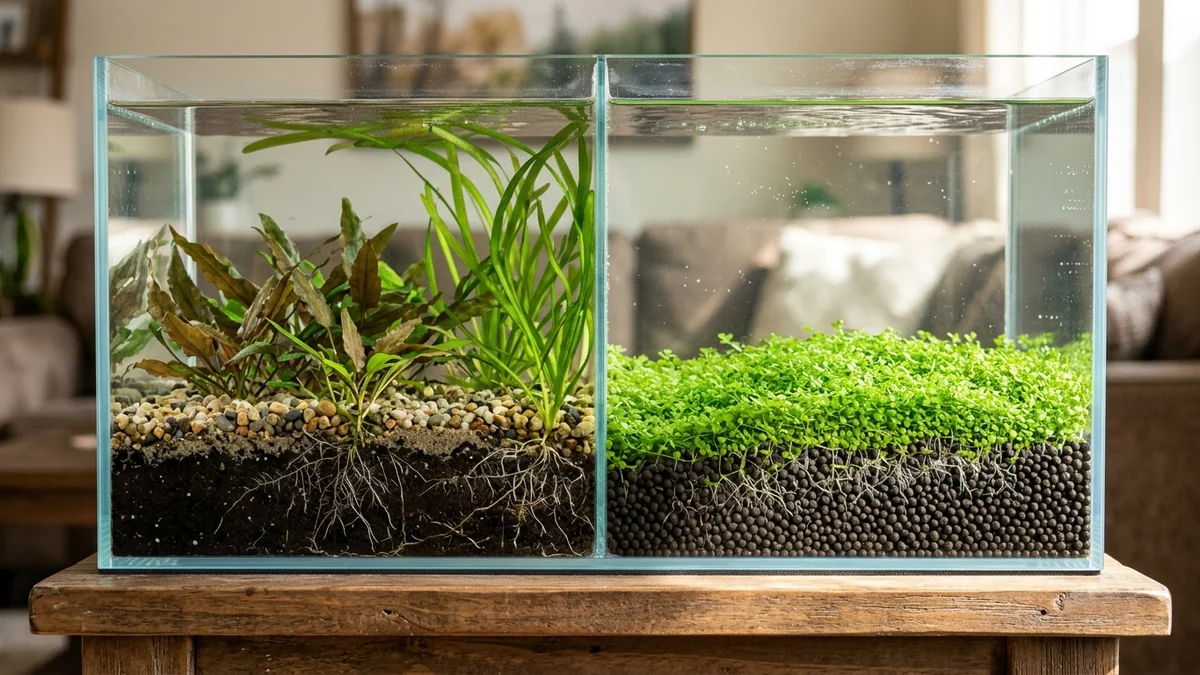
Walstad method or active soil? Choose the Walstad method for a low-tech, no-CO2 tank in ordinary tap water, and expect weeks of ammonia and algae. Choose active soil for soft-water livestock or demanding plants, and expect lower pH and KH, ammonia release and buffering that fades. For hard-water fish, neither acidifying soil is a good fit.
Choosing the right planted tank substrate
Both substrates feed plant roots, but they work in opposite ways. The Walstad method uses ordinary organic soil under a cap of sand or gravel. Active soil is a manufactured, acidic soil that also lowers hardness. The best choice depends on your tap water, your livestock and whether you inject CO2. Test your tap pH, KH and GH first; the general hardness (GH) and carbonate hardness (KH) explain the numbers. For a wider view see the planted tank substrate guide and the planted tank basics.
What is the Walstad method?
The Walstad method was described by Diana Walstad in Ecology of the Planted Aquarium. It uses a soil layer topped with gravel or sand, many plants, no CO2 injection and little equipment. Natural soils release dissolved organic substances; while humic substances and tannins in fish tanks both contribute tinting and mild acidity, tannins and complex humic compounds represent distinct chemical fractions (Gensou; Fish Tank Advisor). The primary book was not read for this guide, so the details come from secondary summaries.
Pros
- Designed for low to medium light and no CO2 injection.
- Few devices to buy; plants do much of the filtering.
- Soil adds some CO2 as it decomposes (Aquarium Science).
Cons
- The soil releases ammonia for days to weeks, and many keepers wait 4-6 weeks before adding fish (Tankflare).
- Soil choice matters: avoid fertiliser pellets, large amounts of perlite, moisture crystals and wetting agents.
- Guides disagree on depth: 0.5-1 inch of soil under at least 1 inch of gravel in one, 2-3 cm of soil under a 2-3 cm cap in another.
- Deep caps, low light or heavy stocking can make it fail (Gensou).
What is commercial active soil?
Active soil is a manufactured substrate, such as ADA Aqua Soil Amazonia, that is rich in nutrients and organic acids. ADA's distributor describes Amazonia as originally acidic at pH 5.0-6.0 and says it makes water more acidic (Aquasabi), and lists it as helping to lower hardness (Aquasabi).
Pros
- Pulls pH and KH down, which suits soft-water species such as Caridina shrimp.
- High nutrient and humic content for demanding plants.
Cons
- Ammonia release for the first weeks. ADA says to add fish and shrimp 2-3 weeks after planting; a retailer reports ammonia for 14-28 days (Gensou).
- KH can fall to 0 within weeks in soft tap water, which risks a pH crash, especially with CO2 (Gensou).
- Buffering fades over months. Retailer observations used Singapore tap water and are not controlled tests.
- In hard, high-KH tap water the effect is expected to be smaller or shorter, but no source reviewed measures this.
Direct comparison
The comparison table on this page lists the main differences. Use the week-by-week timeline to plan your start.
| Week | Walstad (from the sources) | Active soil (from the sources) |
|---|---|---|
| 0 | Rinse or mineralise soil, cap, fill slowly, plant heavily | Rinse per maker, plant, fill slowly, do not add livestock |
| 1-2 | Test ammonia and nitrite every 2 days; expect cloudy water | Large water changes; test pH, KH and ammonia |
| 2-4 | Ammonia usually falls as plants grow | ADA suggests livestock after 2-3 weeks; retailers say 14-28 days of ammonia |
| 4-6 | Many keepers add the first hardy livestock | Retest KH; top up buffering if needed |
| Months | Maintain gently; avoid disturbing the cap | Buffering fades; retest and replace when it stops working |
Which substrate should you choose?
Answer three questions. What are your tap water KH and GH? What livestock do you want? Will you inject CO2? If you want high-light carpeting species and pressurized injection, compare the high-tech planted tank approach. Then use the table.
| Your situation | Better fit | Why | Caveat |
|---|---|---|---|
| Soft-water shrimp such as Caridina | Active soil | It lowers pH and hardness, which these shrimp need | Test KH weekly; plan for months of buffering, not years |
| Hard tap water and livebearers or Malawi cichlids | Neither, or Walstad with inert cap | Acidifying soil works against the livestock | A pH-lowering soil is the wrong tool for hard-water fish |
| First planted tank, no CO2, low light | Walstad | Designed for it; low equipment cost | Expect weeks of ammonia and algae |
| High light and CO2 with demanding plants | Active soil | Strong nutrient supply | Watch KH: if it drops to 0 the pH can crash |
| Fish needed in under two weeks | Inert substrate with root tabs | Neither soil is ready that fast | See the <a href="/blog/root-tabs-dosing/">root tab dosing</a> |
If you choose active soil, protect KH. Stoichiometry says 30 mg/L of sodium bicarbonate raises KH by 1 dKH (Wikipedia). One retailer rule says 1-2 g per 20 L raises KH by about 1 dKH (Gensou), which is 1.7-3.3 times that amount. Use the stoichiometric figure, add in small steps and test. See the how to balance GH and KH.
For the Walstad route see the Walstad method guide and the low-tech planted tank setup. Use the substrate calculator to size the layer.
Common mistakes
- Adding fish too early. Both soils release ammonia. Test ammonia and nitrite until they read zero on consecutive tests (Gensou).
- Assuming Prime fixes it. Prime binds ammonia for up to 48 hours but does not remove it, so keep changing water. Additionally, as substrate nutrients deplete over time, supplement with liquid fertilizer dosing to avoid plant starvation. See the dechlorinating water changes.
- Using fertilised potting soil. Fertiliser pellets and wetting agents cause ammonia spikes or toxicity.
- Expecting buffering to last. Active soil's effect on pH and KH fades.
- Starting CO2 with KH near 0. The pH can crash. Check KH first.
- Strong flow over a Walstad cap. It strips CO2 and disturbs the soil.