
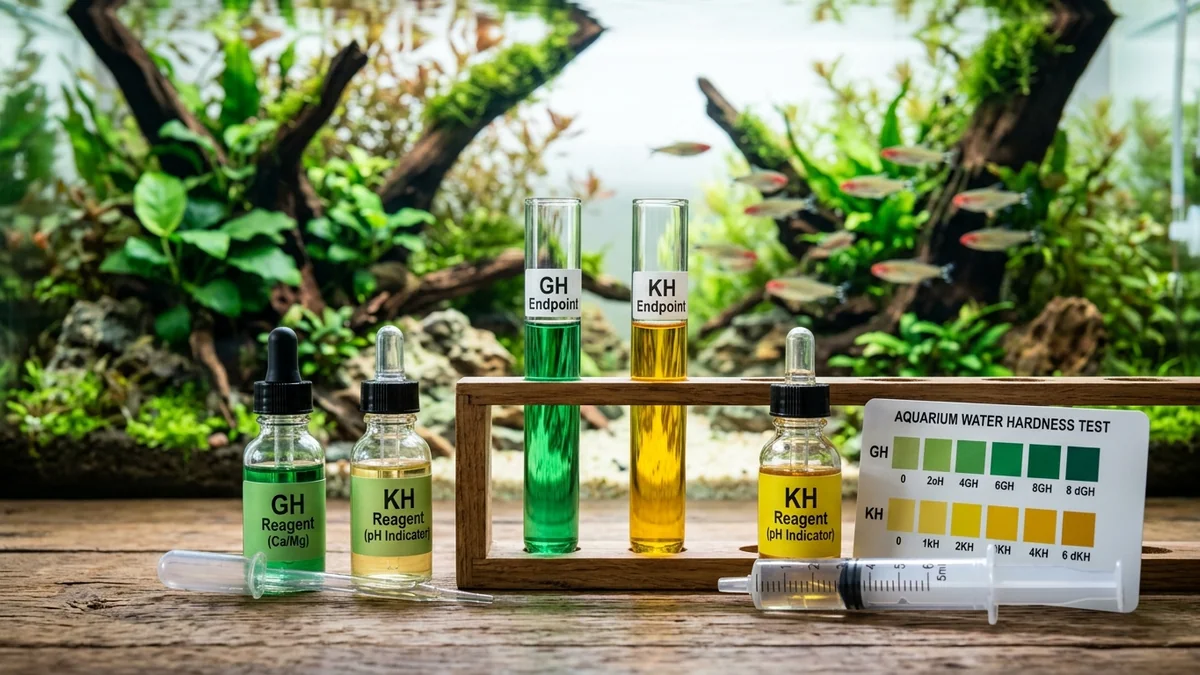
How do you balance GH and KH? Treat them as two separate numbers. Raise GH with calcium and magnesium sulfate salts, raise KH with bicarbonate, lower both by diluting with RO water, and change in small steps. Match the targets to your livestock, not to a fixed range, and test after every adjustment.
Understanding water hardness: GH vs KH
GH measures dissolved calcium and magnesium. KH measures the bicarbonate and carbonate that buffer pH. They have different jobs, and a test kit for one does not measure the other. GH and KH sit alongside other water quality basics such as ammonia, nitrite and nitrate. Both are expressed with the same factor: 1 dGH or 1 dKH is 17.848 mg/L as calcium carbonate (Wikipedia). Read the full pages: general hardness (GH) and carbonate hardness (KH). The comparison table on this page summarises the differences.
The relationship and common misconceptions
- "Hard water means high KH." Not always. Gypsum raises GH without KH, and baking soda raises KH without GH.
- "Raise KH to raise CO2." KH sets how pH responds. Only adding CO2 changes CO2. See carbon dioxide (CO2).
- "Fix pH directly." pH is a result of CO2 and buffering. Change KH or CO2 and pH follows (Aquarium Science).
- "One rule of thumb fits all." Hobby rules for grams per litre disagree. One retailer says 1-2 g of bicarbonate per 20 L raises KH by about 1 dKH (Gensou). Stoichiometry gives 30 mg per litre, or 0.6 g per 20 L. The retailer rule is 1.7-3.3 times higher.
GH and KH target reference by livestock
These are ranges from the listed profiles, not blanket targets. For specific shrimp targets, read the Neocaridina care guide. Sources disagree, so choose the livestock that suits your tap water, then use the table to check the fit.
| Livestock | GH (dGH) | KH (dKH) | Sources |
|---|---|---|---|
| Discus | 0-5 | Not sourced here | Seriously Fish |
| Neon tetra | 1-12 | Not listed; the profile says habitat water has negligible carbonate hardness | Seriously Fish |
| Guppy | 6-18 (other lists differ) | 4-12 (database) | Fluval; Tankflare |
| Neocaridina cherry shrimp | 4-10 (tolerates 3-15) | 1-8 (tolerates 0-15) | Shrimp Science; 2Hr Aquarist |
| Caridina shrimp | 4-6 | 0-2 | Seven Ports |
| Lake Malawi mbuna (electric yellow) | 10-25 | 8-18 | Tankflare; NT Labs |
Test your tap water first. For fish that tolerate hard water see fish for hard water.
How to adjust GH and KH safely
Change in small steps, dissolve salts in a container before adding, and test after each change. The carbonate hardness (KH) page suggests raising KH by no more than about 1 dKH per day. No source reviewed proves a safe rate for every species, so treat it as a precaution. The table lists the methods, and the dose table gives stoichiometric amounts.
| Goal | Method | Watch-outs |
|---|---|---|
| Raise GH only | Gypsum plus Epsom salt, dissolved in a container first | Adds sulfate; gypsum dissolves slowly; test before adding |
| Raise KH only | Sodium or potassium bicarbonate | Sodium load with baking soda; raise slowly; pH rises with KH |
| Raise GH and KH together | Crushed coral, aragonite or a mixed shrimp mineral | Hard to dose; dissolves faster in acidic water; mixes differ by brand |
| Lower both | Mix tap with RO, DI or rain water | Dilutes both by the same ratio; test the mix; change in steps |
| Lower KH only | No practical chemical method in a home tank | Dilution lowers GH too; remove calcareous rock if it drives KH up |
| Change wanted | Per litre | Per 100 L | Per 100 US gal (378.5 L) |
|---|---|---|---|
| +1 dKH with sodium bicarbonate | 30 mg | 3 g | 11.3 g |
| +1 dKH with potassium bicarbonate | 36 mg | 3.6 g | 13.5 g |
| +1 dGH with gypsum (3:1 Ca:Mg split) | 23 mg | 2.3 g | 8.7 g |
| +1 dGH with Epsom salt (3:1 Ca:Mg split) | 11 mg | 1.1 g | 4.2 g |
Raising GH
Use calcium and magnesium salts that carry no carbonate. One dGH is 0.178 mmol/L, so a 3:1 calcium-to-magnesium split gives 23 mg/L gypsum and 11 mg/L Epsom salt per dGH. Gypsum dissolves at about 2 g/L at 20 C (Merck), so dissolve it in warm water. The 3:1 split is an assumption.
Raising KH
Sodium bicarbonate gives 30 mg/L per dKH: 120 mg/L is 4.0 dKH (Wikipedia). Potassium bicarbonate gives 36 mg/L per dKH (derived from its molar mass of about 100.1 g/mol). Add it to a bucket of tank water and pour in slowly. Crushed coral raises KH and GH together, slowly and unpredictably.
Lowering both with RO or rain water
RO fraction = 1 - target / tap, if RO is near zero. With tap at 14 dGH and a target of 6 dGH, mix 57% RO with 43% tap. KH falls by the same proportion. Use the GH/KH remineralization calculator and the GH/KH water change calculator to do the arithmetic.
Troubleshooting water parameter instability
pH crashes and KH drift
Nitrification consumes alkalinity. The reaction NH4+ + 2 O2 gives NO3- + 2 H+ + H2O, so every mole of nitrogen turned into nitrate uses 2 equivalents of alkalinity. That is about 7.1 mg/L as CaCO3 (0.4 dKH) per 1 mg/L of nitrogen oxidised. This is a theoretical maximum from our arithmetic; plants and denitrification offset it. In practice it means KH falls steadily in a stocked tank between water changes. When KH nears zero, pH can crash. Test KH weekly and replace it with water changes. See the pH crash calculator and the CO2 cylinder calculator.
Active soil and CO2 effects
Active soil lowers KH over weeks; see the Walstad vs active soil. CO2 lowers pH but does not change KH. Carbonate rock can dissolve faster under CO2 and raise KH, which can mislead a pH controller (Aquarium Science). If your KH is near zero, do not start CO2 until you have fixed it. Also see KH and CO2 in the injection guide.