
Quick Answer
Neocaridina davidi (Cherry Shrimp) require stable, fully cycled water: temperature 70–75°F (21–24°C), pH 6.8–7.8, GH 6–8 dGH, KH 2–5 dKH, and TDS 150–220 ppm. Maintain parameter stability to prevent fatal molting issues (the White Ring of Death). House them in a 5–10 gallon tank with inert substrate, sponge filtration, and mature biofilm. When water chemistry is stable, females develop a dorsal saddle, molt, mate, and carry eggs on their pleopods for 21–30 days before releasing fully formed shrimplets.
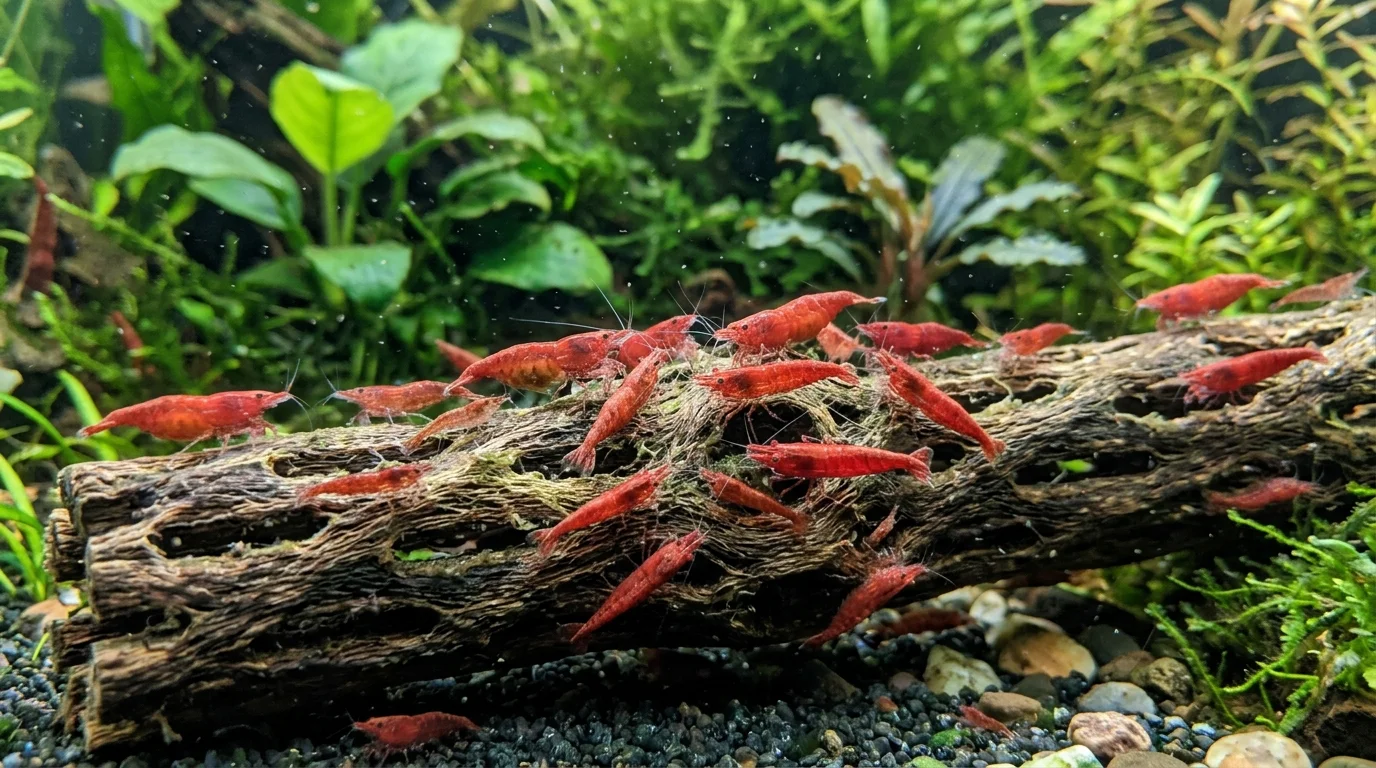
Neocaridina davidi—encompassing Red Cherries, Blue Dreams, Yellow Goldenbacks, Orange Sunkist, Green Jades, and Black Rili—are among the hardiest freshwater invertebrates in the aquarium hobby. Unlike sensitive Caridina species (such as Crystal Reds) that demand acidic, remineralized RO water, Neocaridina tolerate a wider spectrum of water parameters. However, their reliance on a rigid chitinous exoskeleton makes them vulnerable to osmotic shock, poor mineralization during ecdysis (molting), and copper toxicity.
Neocaridina davidi Overview & Color Morphs
All commercial color strains trace their genetic lineage to the wild freshwater dwarf shrimp native to eastern Asia. Through decades of selective line breeding, distinct color morphs have emerged across stable genetic lines (such as the Red line, Blue line, and Yellow line). Because these varieties belong to the identical species, mixing morphs results in heterozygous offspring that revert toward cryptic, mottled wild-type brown coloration. Maintaining intense chromatic saturation requires single-morph housing or systematic culling.
Ideal Water Parameters: GH, KH, TDS, and pH
Neocaridina absorb essential calcium and magnesium ions directly from the water column to calcify their shells. Achieving biological balance requires testing four interdependent parameters:
- General Hardness (GH): 6–8 dGH (approx. 100–145 ppm). GH measures dissolved divalent cations (primarily calcium and magnesium). If GH drops below 4 dGH, shrimp cannot properly harden their new carapaces; levels above 12 dGH make the exoskeleton brittle and difficult to break.
- Carbonate Hardness (KH): 2–5 dKH. KH buffers the water against sudden pH drops. An inert substrate (inert sand or gravel) is critical; active buffering soils designed for Caridina strip KH to 0, causing dangerous chronic stress in Neocaridina.
- pH Range: 6.8–7.8. Slightly alkaline water protects shell composition from chemical erosion.
- Total Dissolved Solids (TDS): 150–220 ppm. TDS serves as a rapid proxy for mineral density and dissolved waste. Keep top-offs strictly to pure RO/distilled water to prevent gradual mineral creep.
- Temperature: 70–75°F (21–24°C). While Neocaridina survive between 65–80°F, 72–74°F offers the ideal metabolic balance between active reproduction and long-term lifespan (1.5 to 2 years).
Tank Setup, Substrate, and Filtration
Recommended Tank Size
While a colony can survive in a 5-gallon tank, a 10-gallon or 20-gallon long setup is strongly recommended. Larger water volumes dilute organic nitrates and buffer against rapid temperature or TDS swings.
Filtration: Why Sponge Filters Reign Supreme
Air-driven sponge filters are the standard for Neocaridina tanks. They provide gentle, high-surface-area biological filtration, maximize dissolved oxygen, and create an active grazing pasture for microfauna. If using a hang-on-back (HOB) or canister filter, you must fit a fine-pore (30–45 PPI) intake sponge over the intake pipe. Unprotected filter impellers will pull in and kill newborn shrimplets.
Substrate and Botanicals
Choose inert substrates like pool filter sand, Black Diamond blasting sand, or fine river gravel. Supplement the layout with natural botanicals—Indian almond leaves (Catappa), alder cones, and cholla wood. These release humic substances, provide hiding spots, and fuel beneficial biofilm growth.
Acclimation: The Step-by-Step Drip Method
Osmotic shock accounts for over 80% of shrimp losses within 72 hours of purchase. Never float-and-dump.
- Empty the shrimp and their transport water into a clean, dedicated 2-gallon bucket.
- Run airline tubing from your main aquarium into the bucket. Restrict the flow with an adjustable control valve or a loose knot to achieve 1 to 2 drops per second.
- Allow the water volume in the bucket to double or triple over 1.5 to 2 hours.
- Check that the bucket's TDS and temperature match the aquarium within 10 ppm and 1°F before gently netting the shrimp into the tank. Discard the shipping water.
Nutrition: Biofilm Management and Supplemental Feeding
Neocaridina are continuous micro-grazers that spend their day picking at biofilm—a living carpet of beneficial bacteria, microalgae, and microscopic detritus. In a mature planted tank (running for at least 4 to 6 weeks), natural grazing provides the bulk of their nutrition.
- Supplemental Diets: Feed high-quality sinking shrimp pellets, spirulina sticks, or blanched vegetables (organic spinach, zucchini) 2 to 3 times per week. Remove uneaten food after 2 hours to prevent organic decay and planaria outbreaks.
- Microbial Powders: Products like Bacter AE encourage colony-wide biofilm development. Dose sparingly—a toothpick tip is sufficient for a 10-gallon tank—to avoid depleting dissolved oxygen levels.
Troubleshooting the White Ring of Death (Molting Problems)
When preparing to molt, a shrimp synthesizes a soft new cuticle beneath its old exoskeleton. It absorbs water to expand, snapping the old shell along the transversal cervical groove behind its head before flexing backwards to escape. If the water's mineral ratio is skewed, or if sudden water changes trigger premature ecdysis, the shell splits unevenly. The shrimp develops a visible white or translucent tear around its midsection—the White Ring of Death. Trapped inside the rigid shell, the shrimp exhausts itself or suffocates. To prevent this, maintain a steady 6–8 dGH, avoid water changes greater than 10–15% at a time, and match top-off water carefully.
Breeding: From Saddle to Shrimplets
1. The Saddle
Sexually mature females develop visible unfertilized ovaries behind the head across the upper carapace, appearing as an opaque yellow or green patch termed the 'saddle'.
2. The Pheromone Run
Once her eggs mature, the female molts and secretes breeding pheromones into the water. Males pick up this scent and swim frantically across the tank searching for her.
3. The Berried Stage
After brief mating, the female passes 20 to 30 fertilized eggs beneath her abdomen, securing them to her pleopods (swimmerets). For the next 21 to 30 days, she continuously fans the eggs with fresh oxygen to prevent fungal spores from developing.
4. Shrimplet Emergence
Neocaridina feature direct development—there is no planktonic larval stage. Shrimplets hatch as fully formed 2 mm miniatures. They remain sheltered inside dense moss (Java, Christmas, or Phoenix moss) for their first few days, grazing exclusively on local biofilm.
Selective Breeding and Culling
If you keep multiple color varieties together (e.g., mixing Red Cherry with Blue Dream), their offspring will crossbreed and quickly revert to wild-type, mottled brown camouflage within 1 to 2 generations. To maintain high color grades (such as Painted Fire Red), selectively cull pale or patterned specimens into a separate display tank, keeping only the most saturated individuals in your breeding colony.
Pests and Common Shrimp Diseases
- Planaria & Hydra: Flatworms (Planaria) and stinging polyps (Hydra) hunt baby shrimplets. Treat with fenbendazole or specialized shrimp-safe betel nut palm extracts.
- Scutariella japonica: Tiny white ectosymbionts that cling around the shrimp's rostrum. They can be cleared with a brief aquarium salt dip (1 tablespoon aquarium salt per cup of water for 30–60 seconds).
- Cladogonium ogishimae: Often misdiagnosed as 'green fungus,' this parasitic alga develops under the shrimp's pleopods. Isolate infected shrimp immediately to prevent colony spread.
The Problem
Your Neocaridina shrimp are experiencing unexplained slow die-offs, failing to molt with visible white tears across their carapaces (White Ring of Death), or mature females are dropping their eggs before hatching.
When to Use This Tool
Use this guide when establishing a dedicated shrimp tank, calibrating remineralized RO or tap water parameters (GH/KH/TDS), troubleshooting failed molts, or scaling breeding output from berried females to shrimplets.
Who is this for?
- Freshwater aquarists, planted tank keepers, and invertebrate breeders seeking to optimize water chemistry, nutrition, and breeding survival for Neocaridina cultivars.
Neocaridina Water Parameter Benchmarks
| Parameter | Ideal / Optimal | Acceptable Range | Risks Outside Range | Priority | Difficulty |
|---|---|---|---|---|---|
| GH (General Hardness) | 6–8 dGH (approx. 100–145 ppm) | 4–12 dGH | <4 causes molt failure / soft shell; >12 causes shell entrapment | High | Beginner |
| KH (Carbonate Hardness) | 2–5 dKH (approx. 35–90 ppm) | 1–8 dKH | <1 risks lethal pH crash; >8 can hinder breeding receptivity | Medium | Beginner |
| pH (Acidity/Alkalinity) | 6.8–7.8 | 6.5–8.0 | Extremes degrade shell structure and stress osmoregulation | Medium | Beginner |
| TDS (Total Dissolved Solids) | 150–220 ppm | 120–300 ppm | Rapid swings cause severe osmotic shock and death within 24h | High | Intermediate |
Troubleshooting Guide
1 Shrimp displaying a clear or white transversal split behind the head (White Ring of Death).
Check your GH immediately using a liquid titration kit. If GH is below 6 dGH, remineralize using a shrimp-specific salt (like SaltyShrimp Shrimp Mineral GH/KH+). Limit water changes to 10-15% weekly, and ensure top-offs use pure distilled/RO water to avoid mineral spikes.
2 Berried females dropping their egg clutches prematurely.
3 Adult shrimp dying one-by-one over days with no visible physical trauma.
Test for copper toxicity from municipal plumbing, plant fertilizers, or snail treatments; ensure nitrates remain strictly below 20 ppm. Inspect the substrate for accumulated decaying food that may harbor pathogenic bacteria.
4 Shrimplets hatch but vanish within 7 to 10 days.
Cover all power filter intakes with a fine-pore 30-45 PPI pre-filter sponge. Confirm the tank has sufficient mature biofilm and dense moss cover; newly hatched shrimplets do not wander for food and will starve in sterile tanks.
Frequently Asked Questions
What are the ideal water parameters for Neocaridina shrimp?
What causes the 'White Ring of Death' and how do I fix it?
How long do female Cherry Shrimp stay berried before hatching?
Can I keep different colors of Neocaridina shrimp together?
What fish make safe tank mates for Neocaridina shrimp?
What is the minimum tank size for Neocaridina shrimp?
Glossary of Terms
- Ecdysis (Molting)
- The biological process of shedding the rigid chitinous exoskeleton to allow physical growth, mineral resorption, and subsequent mating.
- White Ring of Death
- A fatal molting complication where the old exoskeleton separates unevenly, exposing a band of white flesh between the carapace and abdomen, trapping the shrimp inside.
- Berried
- The reproductive state where a female shrimp carries a clutch of fertilized eggs securely attached to her swimmerets (pleopods) beneath her abdomen.
- Saddle
- The visible cluster of unfertilized developing ovaries located behind the head and across the upper carapace of a mature female shrimp.
- Biofilm
- A self-sustaining complex matrix of beneficial bacteria, microalgae, detritus, and microorganisms adhering to submerged surfaces, serving as primary food for shrimp.
Scientific References
- Effects of Water Hardness and Calcium Concentration on Neocaridina davidi Survival and Reproduction
- Freshwater Decapod Crustaceans: Physiology of Molting and Osmoregulation
- Ecdysteroid Titers and Exoskeletal Chitin Dynamics in Dwarf Freshwater Shrimp