Filtration
Technical Specifications & Benchmark Matrix
- Media Allocation
- Largest share biological media, with mechanical pre-filtration to protect it; chemical media optional
Overview
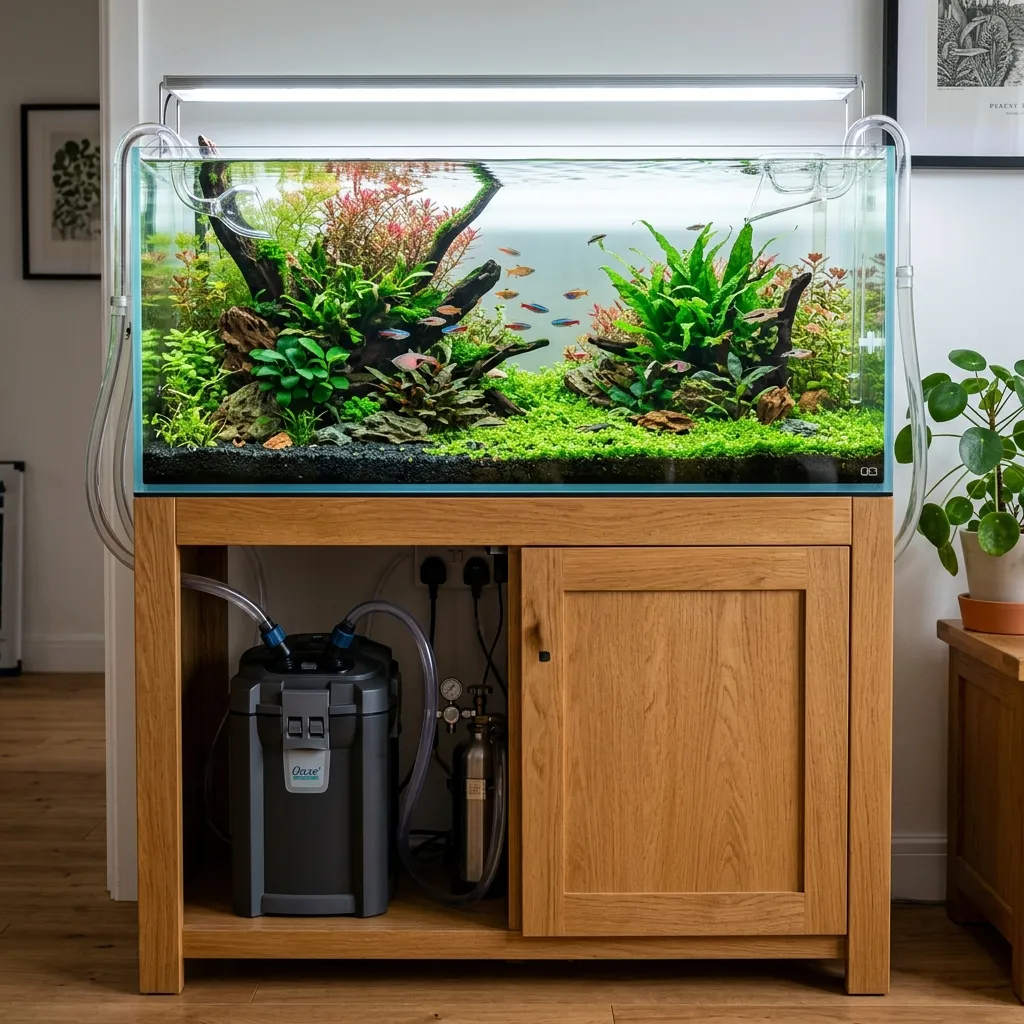
Filtration is a multi-stage life-support system that removes solid waste, cultivates nitrifying bacteria, and optionally strips dissolved organics or medications from aquarium water. A hobbyist who installed a hang-on-back filter rated for a 20-gallon tank on a 55-gallon planted aquarium will wake up to persistent mulm on the substrate and nitrate readings above 40 ppm because the unit simply cannot process the bioload fast enough. Some hobbyists mistake this for a bacterial bloom, but bacterial blooms turn water milky white and clear on their own within days; filtration failure leaves water hazy with visible debris and does not self-resolve. The fix is not more chemicals. It is matching filter capacity to actual stock density and tank volume.
Types of Filtration
### Mechanical Filtration
Mechanical filtration is the physical trapping of uneaten food, feces, and plant debris in porous media such as filter floss, sponge pads, or fine-mesh screens. This stage clogs first. It protects biological media from suffocating under organic sludge. Use 50-micron filter floss for polishing water, but expect to replace it weekly in heavily fed tanks. Coarse sponges last longer and act as pre-filters, extending the life of finer downstream media.
### Biological Filtration
Biological filtration is the colonization of aerobic nitrifying bacteria—primarily Nitrosomonas and Nitrospira—on high-surface-area substrates like ceramic rings, bio balls, or lava rock. These microbes convert lethal ammonia into nitrite and then into relatively benign nitrate. A mature biological filter can process 2 ppm ammonia overnight in a moderately stocked tank. Never let this stage dry out or expose it to chlorinated tap water. Ceramic rings with 5 to 10 square meters of surface area per liter outperform smooth plastic bio balls in compact canisters.
### Chemical Filtration
Chemical filtration uses activated carbon, Seachem Purigen, or phosphate-absorbing resins to adsorb dissolved organic compounds, tannins, or specific ions that mechanical and biological stages cannot capture. It is optional in most planted tanks. It becomes essential after medication courses or when removing yellowing tannins from driftwood. Replace carbon monthly; it stops adsorbing and becomes a biological substrate once exhausted, which is harmless but no longer performs chemical polishing.
Filter Types and Applications
### Canister Filters
Canister filters are pressurized external units that push water through layered media baskets, delivering high flow rates—often 200 to 400 gallons per hour in consumer models—and excellent mechanical polishing for tanks above 40 gallons. They allow custom media arrangements. They cost more. They also require priming after power outages. A Fluval 407 or Eheim Classic 600 handles 75 to 100 gallons with ease, running mechanical floss in the top basket and ceramic rings below.
### Hang-on-Back Filters
Hang-on-back (HOB) filters hang on the tank rim, draw water through an intake tube, and trickle it over disposable cartridges or custom media bags. They suit 10- to 55-gallon setups. They create surface agitation that drives off CO2 in planted tanks. Many hobbyists modify them with coarse sponge pre-filters to protect fry and extend cartridge life. AquaClear and Seachem Tidal models allow dropping in bags of biomedia instead of relying solely on disposable cartridges.
### Sponge Filters
Sponge filters run on air pumps, draw water through a porous foam block that hosts massive bacterial colonies, and provide gentle flow ideal for shrimp, breeding tanks, or quarantine systems up to 20 gallons. They offer no chemical stage. They are nearly impossible to clog completely. They also occupy tank space and look unsightly in display aquascapes. A dual-sponge model lets you rinse one sponge while the other maintains the colony, preventing biological crash during maintenance.
Sizing and Flow Rate
Filter sizing is the calculation of turnover rate, defined as the number of times the entire tank volume passes through the filter each hour. A healthy freshwater community tank requires four to six turnovers per hour; a 40-gallon breeder needs a filter rated at 160 to 240 gallons per hour at minimum. Overstocking amplifies the problem: ten small tetras in a 10-gallon tank with a 40 GPH filter will overload the biological stage within a week. Cichlid tanks or heavily stocked goldfish systems demand six to ten turnovers per hour because these fish produce proportionally more ammonia. Always verify the manufacturer's GPH rating at zero head height, then derate by 15 to 25 percent once media, tubing, and vertical lift are factored in.
Common Failures and Fixes
### Filter Bypass
Filter bypass is a condition where water flows around clogged media instead of through it, rendering the unit ineffective even though the motor runs. The solution is replacing or rinsing mechanical media every two to four weeks and arranging media so water cannot channel around baskets. Lift the media basket and inspect the housing walls for detritus buildup that creates shortcuts.
### Biological Crash
Biological crash is the sudden die-off of nitrifying bacteria caused by replacing all biological media at once or exposing it to chlorinated water, resulting in an ammonia spike. Preserve bio-filtration by never replacing all biological media at once. Rinse sponges or ceramic media in tank water, never chlorinated tap water. If you must replace a cartridge, cut the old floss away and stuff the new cartridge with the seeded biomedia from the old one.
### Dead Zones
Dead zones are areas of stagnant water below the filter outflow or behind rockwork where debris settles and anaerobic pockets form. Eliminate them by repositioning the outflow with a spray bar or adding a small circulation pump. This is the fix everyone skips, and it is why detritus keeps accumulating in the same corner. A 200 to 400 GPH circulation pump costs less than most filter upgrades and solves the symptom permanently.
Maintenance Schedule
Filter maintenance is the scheduled cleaning and replacement of mechanical, biological, and chemical media to prevent flow reduction and biological crash. Mechanical media requires rinsing or replacement when water flow visibly drops, typically every two to four weeks in stocked tanks. Biological media should last years if kept oxygenated and free of sludge; rinse it gently in siphoned tank water during water changes. Chemical media such as activated carbon saturates within three to six weeks and must be replaced on schedule or it will leach adsorbed compounds back into the water.
Run Precision Calculations For Your Setup
Check species compatibility, volumetric displacement, and filtration turnover benchmarks for your specific aquarium parameters.
🐟 Associated Species Profiles & Susceptibility
Browse All Fish Profiles →
⚙ Diagnostic & Sizing Calculators
Never buy an underpowered filter again. Calculate exactly how much filter flow rate (turnover) your aquarium needs to keep water clear, ammonia zero, and fish healthy — based on your specific tank size, stocking density, and fish species.
Estimate the net usable water volume in your aquarium.
Estimate realistic fish stocking capacity using adult size, bioload, filtration, swimming space, tank maturity, plants, and maintenance habits. Suitable for community tanks, cichlids, predators, and planted aquariums.
Aquarium Filter Types Compared
| Filter Type | Best For | Flow Rate (GPH) | Cost | Maintenance |
|---|---|---|---|---|
| Canister Filter | 40+ gallon planted/community tanks | 200–400+ | $$$ | Monthly media rinse, quarterly deep clean |
| Hang-on-Back (HOB) | 10–55 gallon community tanks | 100–300 | $$ | Bi-weekly cartridge check, monthly media swap |
| Sponge Filter | Breeding, shrimp, quarantine tanks | 20–80 (air-driven) | $ | Bi-weekly squeeze in tank water |
| Internal Power Filter | Nano tanks up to 20 gallons | 40–100 | $ | Weekly sponge rinse, monthly impeller check |
| Sump/Refugium | 75+ gallon or marine setups | Custom (500+) | $$$$ | Weekly sock change, monthly pump maintenance |
Frequently Asked Questions
What causes an aquarium filter to stop working even though the motor is running?
How often should I clean my aquarium filter?
Can you over-filter an aquarium?
Do fish tanks need a filter if I do frequent water changes?
Why is my new filter making my water cloudy?
Can I rinse my filter media under tap water?
Is a bigger filter always better?
How do I know if my filter is the right size for my tank?
Sources & References
- Publisher:Wiley-Interscience
- Accessed:2026-10-14
- Aquaculture Engineering: Filtration and Water Treatment
- Source:Wiley-Blackwell Aquaculture Series
- Standard Methods for the Examination of Water and Wastewater
- Source:APHA/AWWA/WEF
- The Ecology of the Planted Aquarium
- Source:Echinodorus Publishing
- Aquarium Filtration: Biological, Chemical, and Mechanical Processes
- Source:Journal of Aquatic Animal Health