Species Overview
African Cichlids are among the most diverse, colorful, and behaviorally fascinating groups of freshwater fish in the aquarium hobby. Native to the African Great Lakes—primarily Lake Malawi, Lake Tanganyika, and Lake Victoria—these fish have undergone explosive adaptive radiation, resulting in hundreds of species with incredible variation in color, shape, and behavior.
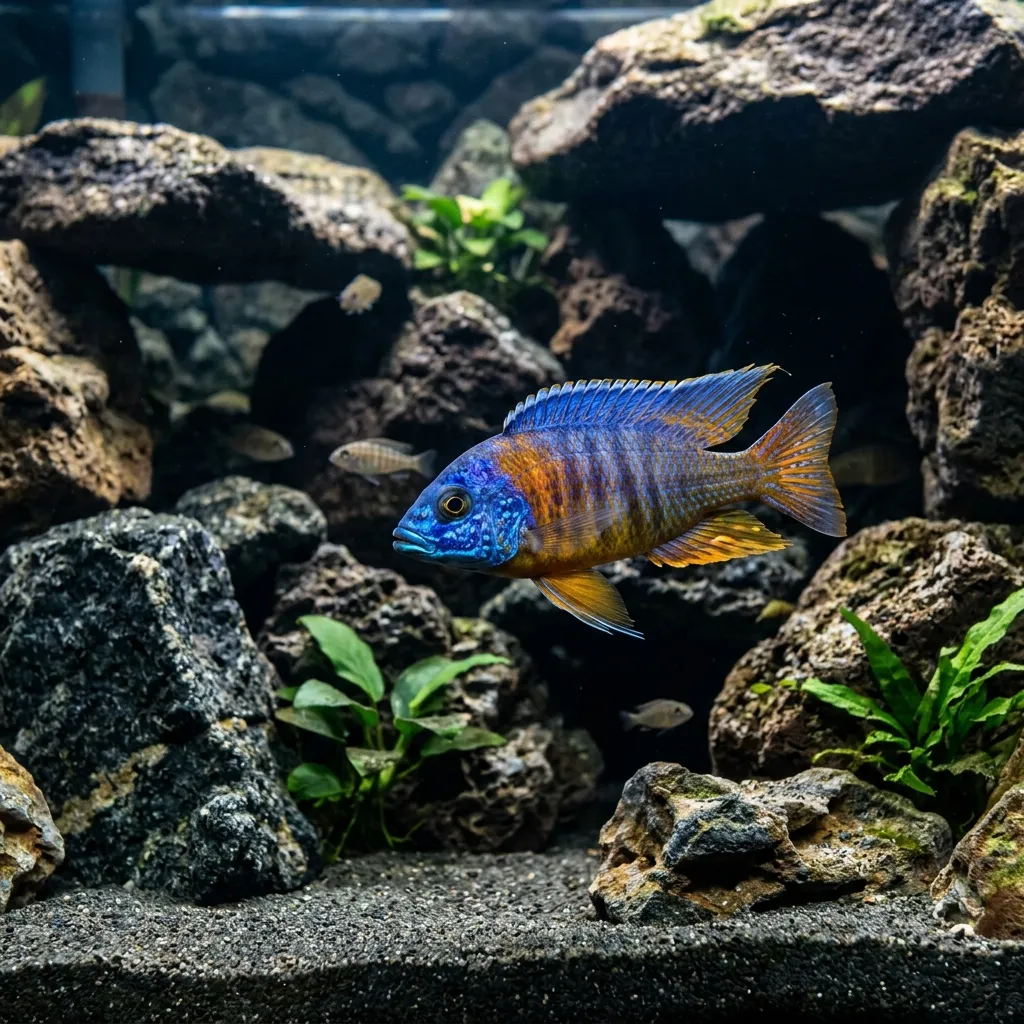
They are divided into three main groups: Mbuna (rock-dwelling herbivores), Peacocks (Aulonocara, sandy-bottom omnivores), and Haps (Haplochromis, open-water carnivores). Each group has distinct care requirements, dietary needs, and aggression levels. Their brilliant colors, active personalities, and complex social hierarchies make them a centerpiece of many advanced aquarists' collections.
Physical Appearance
African Cichlids display extraordinary diversity. Mbuna are typically stocky with bold vertical stripes and bright colors (yellow, blue, orange). Peacocks have elongated bodies with iridescent, peacock-like coloration in males. Haps are larger, more streamlined predators. All possess a single nostril on each side (a cichlid hallmark) and specialized pharyngeal jaws for crushing food. Males are generally more colorful and larger than females. Adult sizes range from 4 inches (Mbuna) to 10+ inches (large Haps).
Natural Habitat & Distribution
Lake Malawi is the ninth-largest lake in the world, with clear, hard, alkaline water (pH 7.8-8.6) and rocky shorelines. Mbuna inhabit the rocky intertidal zones, grazing algae from rocks. Peacocks patrol sandy bottoms near rock outcrops. Haps roam open water. Lake Tanganyika is deeper and older, with even harder water and more specialized species. Lake Victoria cichlids have suffered catastrophic declines due to Nile Perch introduction.
Aquarium Care & Tank Requirements
Tank Setup & Dimensions
African Cichlid tanks must be designed around territory management rather than aesthetics. The minimum tank size is 55 gallons for a small Mbuna group, but 75+ gallons is strongly recommended. For Peacocks, 50+ gallons; for Haps, 75-125+ gallons.
Key design principles:
- Rockwork: Pile rocks to create caves, crevices, and visual barriers. Each dominant male needs 2-3 caves.
- Substrate: Sand or fine gravel (Mbuna sift substrate; sharp gravel damages mouths).
- Overstocking: Maintain 12-15+ fish in 75 gallons to disperse aggression. Understocking leads to targeted harassment.
- Filtration: Heavy bioload requires canister filters rated for 2x tank volume.
- Lighting: Moderate to bright lighting enhances colors and supports minimal plant growth (Anubias, Java Fern).
Water Parameters
Rift Lake cichlids require hard, alkaline, mineral-rich water that is the opposite of most tropical community fish.
Temperature
Maintain 75–82°F (24–28°C). Stable temperature is critical; fluctuations stress fish and trigger disease.
pH
Maintain 7.8–8.6. This is non-negotiable for long-term health. Use aragonite, crushed coral, or commercial buffers (Seachem Malawi/Victoria Buffer).
Hardness (GH)
10–18 dGH (300+ ppm). In the wild, GH reaches 2000 ppm. Use cichlid salts containing calcium, magnesium, and trace minerals—not table salt.
Carbonate Hardness (KH)
8–15 dKH. This buffers pH and prevents dangerous swings. A KH below 6 leaves no margin for error.
Water Flow
Moderate flow mimics natural lake conditions and improves oxygenation.
Diet & Feeding Protocol
African Cichlid diet is lake-specific and getting it wrong is fatal.
- Mbuna (Herbivores): Require 70%+ plant matter. Feed spirulina flakes, blanched zucchini, nori seaweed, and vegetable-based cichlid pellets. Never feed bloodworms, brine shrimp, or meaty proteins—this causes Malawi Bloat, a fatal intestinal blockage.
- Peacocks (Omnivores): 60% carnivore / 40% herbivore. High-quality cichlid pellets (35-40% protein) plus mysis shrimp, krill, and occasional vegetable matter.
- Haps (Carnivores): Primarily carnivorous. Large pellets, frozen silversides, krill, and occasional vegetable supplements.
Feed 2-3 small portions daily, fasting one day per week. Remove uneaten food promptly to maintain water quality.
Behavior & Social Dynamics
Temperament & Social Behavior
African Cichlids are aggressive and highly territorial. They establish strict dominance hierarchies, with dominant males controlling the best territories and displaying the brightest colors. Subordinate males may be harassed to death if adequate hiding spots are not provided.
Maternal mouthbrooding is the primary reproductive strategy: females incubate fertilized eggs in their mouths for 18-24 days, during which they do not eat. This makes them vulnerable to aggression.
Overstocking (12-15+ fish in 75 gallons) is the single most effective aggression management technique. It prevents any single fish from becoming a target. Maintain a male-to-female ratio of 1:3-4 for Mbuna and Peacocks.
Health & Disease Prevention
African Cichlids are generally hardy when water parameters are correct, but they are susceptible to several serious conditions. Their specialized digestive systems make them particularly vulnerable to dietary mistakes.
Breeding & Spawning
Most African Cichlids are maternal mouthbrooders, one of the most fascinating reproductive strategies in the aquarium hobby.
Breeding Trigger
Raise temperature to 80-82°F (27-28°C) and perform a 30% water change with slightly cooler (2°F/1°C) hard water. Increase photoperiod to 12 hours of bright light.
Spawning Process
- The male establishes a territory and displays vibrant colors.
- The female lays 10-40 eggs on a flat rock or in a pit in the sand.
- She immediately picks up the eggs in her mouth.
- The male displays 'egg spots' (ocelli) on his anal fin; the female tries to add these to her mouth, at which point the male releases sperm, fertilizing the eggs in her mouth.
- The female incubates the eggs for 18-24 days at 78°F (25°C), during which she does not eat.
- She releases 0.2-inch (5 mm) free-swimming fry.
Artificial Stripping
For higher survival rates, strip eggs from the female's mouth on day 5-7 and incubate in a tumbler. This yields up to 90% survival vs. 30-50% when left with the mother. Fry accept crushed flakes and baby brine shrimp immediately.