Yellow Lab Cichlid Care Guide (Labidochromis caeruleus)

Quick Answer
The Yellow Lab Cichlid (Labidochromis caeruleus) is a vibrant, relatively peaceful African cichlid from Lake Malawi. It requires a minimum 55-gallon aquarium with hard, alkaline water (pH 7.8-8.6, 10-18 dGH), temperature 75-82°F (24-28°C), and plenty of rockwork. As an omnivore, it thrives on spirulina-based pellets mixed with occasional crustaceans. It grows to 4-5 inches and is an excellent beginner cichlid.
Quick Facts
| Scientific Name | Labidochromis caeruleus |
|---|---|
| Common Names | Yellow Lab Cichlid, Electric Yellow Cichlid, Lemon Yellow Cichlid |
| Family | Cichlidae |
| Genus | Labidochromis |
| Type | Freshwater |
| Temperament | semi-aggressive |
| Care Difficulty | intermediate |
| Lifespan | 8 years |
| Maximum Size | Up to 5 in (13 cm) |
| Diet | Omnivore |
| Temperature | 75–82°F (24–28°C) |
| pH | 7.8–8.6 |
| Hardness | 10–20 dGH |
| Minimum Size | 55 gallons |
Key Takeaways
- Considered the most peaceful Mbuna, making it great for beginner cichlid tanks.
- Requires hard, alkaline water (pH 7.8-8.6); incompatible with most community fish.
- Omnivorous diet: feed spirulina flakes and mysis shrimp; avoid beef heart.
- Maternal mouthbrooder: females hold eggs and fry in their mouth for 3-4 weeks.
- Both males and females are brilliantly colored yellow.
Overview
The Yellow Lab Cichlid (Labidochromis caeruleus), often called the Electric Yellow Cichlid, is arguably the most popular and widely kept African cichlid in the aquarium hobby. Its stunning, solid electric-yellow body contrasted by stark black stripes along its fins makes it a spectacular centerpiece for any hard-water aquarium.
Native to Lake Malawi in the East African Rift Valley, the Yellow Lab belongs to the Mbuna group (which translates to 'rockfish'). However, unlike most notoriously aggressive Mbuna, the Yellow Lab is relatively peaceful. This mild temperament, combined with its brilliant coloration and hardiness, makes it the perfect introductory species for aquarists looking to venture into the world of African cichlids.
Ideal For
- Beginner cichlid keepers setting up their first Lake Malawi biotope.
- Aquarists with hard, alkaline tap water (pH 7.8+).
- Keepers wanting bright, active fish that are less aggressive than typical Mbuna.
Appearance
The Yellow Lab features an elongated, stocky body typical of Mbuna. The most common aquarium variant is a striking, uniform electric yellow. Mature individuals, particularly dominant males, develop thick, jet-black stripes extending along the dorsal, anal, and pelvic fins. The eyes often have a dark horizontal bar through them. Both males and females exhibit this brilliant yellow coloration (unlike Peacocks, where females are drab), though males tend to be slightly larger and have more pronounced black markings. Adult size is typically 4 to 5 inches (10-13 cm).
Natural Habitat
Endemic to Lake Malawi, the ‘Lion’s Cove’ variant (the source of the electric yellow morph in the hobby) inhabits rocky shorelines at depths of 30 to 130 feet. The water is exceptionally clear, hard, and alkaline (pH 7.8-8.6). They navigate through rocky crevices, utilizing their pointed snouts to pick small insects, crustaceans, and snails from the biocover (aufwuchs) growing on the rocks.
Care
Housing & Pond Requirements
A successful Yellow Lab setup requires replicating the rocky environment of Lake Malawi while providing enough horizontal swimming space.
- Tank Size: A 55-gallon tank (48x13 inches) is the minimum recommended for a small group. A 75-gallon is ideal for a community Mbuna tank.
- Rockwork: Provide extensive rockwork piled securely to create numerous caves, crevices, and visual barriers. This is essential for establishing territories and providing refuge for subdominant fish and holding females.
- Substrate: Aragonite sand or crushed coral is highly recommended to naturally buffer the pH and hardness. Fine sand allows them to exhibit natural digging behaviors without injuring their mouths.
- Filtration: African cichlids produce a heavy bioload. Use powerful canister filtration (turning over the tank volume 5-10 times per hour).
Water Parameters
Lake Malawi has highly stable, mineral-rich water. Yellow Labs require these conditions for long-term health and vibrant coloration.
Temperature
Maintain 75-82 degrees Fahrenheit (24-28 degrees Celsius).
pH
Maintain 7.8-8.6. They will not thrive in acidic or neutral water.
Hardness (GH)
10-20 dGH. The water must be hard and rich in calcium and magnesium. If your tap water is soft, use commercial cichlid lake salts.
Carbonate Hardness (KH)
8-15 dKH. High KH provides a buffer that locks the pH in the high alkaline range.
Total Dissolved Solids (TDS)
250-450 ppm. Lake Malawi water is exceptionally mineral-rich.
Electrical Conductivity
500-900 microSiemens per centimeter.
Nitrates
Below 20 ppm for optimal health; some sources accept up to 40 ppm but lower is safer.
Water Flow
Moderate to gentle flow. These fish do not like strong currents.
Diet
Unlike most strictly herbivorous Mbuna (which graze on algae), Yellow Labs are naturally insectivorous or omnivorous. In the wild, they use their tweezer-like teeth to pluck insects and crustaceans from the rocks.
- Staple Diet: A high-quality cichlid pellet containing a balance of spirulina or vegetable matter and protein (e.g., krill, fish meal).
- Supplements: Frozen mysis shrimp, daphnia, or cyclops fed 1-2 times a week.
- Vegetable Matter: Blanched zucchini, spinach, or spirulina flakes.
- Avoid: Do not feed mammalian proteins (beef heart) or heavy, hard-to-digest worms (bloodworms) as a staple, as this can still trigger Malawi Bloat, even though they are more tolerant of protein than other Mbuna.
Feed small amounts 1-2 times daily, and skip feeding one day a week to clear their digestive tracts.
Health
Yellow Labs are extremely hardy and disease-resistant when kept in proper water conditions. Most health issues arise from improper diet or poor water quality.
Malawi Bloat
Intestinal blockage and bacterial infection caused by poor diet or stress.
- Swollen abdomen.
- White, stringy feces.
- Refusal to eat and lethargy.
- Clamped fins.
Feeding heavy, indigestible proteins (bloodworms, beef heart). Poor water quality causing chronic stress.
Feed a balanced omnivore diet heavy in spirulina. Maintain pristine water conditions and high pH/GH. Treat early symptoms with Metronidazole.
Ich (White Spot Disease)
Common parasite causing white spots.
- White salt-like grains on fins and body.
- Flashing (scratching against rocks).
Stress from temperature drops or introduction of infected fish.
Maintain stable temperature. Quarantine new additions. Treatable with heat (86°F) and aquarium salt, or standard ich medications.
Hole in the Head (Hexamita)
A flagellate parasite causing pitting lesions on the head and lateral line, often linked to poor water quality, stress, and improper nutrition.
- Pitting or holes forming around the head and lateral line.
- White stringy feces.
- Loss of appetite and weight loss.
- Lethargy and darkened coloration.
A flagellate parasite (Hexamita) exacerbated by stress. Poor water quality with high ammonia or nitrate levels. Overcrowding and improper nutrition.
Skin Flukes and Parasitic Infections
External parasites that attach to the skin and gills, causing irritation and secondary infections.
- Excessive flashing (rubbing against rocks and substrate).
- Reddening or inflammation of the skin and gills.
- Rapid breathing and gasping at the surface.
- Clamped fins and lethargy.
Introduction of infected fish or plants without quarantine. Stress from poor water quality or temperature fluctuations. Overcrowding and inadequate filtration.
Quarantine all new fish and plants for 2-4 weeks. Maintain stable water parameters and excellent filtration. Treat with praziquantel or formalin-based medications at reduced doses. Perform regular water changes to reduce organic load.
Breeding
Yellow Labs are incredibly easy to breed in the home aquarium; in fact, if you have a male and females in good conditions, they will likely breed without any intervention.
They are maternal mouthbrooders.
- Spawning: The male will display intensely and dance for a female. They will circle each other in a flat sandy area or flat rock. The female lays eggs, picks them up in her mouth, and nudges the male's anal fin (which has faint egg spots) to stimulate him to release sperm, fertilizing the eggs in her mouth.
- Incubation: The female will hold the eggs (and later, fry) in her buccal cavity (mouth) for roughly 21 to 28 days. Her 'chin' will look distended, and she will rarely eat during this time.
- Release: After 3-4 weeks, she will spit out 10-30 fully formed, miniature versions of the adults.
- Fry Care: To ensure fry survival, 'strip' the female of the fry around day 21 into a separate grow-out tank, or provide piles of small rubble rock where the fry can hide from adult fish. Fry can immediately eat crushed flake food.
Tips
Common Mistakes
Mbuna means ‘rockfish’. Keeping them in an open tank without caves causes extreme stress, fading of colors, and heightened aggression as they have nowhere to hide or claim as territory.
Expert Tips
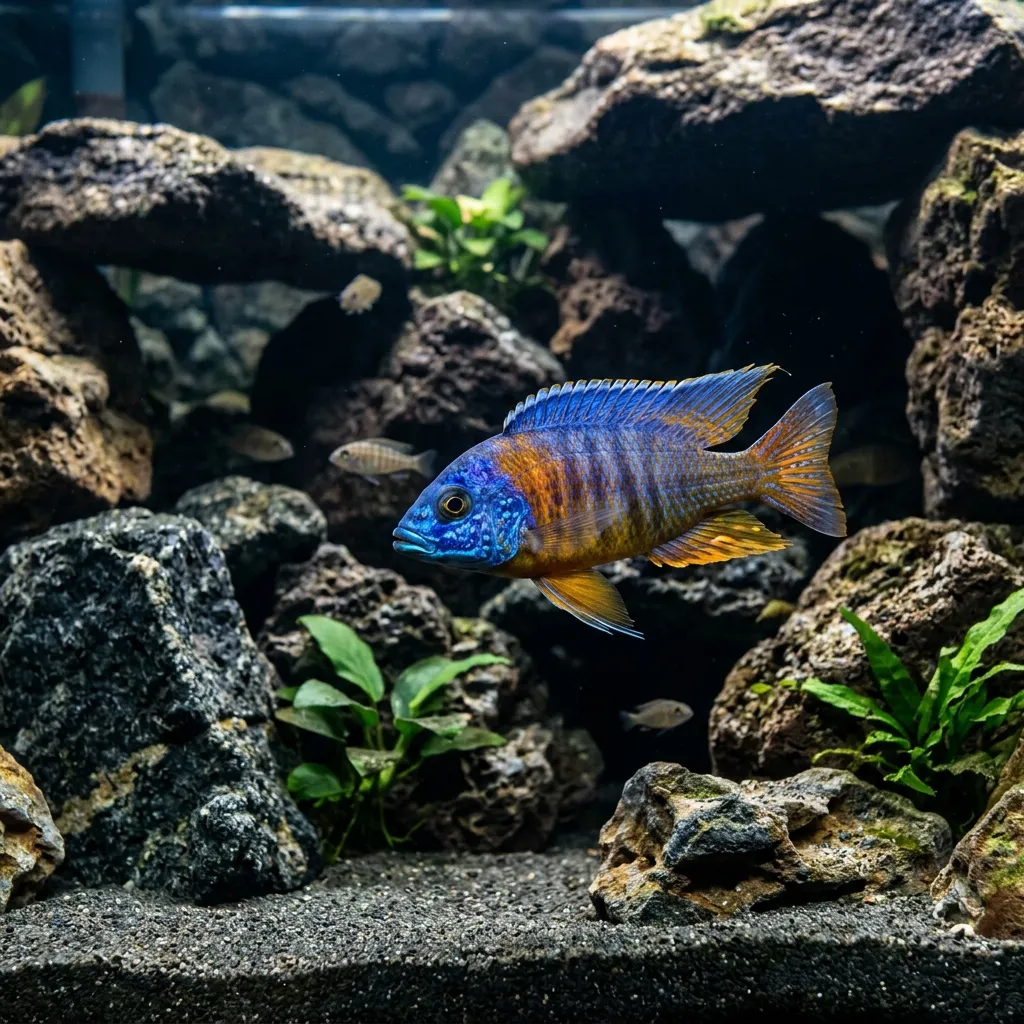
For a stunning, balanced 55-gallon tank, combine a group of Yellow Labs (1M/4F) with a group of Acei Cichlids (1M/4F) and Rusty Cichlids (1M/4F). Their colors contrast beautifully (Yellow, Blue, Bronze), and all three are mild-mannered.
Compatible Tank Mates
Beginner African Cichlid Comparison
| Feature | Yellow Lab Cichlid | Acei Cichlid | Rusty Cichlid | Peacock Cichlid (Aulonocara) |
|---|---|---|---|---|
| Scientific Name | Labidochromis caeruleus | Pseudotropheus acei | Iodotropheus sprengerae | Aulonocara spp. |
| Adult Size | 4-5 in (10-13 cm) | 5-6 in (13-15 cm) | 4 in (10 cm) | 4-6 in (10-15 cm) |
| Minimum Tank Size | 55 gallons | 55-75 gallons | 40-55 gallons | 55 gallons |
| Temperament | Semi-aggressive (Mild for Mbuna) | Semi-aggressive (Mild for Mbuna) | Semi-aggressive (Mild for Mbuna) | Semi-aggressive |
| Diet | Omnivore | Herbivore | Omnivore | Omnivore (Carnivore leaning) |
| Coloration | Electric yellow with black fin stripes | Purple/blue body, yellow fins | Rusty orange-brown with purple sheen | Vibrant blues, reds, yellows (males only) |