
Neon Tetra (Paracheirodon innesi)
Quick Answer
Neon Tetras (Paracheirodon innesi) are iconic freshwater fish native to the clearwater and blackwater tributaries of the Amazon basin in South America. They require a minimum 15 gallon (57 liter) aquarium with a pH of 6.0 - 7.0, soft water (2-6 dGH), and temperature range of 70-78 degrees Fahrenheit (21-26 degrees Celsius). This omnivorous mid-water schooling species demands groups of 10 or more and makes an excellent addition to peaceful community setups.
Quick Facts
| Scientific Name | Paracheirodon innesi |
|---|---|
| Common Names | Neon Tetra |
| Family | Characidae |
| Genus | Paracheirodon |
| Type | Freshwater |
| Temperament | peaceful |
| Care Difficulty | beginner |
| Lifespan | 5 years |
| Maximum Size | Up to 1.5 in (4 cm) |
| Diet | Omnivore |
| Temperature | 70–78°F (21–26°C) |
| pH | 6–7 |
| Hardness | 2–6 dGH |
| Minimum Size | 15 gallons |
Key Takeaways
- Requires a minimum school of 10 to 15 individuals for natural behavior and stress reduction
- Needs a tank of at least 15 gallons (57 liters) with a footprint of 24 inches (60 cm) or greater
- Extremely sensitive to copper-based medications and salt; quarantine with methylene blue at half-strength
- Modern specimens are heavily inbred; source from reputable breeders when possible
- Neon Tetra Disease is incurable; affected fish must be euthanized immediately to prevent spread
Overview
Species Overview
Natural History and Origin
The Neon Tetra (Paracheirodon innesi) is one of the most recognizable and widely kept ornamental fish in the aquarium hobby, with annual global trade exceeding 2 million specimens. Native to the upper Amazon basin, specifically the Rio Putumayo, Rio Nanay, and Rio Napo tributaries of Peru, Colombia, and Brazil, this species inhabits both clearwater streams and tannin-stained blackwater environments. Their natural waters are characterized by extremely soft conditions, pH values as low as 4.0 in some blackwater systems, minimal mineral content, dense riparian vegetation, and substrates composed of leaf litter, submerged roots, and fine sand.
Physical Description
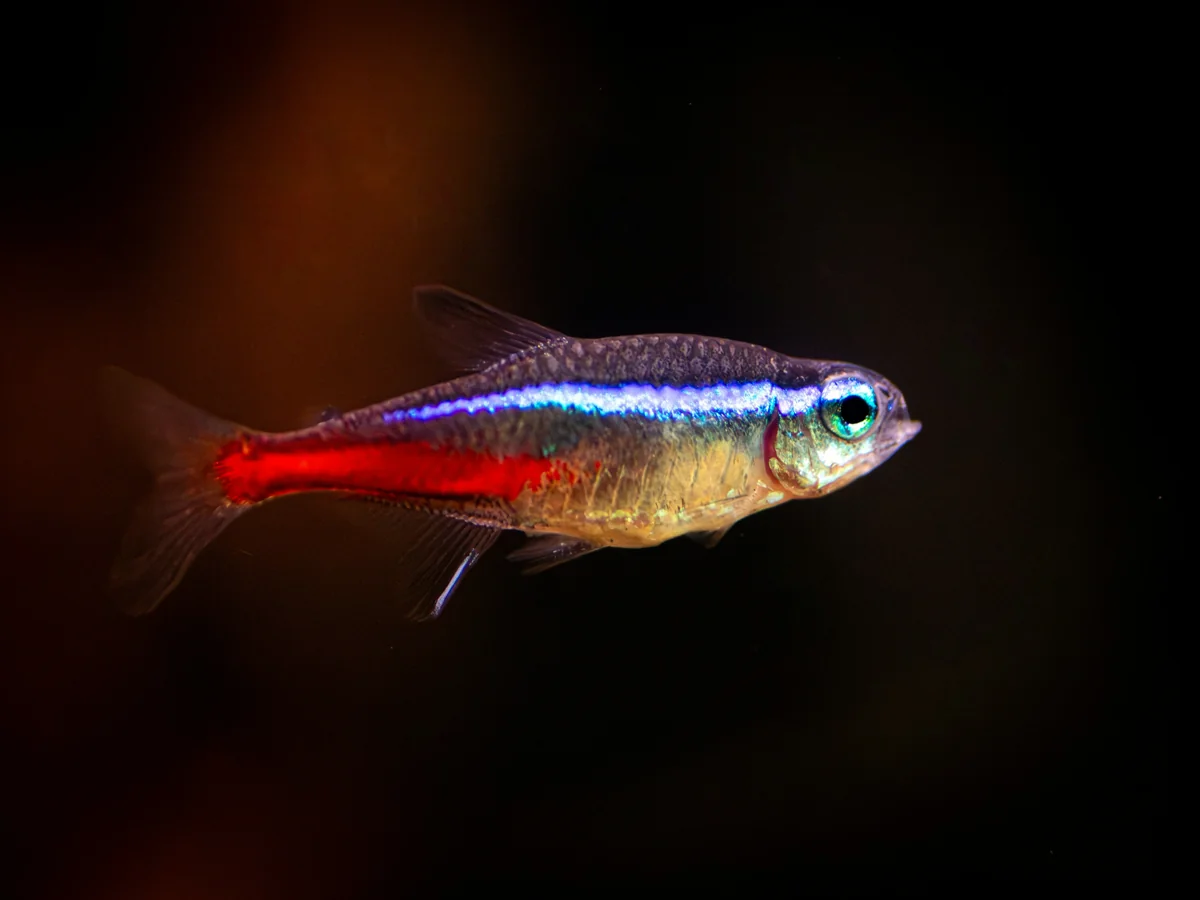
Adult Neon Tetras reach a maximum length of 1.5 inches (3.8 cm), though most commercially available specimens measure 1.0 to 1.2 inches (2.5 to 3.0 cm). The species displays sexual dimorphism: males are slimmer with a straight blue lateral line, while females are rounder-bodied with a slightly curved blue line, particularly when gravid. The iconic coloration consists of an iridescent electric blue stripe extending from the nose to the adipose fin, with a brilliant red stripe running from the middle of the body to the caudal peduncle. This red stripe distinguishes them from the Cardinal Tetra (Paracheirodon axelrodi), whose red coloration extends the full length of the body. The iridescent blue color is structural, produced by guanine crystal iridophores, and appears to shift between green and blue depending on viewing angle and light intensity.
Conservation and Trade
Wild populations are listed as Not Evaluated by the IUCN. The vast majority of specimens in the aquarium trade are commercially bred in Southeast Asia, Eastern Europe, and Florida. However, decades of mass production have resulted in significant inbreeding depression, producing fish with weaker immune systems, reduced color intensity, and shorter lifespans compared to wild-caught or carefully bred stock. Serious aquarists should seek out fish from reputable breeders who maintain genetic diversity or purchase wild-caught specimens from sustainable sources.
Care
Aquarium Care Requirements
Tank Size and Dimensions
The absolute minimum tank size for a school of Neon Tetras is 15 gallons (57 liters) with a footprint of at least 24 by 12 inches (60 by 30 cm). However, a 20-gallon long (76 liters, 30 by 12 inches or 76 by 30 cm) is strongly recommended. Tank height is less critical than length; these fish are lateral swimmers that require horizontal swimming space to exhibit natural schooling behavior. In tanks smaller than 15 gallons, water parameters fluctuate too rapidly for these sensitive fish, and adequate school sizes cannot be maintained.
Filtration and Water Flow
Use a sponge filter, hang-on-back filter with an intake sponge guard, or a canister filter with adjustable flow. Neon Tetras are small and weak swimmers; strong currents exhaust them and can cause them to be pinned against decor or sucked into filter intakes. Always cover filter intakes with fine foam pre-filters; multiple hobbyists report neon tetras disappearing overnight, only to find them deceased inside filter housings. The filter should turn over the tank volume 4 to 6 times per hour. Add a UV sterilizer to the system if Neon Tetra Disease has ever been present in the aquarium.
Substrate and Hardscape
Use dark fine gravel or sand substrate to replicate their natural habitat and enhance color display. Bright white or light substrates cause stress and washed-out coloration. Add driftwood, Indian almond leaves (Terminalia catappa), and botanicals to release tannins, lower pH naturally, and provide antimicrobial benefits. Rocks should be smooth and rounded; sharp edges can damage fins. Provide dense planting in the rear and sides of the tank, leaving the front center open for schooling.
Plant Recommendations
Plant densely with Cryptocoryne, Anubias, Java fern, Java moss, Amazon sword, and Vallisneria. Floating plants such as Amazon frogbit, red root floaters, or water lettuce are essential to diffuse overhead lighting and create the dim conditions neons prefer. Stem plants like Bacopa, Ludwigia, and Rotala provide additional cover and improve water quality through nutrient uptake.
Lighting
Maintain low to moderate lighting intensity for 8 to 10 hours daily. Bright lighting causes chronic stress, suppresses coloration, and promotes algae that competes with plants for nutrients. Use dimmable LED fixtures or position floating plants to create dappled light patterns simulating forest canopy cover. A siesta period (lights off for 2 to 3 hours midday) can reduce algae and mimic natural photoperiods.
Common Care Mistakes
- Adding neons to uncycled tanks: They are not true starter fish and require fully cycled, stable aquariums.
- Insufficient school size: Groups under 10 cause chronic stress and immunosuppression.
- Hard water without modification: Municipal tap water exceeding 8 dGH causes osmotic stress and organ damage.
- Overfeeding: These small fish have tiny stomachs; excess food degrades water quality rapidly.
- Skipping quarantine: Commercial neons frequently carry subclinical infections that explode in established tanks.
Diet
Diet and Feeding Protocol
Nutritional Requirements
Neon Tetras are omnivores with a dietary composition targeting 35 percent protein, 10 percent fat, and 55 percent plant matter and fiber. In the wild, they consume small crustaceans, insect larvae, zooplankton, algae, and detritus. In captivity, their small mouth size restricts them to foods under 1 millimeter in diameter.
Recommended Foods
- Staple: High-quality micro-pellets or crushed tropical flakes specifically formulated for small tetras. Look for products containing fish meal, shrimp meal, spirulina, and wheat germ as primary ingredients.
- Protein supplement (3 to 4 times weekly): Frozen or live baby brine shrimp (Artemia salina), cyclops, daphnia, and microworms. These provide essential fatty acids and carotenoids that enhance coloration.
- Plant matter (weekly): Spirulina powder, vegetable-based micro-pellets, or blanched zucchini pieces. Plant fiber supports digestive health and prevents constipation.
- Conditioning foods (breeding): Live blackworms, white worms, and enriched adult brine shrimp to bring females into spawning condition.
Feeding Schedule
Feed small portions twice daily, offering only what the school can consume within 2 minutes. A single feeding of crushed flakes in the morning and a protein supplement in the evening is ideal. Fast the tank one day per week to clear digestive tracts and reduce waste accumulation. Overfeeding is the primary cause of water quality degradation in neon tetra tanks.
Foods to Avoid
- Beef heart and mammalian proteins: Tetras lack the enzymes to digest mammalian lipids, leading to fatty liver disease and organ failure.
- Large pellets: Food particles exceeding 1 mm cannot be consumed and will foul the water.
- Low-quality generic flakes: Products containing excessive fillers (wheat, soy) provide poor nutrition and cloud water.
- Excessive live foods from outdoor sources: Risk introducing parasites and pathogens.
Expert Tip: Color Enhancement
To maximize red and blue coloration, provide foods rich in astaxanthin and canthaxanthin, such as krill-based flakes, color-enhancing micro-pellets, and cyclops. Maintain stable water parameters and dim lighting, as stress causes rapid color fading regardless of diet quality.
Health
Health, Disease, and Treatment Protocols
General Health Considerations
Neon Tetras are moderately hardy but suffer from significant genetic weaknesses due to decades of commercial inbreeding. Their small size makes them susceptible to rapid parameter fluctuations, and their scaleless relative sensitivity to medications requires careful dosing. The most critical health threat is Neon Tetra Disease (NTD), a fatal microsporidian infection with no cure. Prevention through strict quarantine, stable water chemistry, and sourcing from reputable breeders is far more effective than any treatment.
Medication Sensitivity
Neon Tetras are highly sensitive to several common aquarium medications. Copper-based treatments are toxic at concentrations above 0.1 mg per liter and should be avoided entirely. Formalin causes gill damage and respiratory distress. Malachite green must be dosed at quarter strength (0.025 mg per liter). Aquarium salt is poorly tolerated; concentrations above 3 ppt cause osmotic stress. Praziquantel is safe for internal parasites. Methylene blue is safe for quarantine and egg fungicide at half-strength. Antibiotics should be administered in food, not water, as freshwater fish do not drink and water-borne antibiotics are largely ineffective.
Preventive Health Measures
- Quarantine all new fish for 21 days minimum.
- Maintain nitrates below 15 ppm through weekly 20 percent water changes.
- Use a UV sterilizer to reduce free-floating pathogens.
- Source fish from reputable breeders rather than mass-market suppliers when possible.
- Never introduce wild-caught live foods without freezing or quarantine.
- Monitor for early NTD symptoms daily; early removal prevents spore release.
Neon Tetra Disease (Pleistophora hyphessobryconis)
A fatal microsporidian parasite infection that is currently incurable and highly contagious within the aquarium.
- Localized milky white or pale discoloration on the body, progressive spinal curvature (S-shaped or hitched spine), emaciation despite normal feeding, loss of schooling behavior, lethargy, and difficulty swimming. In advanced stages, snout chondromas (benign mouth tumors) may develop.
Ingestion of spores from infected fish, contaminated food, or detritus. Spores can remain viable in the substrate and filter media for extended periods.
Quarantine all new fish for 21 days. Source fish from reputable breeders. Remove and euthanize infected fish immediately upon diagnosis. Use a UV sterilizer. Perform frequent water changes and vacuum substrate thoroughly if NTD is suspected. Disinfect nets and equipment between tanks.
Ichthyophthirius multifiliis (Ich or White Spot Disease)
A common protozoan parasite causing white salt-grain-like spots on the body and fins.
- Small white cysts covering body, fins, and gills; rubbing against decor (flashing); rapid breathing; clamped fins; lethargy in advanced stages.
Introduction via new fish, plants, or equipment. Triggered by temperature fluctuations and stress-induced immunosuppression.
Quarantine all additions. Maintain stable temperature between 72 and 78 degrees Fahrenheit (22 to 26 degrees Celsius). Treat with gradual temperature increase to 82 to 84 degrees Fahrenheit (28 to 29 degrees Celsius) combined with half-dose malachite green (0.025 mg per liter). Avoid copper-based medications.
Columnaris (Flavobacterium columnare)
A bacterial infection often secondary to Neon Tetra Disease or physical injury, frequently misdiagnosed as fungal infection.
- White or grayish patches on mouth, fins, or body resembling cotton wool; frayed or eroded fin edges; ulcerations; lethargy; loss of appetite.
Bacterial infection entering through wounds or gill damage. Often secondary to NTD, poor water quality, or aggressive tank mates.
Fin Rot (Aeromonas, Pseudomonas species)
Bacterial degradation of fin tissue, typically beginning at the edges and progressing toward the body.
- Frayed, ragged, or receding fin edges with white, red, or black discoloration. In severe cases, fin tissue erodes to the fin base and may progress to body rot.
Poor water quality, especially elevated nitrates and organic waste. Often triggered by fin-nipping tank mates or physical damage from sharp decor.
Perform weekly 20 to 25 percent water changes. Remove aggressive fin-nipping tank mates. Treat with water changes and antibiotic food if bacterial. Ensure all decor has smooth, rounded edges.
Velvet Disease (Piscinoodinium pillulare)
A dinoflagellate parasite causing a fine yellow-gold dusting on the skin, often more dangerous than ich due to rapid progression.
- Fine yellow or gold dust covering the body, giving a velvety appearance; scratching against objects; rapid gill movement; clamped fins; lethargy. Often harder to see than ich, especially on silver fish.
Introduction via new fish or plants. Thrives in temperatures below 75 degrees Fahrenheit (24 degrees Celsius) and poor water quality.
Quarantine all additions. Raise temperature to 82 degrees Fahrenheit (28 degrees Celsius) and treat with copper-free anti-parasitic medication. Increase aeration during treatment. Dim lights, as the parasite contains photosynthetic pigments.
Dropsy (Edema / Fluid Retention)
A symptom of severe internal organ failure rather than a specific disease, characterized by fluid accumulation in the body cavity.
- Severe bloating with scales protruding like a pinecone (pineconing), bulging eyes, pale gills, lethargy, and loss of appetite. Scales may detach easily.
Bacterial infection (typically gram-negative aeromonas), kidney failure, liver disease, or advanced NTD compromising organ function.
Dropsy is extremely difficult to treat once external symptoms appear. Focus on prevention through pristine water quality, proper diet, and early removal of sick fish. Euthanasia is often the most humane option for advanced cases.
Breeding
Breeding Neon Tetras
Breeding Challenges
Breeding Neon Tetras in captivity is moderately difficult and requires precise environmental control. Commercial breeders use hormone injections, but home aquarists can achieve success through careful conditioning and dedicated spawning tanks. The primary challenges include triggering spawning behavior, protecting eggs from parental predation, and raising microscopic fry that require specialized first foods.
Parent Selection and Conditioning
Select 12 to 15 mature fish at least 12 months old. Sexually mature males display intense coloration and have slimmer bodies; females are rounder with a more pronounced belly when gravid. Separate males and females into different conditioning tanks for 7 to 10 days. Feed heavily with live baby brine shrimp, blackworms, white worms, and high-protein frozen foods. Maintain water temperature at 78 to 80 degrees Fahrenheit (25.5 to 26.5 degrees Celsius) during conditioning to accelerate gamete development.
Spawning Tank Setup
Set up a dedicated 10-gallon (38 liter) breeding tank with the following specifications:
- Water: Reverse osmosis water adjusted to pH 6.0, 1 dGH, and 76 degrees Fahrenheit (24 degrees Celsius). Use peat extract or Indian almond leaves to darken and acidify the water.
- Substrate: Bare bottom or dark fine gravel for easy cleaning and egg visibility.
- Spawning medium: Fine-leaved plants (java moss, christmas moss), spawning mops made of acrylic yarn, or a mesh grid raised 1 inch (2.5 cm) above the bottom to allow eggs to fall through.
- Lighting: Extremely dim. Cover three sides of the tank with black paper. Use a single 1-watt LED on a timer to simulate dawn.
- Filtration: Sponge filter with gentle air-driven flow. No hang-on-back filters that could suck up eggs or fry.
Spawning Procedure
Introduce conditioned males and females to the spawning tank in the evening at a ratio of 2 males to 1 female. Gradually reduce lighting over 2 hours until complete darkness. Spawning typically occurs within 1 to 3 hours after total darkness, stimulated by the simulated dawn light cycle. The female scatters 100 to 200 adhesive eggs among the plants or spawning mop while males fertilize them externally. Eggs are semi-transparent and approximately 1 mm in diameter.
Post-Spawning Care
Remove all adult fish within 6 hours of spawning to prevent egg predation. Neon Tetra eggs and fry are extremely light-sensitive; cover the tank completely with a dark towel or blanket for the first 7 days. Eggs hatch in 24 to 30 hours at 76 degrees Fahrenheit (24 degrees Celsius). Newly hatched fry absorb their yolk sacs for 3 to 4 days and remain attached to surfaces. Once free-swimming, they require infusoria as their first food. Feed infusoria 3 to 4 times daily for 5 days, then transition to microworms, vinegar eels, and finally baby brine shrimp after day 10. Perform daily 10 percent water changes with aged, temperature-matched RO water. Maintain total darkness except during feeding observations for the first 14 days.
Fry Development Timeline
- Day 0 to 1: Eggs adhesive, semi-transparent. No intervention required.
- Day 1 to 2: Hatching occurs. Fry have visible eyes but no free-swimming ability.
- Day 3 to 5: Yolk sac absorption. Begin infusoria feeding once fry are free-swimming.
- Day 6 to 10: Transition to microworms and vinegar eels. First coloration may appear faintly.
- Day 11 to 20: Introduce baby brine shrimp. Blue iridophores begin developing under proper lighting.
- Day 21 to 45: Juvenile coloration becomes visible. Red stripe develops last, around day 30 to 40.
- Month 3 to 6: Sexual differentiation begins. Full adult coloration achieved by month 6 to 8.
Tips
Expert Tips and Advanced Care
Genetic Quality and Sourcing
Modern commercially bred Neon Tetras suffer from severe inbreeding depression. Mass-market fish often display washed-out colors, shortened lifespans (2 to 3 years versus 5 to 8 years for quality stock), and heightened disease susceptibility. When possible, purchase from specialized breeders who maintain genetic diversity, or buy wild-caught specimens from sustainable Peruvian or Colombian exporters. Avoid fish with bent spines, faded stripes, or visible tumors, even in the store tank.
Blackwater Biotope Simulation
For optimal health and coloration, simulate a South American blackwater biotope. Add 2 to 3 Indian almond leaves per 10 gallons (38 liters), replace every 2 weeks. Add alder cones, oak leaves, or commercial blackwater extracts. Target a tea-colored water tint with tannins at 5 to 15 mg per liter. This environment reduces pathogen loads, supports immune function, and triggers natural behaviors rarely seen in standard community setups.
Filter Intake Protection
One of the most commonly overlooked hazards is filter intake suction. Neon Tetras measure only 1 to 1.5 inches (2.5 to 3.8 cm) and can easily be drawn into hang-on-back or canister filter intakes, especially when weakened by disease or stress. Always install fine-pore foam pre-filters on every intake tube. Check pre-filters weekly for clogging. If a fish goes missing, check the filter housing first before assuming escape or predation.
Acclimation Precision
Neon Tetras are among the most sensitive fish to parameter shock. Never use the float-and-dump method. Drip acclimation at 1 to 2 drops per second for 60 to 90 minutes is mandatory. Match pH within 0.3 units and temperature within 2 degrees Fahrenheit (1 degree Celsius). Even brief exposure to chlorine, chloramines, or pH swings above 0.5 units can trigger immunosuppression and latent disease expression.
School Size and Tank Length
The relationship between school size and tank length is critical. A school of 10 neons requires 24 inches (60 cm) of horizontal swimming space minimum. Each additional 5 fish requires 6 more inches (15 cm) of tank length. Inadequate length causes the school to break into subgroups, increasing individual stress. For a school of 20, use a 40-gallon breeder (36 by 18 inches or 91 by 46 cm) or larger.
Seasonal Parameter Shifts
In the wild, Neon Tetras experience seasonal flooding that dilutes water and lowers temperatures. Simulating a 2 to 3 degree Fahrenheit (1 to 1.5 degree Celsius) temperature drop and slightly increased water changes for 2 weeks can trigger spawning behavior in conditioned adults. This seasonal simulation also strengthens immune response by mimicking natural environmental cues.
UV Sterilization
Install a UV sterilizer rated for your tank volume to control free-floating pathogens, particularly the spores of Pleistophora hyphessobryconis. Run the UV at 30,000 microwatts per second per square centimeter for pathogen control. This is especially important if NTD has ever been diagnosed in your aquarium or if you frequently add new fish.
Common Expert Mistakes to Avoid
- Assuming neons are indestructible starter fish: They require stable, cycled systems.
- Keeping them with angelfish: Angelfish prey on neons in the wild; this is not a safe combination regardless of tank size.
- Using medications at full dose: Their small size and sensitivity require half-strength or quarter-strength treatments.
- Ignoring nighttime color fading: Learn the difference between normal nocturnal fading and pathological color loss.
- Skipping RO water for breeding: Tap water almost always contains minerals and pH buffers that prevent successful spawning.
Compatible Tank Mates






Neon Tetra vs Similar Species Comparison
| Feature | Neon Tetra | Cardinal Tetra | Glowlight Tetra | Ember Tetra |
|---|---|---|---|---|
| Scientific Name | Paracheirodon innesi | Paracheirodon axelrodi | Hemigrammus erythrozonus | Hyphessobrycon amandae |
| Adult Size | 1.5 in (3.8 cm) | 2.0 in (5.1 cm) | 1.6 in (4.0 cm) | 0.8 in (2.0 cm) |
| Temperament | Peaceful, schooling | Peaceful, schooling | Peaceful, schooling | Peaceful, schooling |
| Minimum Tank Size | 15 gal (57 L) | 20 gal (76 L) | 15 gal (57 L) | 10 gal (38 L) |
| Temperature Range | 70-78 F (21-26 C) | 73-81 F (23-27 C) | 72-80 F (22-27 C) | 73-84 F (23-29 C) |
| pH Range | 6.0-7.0 | 5.5-7.5 | 6.0-7.5 | 5.0-7.0 |
| Diet | Omnivore; micro-pellets, flakes, frozen foods | Omnivore; similar to neon but accepts larger foods | Omnivore; prefers live and frozen foods | Omnivore; tiny foods, micro-pellets, powdered flakes |
| Hardiness | Moderate; inbreeding depression in commercial stock | Moderate; slightly more robust than neons | Moderate to hardy | Hardy; very forgiving of parameters |
| Color Pattern | Blue stripe upper half, red stripe lower half; red does not extend full body length | Blue and red stripes extend full body length from gills to tail | Silvery body with bright orange-red stripe along lateral line | Solid bright orange-red body with slightly darker dorsal area |
| Price Range | $1-3 USD per fish | $3-6 USD per fish | $2-4 USD per fish | $3-5 USD per fish |