Synodontis Catfish Care Guide (Synodontis spp.)
Quick Answer
Synodontis Catfish (including the Upside-Down Catfish and Cuckoo Catfish) are hardy, armored African catfish. They require a minimum 30-75 gallon aquarium (depending on species) with pH 6.5-8.5. They are the ideal tank mates for aggressive African Cichlids. As omnivorous scavengers, they keep the substrate clean and thrive in groups of 3-5.
Quick Facts
| Scientific Name | Synodontis spp. |
|---|---|
| Common Names | Synodontis Catfish, Upside-Down Catfish, Cuckoo Catfish, Featherfin Squeaker |
| Family | Mochokidae |
| Genus | Synodontis |
| Type | Freshwater |
| Temperament | peaceful |
| Care Difficulty | intermediate |
| Lifespan | 10 years |
| Maximum Size | Up to 6 in (15 cm) |
| Diet | Omnivore |
| Temperature | 72–82°F (22–28°C) |
| pH | 6–8.5 |
| Hardness | 4–18 dGH |
| Minimum Size | 30 gallons |
Key Takeaways
- The best bottom-dwellers for an African Cichlid tank.
- Most are nocturnal; feed them sinking pellets just before turning the lights out.
- Use sand substrate to prevent their delicate sensory barbels from eroding.
- Provide numerous caves, PVC pipes, or stacked rocks for daytime hiding.
- Some species (Upside-Down Catfish) naturally swim belly-up.
Overview
Synodontis is a large genus of fascinating African catfish, widely known in the aquarium hobby for their unique behaviors, striking patterns, and tough armor. Some swim almost entirely upside down, some make squeaking noises when distressed, and some are the only fish known to parasitize the breeding behavior of other fish (brood parasitism).
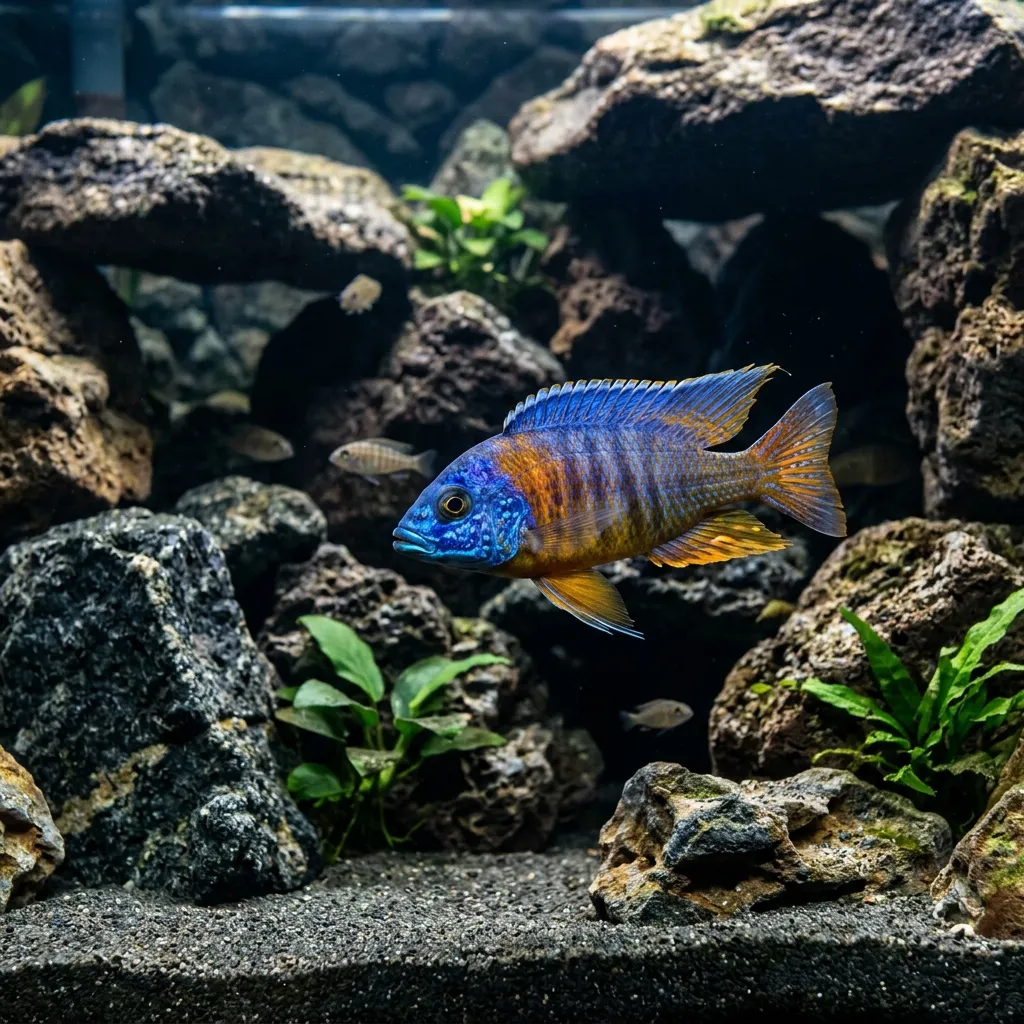
They are incredibly popular because they are one of the few bottom-dwelling fish robust enough, and biologically adapted enough, to share a tank with highly aggressive African Cichlids.
Ideal For
- African Cichlid keepers looking for a compatible bottom-dwelling cleanup crew.
- Aquarists wanting a unique oddball fish (like the Upside-Down catfish) for a community tank.
- Keepers wanting a long-lived, hardy, and disease-resistant catfish.
Appearance
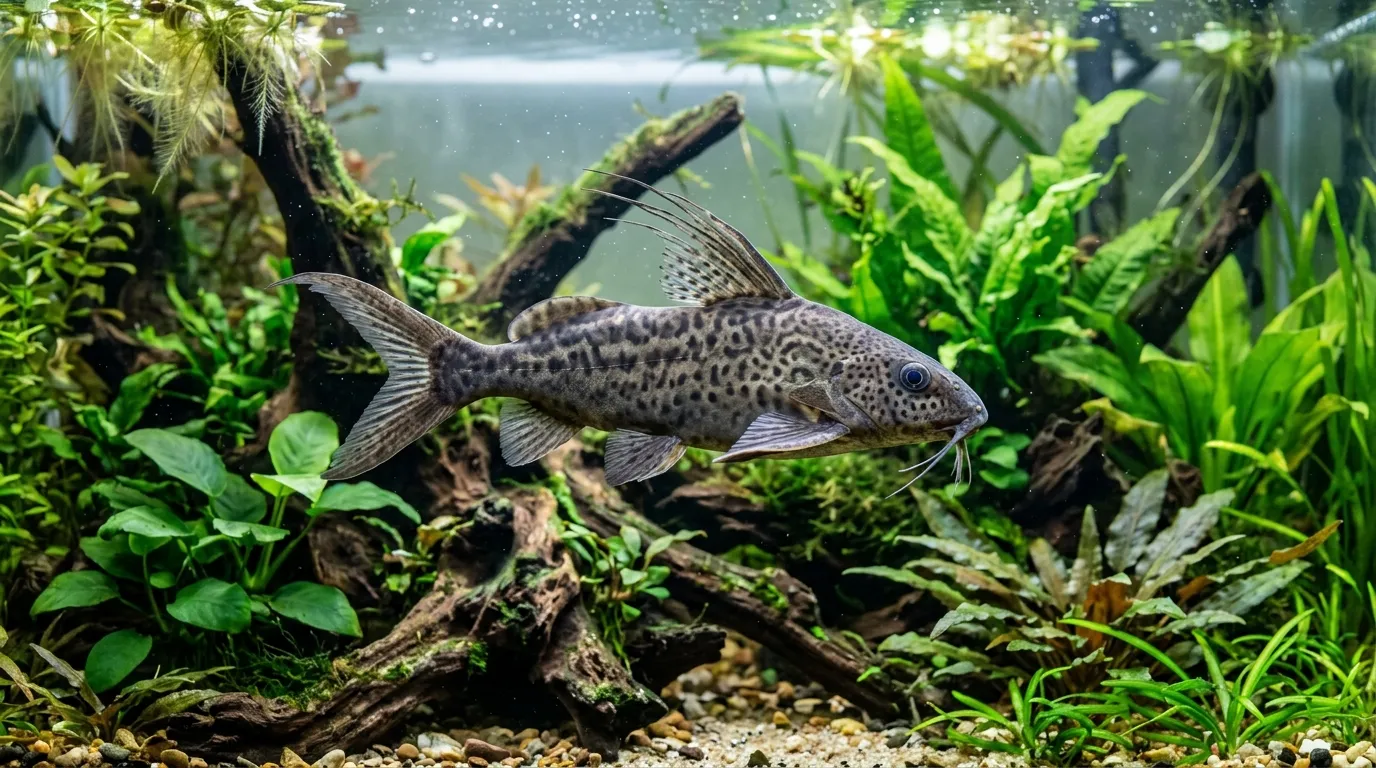
Synodontis catfish have a stout, somewhat humped body covered in tough, leathery skin rather than scales. They feature a heavily armored head and three pairs of barbels (whiskers) used to navigate and find food in the dark. The dorsal fin often has a sharp, serrated spine. Patterns range from the leopard-like spots of the S. multipunctatus (Cuckoo Catfish) to the high-contrast netting of the S. eupterus (Featherfin).
Natural Habitat
They are widely distributed across the African continent. Species like S. multipunctatus and S. petricola are endemic to the hard, alkaline waters of Lake Tanganyika. Others, like the Upside-Down Catfish (S. nigriventris), inhabit the softer, acidic, heavily vegetated rivers of the Congo Basin.
Care
Housing & Pond Requirements
The primary requirement for all Synodontis is plenty of hiding spots.
- Caves and Crevices: They are nocturnal and will spend the daylight hours wedged into tight spaces. Provide PVC pipes, stacked slate, or large hollow driftwood.
- Substrate: Sand is highly recommended. Sharp gravel can wear down their delicate barbels as they constantly forage along the bottom.
- Lighting: Dim lighting encourages them to venture out during the day. Brightly lit tanks will result in you rarely seeing them.
- Groups: Most species are highly social. Keeping a single specimen often leads to severe shyness. A group of 3-5 is ideal.
Water Parameters
Water parameters depend entirely on the specific species you purchase.
- Rift Lake Species (Cuckoo, Petricola): Require hard, alkaline water (pH 7.8-8.5, GH 10-18 dGH, KH 8-15 dKH, TDS 250-450 ppm) to match their cichlid tank mates.
- Riverine Species (Upside-Down Catfish): Prefer softer, neutral to slightly acidic water (pH 6.0-7.5, GH 4-10 dGH, KH 3-8 dKH, TDS 80-200 ppm).
They are generally adaptable but thrive when kept within their specific biotope parameters.
Temperature
72-82 degrees Fahrenheit (22-28 degrees Celsius).
pH
6.0-8.5, species-dependent.
Hardness (GH)
4-18 dGH, depending on species origin.
Carbonate Hardness (KH)
3-15 dKH.
Nitrates
Below 20 ppm.
Water Flow
Gentle to moderate. They appreciate well-oxygenated water but do not need strong currents.
Diet
Synodontis are opportunistic omnivorous scavengers. They are excellent at cleaning up leftover food that misses your mid-water fish.
- Staple: High-quality sinking pellets, algae wafers, and shrimp pellets.
- Treats: Frozen bloodworms, blackworms, mysis shrimp, and chopped earthworms.
- Vegetables: Blanched zucchini, cucumber, and peas.
- Schedule: Feed them just before turning the aquarium lights out at night to ensure they get enough to eat without competing with faster daytime fish.
Health
Synodontis are incredibly hardy and resilient. Because they lack scales, they are somewhat sensitive to certain medications.
Barbel Erosion
The whiskers wear away due to poor substrate.
- Barbels appear short, blunt, or reddened.
Using sharp, jagged gravel. High bacterial loads in the substrate (poor vacuuming).
Use sand substrate and vacuum regularly.
Ich (White Spot Disease)
Common protozoan parasite causing white salt-like spots on body and fins. Scaleless skin requires careful treatment selection.
- White salt-like spots on body and fins.
- Rubbing against decorations (flashing).
- Rapid breathing and clamped fins.
- Lethargy and loss of appetite.
Ichthyophthirius multifiliis parasite introduced via new fish or plants. Stress from temperature fluctuations or poor water quality. Overcrowding and inadequate quarantine procedures.
Quarantine all new fish and plants for 2-4 weeks. Maintain stable temperature between 72-82 degrees Fahrenheit. Use heat treatment (86 degrees Fahrenheit for 3 days) or scaleless-safe medications like malachite green at half dose. Avoid copper-based treatments which are toxic to scaleless catfish.
Bloat and Dropsy
Internal bacterial infection or blockage causing fluid retention and abdominal swelling. Often triggered by overfeeding or poor-quality food.
- Swollen, pinecone-like abdomen (scales sticking out).
- Lethargy and loss of appetite.
- Floating at the surface or sinking to the bottom.
- Clamped fins and rapid breathing.
Overfeeding or feeding spoiled, low-quality foods. Internal bacterial infection (Aeromonas or Pseudomonas). Poor water quality with high organic load and nitrate levels.
Feed appropriate portions (what they can eat in 2-3 minutes) 1-2 times daily. Maintain excellent water quality with regular testing and water changes. Treat early with broad-spectrum antibiotics like Kanamycin or Maracyn-Two. Use Epsom salt baths to reduce fluid retention.
Fungal Infections
Cotton-like fungal growth on barbels, fins, or body, often secondary to barbel erosion or injury.
- White, cotton-like patches on barbels, fins, or body.
- Frayed or disintegrating fins.
- Reddening at the base of affected areas.
- Lethargy and reduced foraging behavior.
Fungal infection (Saprolegnia) secondary to barbel erosion or physical injury. Poor water quality with high organic load. Stress from incompatible tank mates or inadequate hiding spots.
Use sand substrate to prevent barbel erosion. Maintain pristine water conditions with regular vacuuming. Treat with antifungal medications like Pimafix or Methylene Blue at reduced doses for scaleless fish. Provide adequate caves and hiding spots to reduce stress.
Breeding
Breeding in the home aquarium is very rare without hormonal injections, with the notable exception of the Cuckoo Catfish, which requires a host mouthbrooding cichlid to rear its young.
Some species like S. lucipinnis (Dwarf Petricola) have been successfully bred in captivity. They spawn in caves or flowerpots, with females laying small amber-colored eggs. The fry can be started on baby brine shrimp or microworms. Breeding often occurs around the full moon cycle.
For most Synodontis, sexing involves examining the genital papilla: females have a rounder, more pronounced papilla, while males have a longer, more triangular one. Females are often plumper and higher-bodied when carrying eggs.
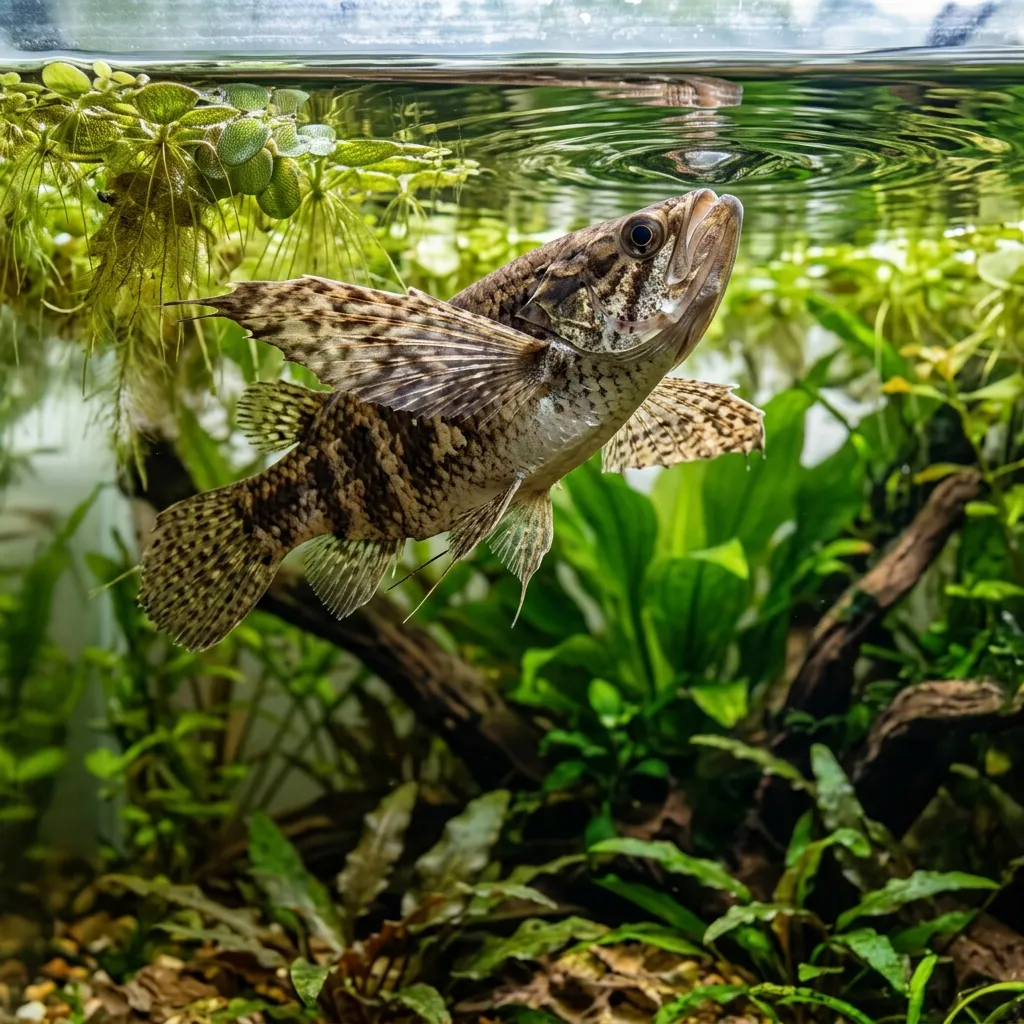
Compatible Tank Mates
Popular Synodontis Species Comparison
| Feature | Upside-Down Catfish | Cuckoo Catfish | Featherfin Squeaker |
|---|---|---|---|
| Scientific Name | S. nigriventris | S. multipunctatus | S. eupterus |
| Adult Size | 3-4 in (8-10 cm) | 5-6 in (13-15 cm) | 8-10 in (20-25 cm) |
| Min Tank Size | 30 gallons | 55 gallons | 75 gallons |
| Water pH | 6.0-7.5 (Soft/Neutral) | 7.5-8.5 (Hard/Alkaline) | 6.5-8.0 (Adaptable) |
| Best Tank Mates | Community fish, Tetras | African Cichlids | Large community or Cichlids |