
Tiger Barb Care Guide (Puntigrus tetrazona)
Quick Answer
Tiger Barb (Puntigrus tetrazona) is a highly active, schooling cyprinid requiring a minimum school of 8 to 12 individuals in a 30-gallon (113-liter) aquarium with a pH of 6.5 to 7.5 and temperature of 72 to 79 degrees Fahrenheit (22 to 26 degrees Celsius). As an omnivore with semi-aggressive intraspecific behavior, they demand careful tank mate selection and large group sizes to prevent fin-nipping redirection toward other species.
Quick Facts
| Scientific Name | Puntigrus tetrazona |
|---|---|
| Common Names | Tiger Barb |
| Family | Cyprinidae |
| Genus | Puntigrus |
| Type | Freshwater |
| Temperament | semi-aggressive |
| Care Difficulty | intermediate |
| Lifespan | 7 years |
| Maximum Size | Up to 3 in (8 cm) |
| Diet | Omnivore |
| Temperature | 72–79°F (22–26°C) |
| pH | 6.5–7.5 |
| Hardness | 5–15 dGH |
| Minimum Size | 30 gallons |
Key Takeaways
- Minimum school of 8 to 12 individuals; 15 to 20 is optimal for natural behavior
- Minimum 30-gallon (113 L) tank with 36-inch (90 cm) length for a school of 8
- Semi-aggressive intraspecific behavior; fin nipping is displaced social hierarchy behavior
- Never house with long-finned fish such as Angelfish, Bettas, or Guppies
- Never mix long-finned and short-finned Tiger Barb variants
- Temperature 72 to 79 degrees Fahrenheit (22 to 26 degrees Celsius); prefer cooler tropical range
- Omnivore requiring 35 to 40% protein with spirulina and vegetable fiber
- Quarantine new specimens 3 to 4 weeks; common carriers of Ich, flukes, and Camallanus worms
- Live 5 to 7 years with proper care; reach 2.5 to 3 inches (6.4 to 7.6 cm) in adulthood
Overview
Species Overview
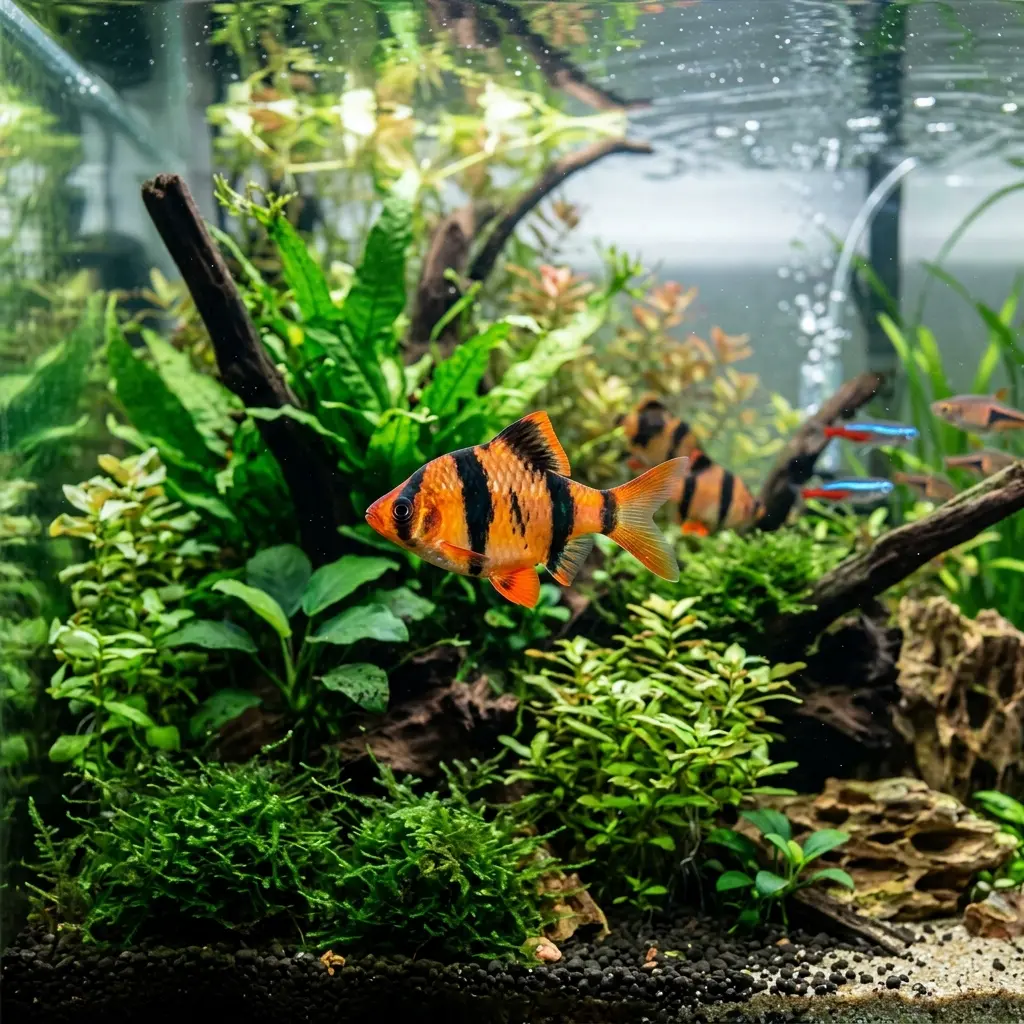
The Tiger Barb (Puntigrus tetrazona) is one of the most recognizable and widely distributed ornamental cyprinids in the aquarium trade. Native to the clear, moderately flowing streams and peat swamp forests of Sumatra, Borneo, and the Malay Peninsula, this species has been a staple of freshwater aquaria since the early twentieth century. Their striking color pattern of four vertical black bands against a vibrant orange-yellow body with red-edged fins makes them immediately identifiable even to novice aquarists.
The taxonomy of the Tiger Barb has undergone repeated revision. Older literature places them in Barbus tetrazona, Puntius tetrazona, or Capoeta tetrazona. The currently accepted scientific designation is Puntigrus tetrazona, though some ichthyologists argue that the aquarium strain may actually represent Puntigrus anchisporus and that true P. tetrazona has never entered the ornamental trade in significant numbers. For practical aquarist purposes, Puntigrus tetrazona remains the standard reference.
Physical Characteristics and Variants
Standard Tiger Barbs reach 2.5 to 3 inches (6.4 to 7.6 cm) in total length, with males remaining slightly smaller and more slender than females. Females develop a noticeably rounder, heavier abdomen when gravid. Males display more intense color saturation, particularly the bright red nasal coloration and deeper black banding that intensifies during spawning condition.
Through decades of selective breeding and genetic modification, several color variants exist. These include the Green Tiger Barb, which exhibits a metallic emerald body with black bands; the Albino Tiger Barb, displaying cream-pink bodies with faint banding; the Gold Tiger Barb; and the GloFish transgenic line with fluorescent coloration. Long-finned variants of all color morphs are commercially available. You must never mix long-finned and short-finned variants in the same tank. The disparity in swimming speed and maneuverability causes the short-finned majority to relentlessly harass and damage the slower long-finned individuals.
Natural Habitat and Behavior
In their native range, Tiger Barbs inhabit shallow, slow-moving tributaries, forest pools, and flooded peat swamps with dense marginal vegetation and submerged leaf litter. Water is typically soft to moderately hard, acidic to neutral, and stained with tannins from decaying botanical matter. They form large schools numbering in the hundreds, moving as cohesive units through open water columns and retreating to plant borders when threatened by predators such as snakeheads and larger cyprinids.
Their reputation as fin nippers is a direct consequence of their natural social structure. Within schools, Tiger Barbs establish and maintain dominance hierarchies through brief chasing, lateral displays, and gentle nipping. All members of the school participate in and understand this behavioral language. When aquarists keep them in groups too small to sustain natural hierarchy dynamics, the fish redirect these behaviors toward tank mates that do not understand the rules, resulting in what appears to be aggression but is actually displaced social behavior.
Care
Housing and Aquarium Requirements
Tank Size and Dimensions
The absolute minimum aquarium for a school of Tiger Barbs is 30 gallons (113 liters) with a length of at least 36 inches (90 cm) and a width of 12 inches (30 cm). A school of 8 to 12 individuals requires this baseline volume. For every additional 4 to 5 barbs, add 10 gallons (38 liters) of water volume. A 55-gallon (208-liter) aquarium measuring 48 by 13 by 21 inches (122 by 33 by 53 cm) provides superior conditions for a school of 15 to 20 adults and significantly reduces redirected aggression.
Tank height is less critical than length and width. Tiger Barbs are horizontal schooling fish that cruise the middle water column. Tall, narrow tanks restrict their natural weaving and burst-speed behaviors. You must provide open swimming lanes at least 18 inches (45 cm) wide with unobstructed horizontal travel paths. Avoid cluttered aquascapes that force constant direction changes.
School Size Requirements
The single most critical factor in Tiger Barb husbandry is school size. You must never keep fewer than 8 individuals. Groups of 6 or fewer produce chronic stress, abnormal aggression redirection, and fin-nipping of tank mates. A school of 8 to 12 is the functional minimum. A school of 15 to 20 individuals is optimal, allowing natural hierarchy establishment entirely within the group. In very large tanks of 75 gallons (284 liters) or more, schools of 25 or more display the most natural, peaceful behavior and create a spectacular visual display.
Maintain a sex ratio of 1 male to 2 or 3 females. All-male groups escalate aggression as males compete for dominance. All-female groups function adequately but lack the intense color displays and spawning behaviors that make the species visually rewarding.
Filtration and Water Flow
Tiger Barbs prefer moderate water flow rather than strong current. Size filtration at 4 to 6 times the tank volume per hour. A 30-gallon (113-liter) aquarium requires a filter rated for 120 to 180 gallons per hour (450 to 680 liters per hour). Canister filters with adjustable outflow or hang-on-back units with flow diffusers are ideal. High-velocity currents exhaust these fish and suppress natural schooling behavior. Position filter outflows to create gentle circulation rather than torrential streams.
Provide surface agitation for gas exchange but avoid bubble wands or air stones that create turbulent vertical currents. Tiger Barbs are obligate air-breathers only in oxygen-depleted conditions; under normal filtration they obtain sufficient dissolved oxygen from water movement.
Substrate and Decor
Use smooth, rounded gravel 2 to 4 mm in diameter or fine pool-filter sand. Dark substrates enhance the contrast of their black stripes and orange bodies. Avoid white or brightly colored gravel, which causes stress-induced color fading. Tiger Barbs do not dig extensively, so substrate depth of 1 to 2 inches (2.5 to 5 cm) is sufficient.
Hardscape should include smooth river rocks, driftwood with rounded edges, and terracotta caves. Avoid sharp lava rock or rough slate that can abrade scales during high-speed chasing. Plant selection is critical: use dense border plantings of Cryptocoryne, Java Fern, Anubias, and Vallisneria along the rear and sides of the tank, leaving the front and center open for schooling. Floating plants such as Water Sprite, Salvinia, or Frogbit provide dappled shade and security without obstructing swimming lanes. Tiger Barbs may nibble tender plants such as Cabomba or Elodea but generally ignore tougher-leaved species.
Heating and Temperature Management
Tiger Barbs thrive at 72 to 79 degrees Fahrenheit (22 to 26 degrees Celsius). They tolerate brief excursions to 68 degrees Fahrenheit (20 degrees Celsius) and 82 degrees Fahrenheit (28 degrees Celsius) but suffer chronic stress outside their preferred range. In heated homes maintained at 70 to 75 degrees Fahrenheit (21 to 24 degrees Celsius), they often do not require an aquarium heater. Set heaters to 75 degrees Fahrenheit (24 degrees Celsius) as a safeguard against temperature drops rather than as an active heating target. Overheating above 80 degrees Fahrenheit (26.5 degrees Celsius) accelerates metabolism, increases oxygen demand, and shortens lifespan.
Diet
Diet and Nutritional Requirements
Feeding Biology
Tiger Barbs possess a true stomach and moderate-length intestinal tract, making them more efficient digesters than stomachless cyprinids such as goldfish. They are opportunistic omnivores in the wild, consuming insect larvae, small crustaceans, zooplankton, algae, and detritus. In captivity, they accept virtually any appropriately sized food, but dietary monotrophy produces washed-out coloration, reduced immune function, and shortened lifespan.
Macronutrient Requirements
Adult Tiger Barbs require a diet containing 35 to 40 percent protein, 8 to 12 percent fat, and significant plant-derived fiber and carbohydrates. Juveniles under 3 months of age benefit from 42 to 45 percent protein for rapid growth. Fat content exceeding 15 percent causes hepatic lipidosis and obesity in this active species. Fiber below 3 percent leads to constipation and gastrointestinal stasis.
Recommended Foods
- Staple Dry Foods: High-quality tropical micro-pellets or small granules such as Tetra Color Tropical Granules, Omega One Super Color Flakes, or Hikari Micro Pellets. Choose formulations with spirulina, krill meal, and fish meal as primary ingredients.
- Live and Frozen Foods: Bloodworms, tubifex worms, daphnia, brine shrimp, mosquito larvae, and blackworms. These provide essential amino acids, stimulate hunting behavior, and intensify coloration. Feed live foods 2 to 3 times weekly.
- Vegetable Matter: Spirulina flakes, blanched peas with skins removed, zucchini slices, cucumber, and lettuce. Vegetable fiber maintains gastrointestinal motility and provides B-vitamins. Offer vegetable matter at least twice weekly.
Foods to Avoid
You must never feed beef heart, mammalian meats, or bread to Tiger Barbs. Mammalian proteins contain lipids and structural proteins that cyprinids cannot metabolize, causing intestinal blockage and organ damage. Bread expands in the gut and provides zero nutritional value. Avoid large pellets designed for cichlids; Tiger Barbs have small throats and can choke on food exceeding 2 mm in diameter. Soak freeze-dried foods in tank water for 60 seconds before feeding to prevent expansion in the stomach.
Feeding Schedule
Feed adult Tiger Barbs 2 to 3 percent of their body weight daily, divided into two feedings. Morning and evening feedings 12 hours apart optimize digestion. Observe the 2-minute rule: offer only what the school consumes completely within 2 minutes. Remove all uneaten food immediately to prevent ammonia spikes and fungal growth. Increase feeding frequency to three times daily for juvenile fish under 2 inches (5 cm) to support rapid growth.
Breeding
Breeding Tiger Barbs
Sexual Dimorphism and Selection
Tiger Barbs are sexually dimorphic, though the differences are subtle outside of spawning condition. Males are smaller, more slender, and display brighter, more saturated coloration with vivid red nasal patches and sharply defined black bands. Females are larger, deeper-bodied, and develop a noticeably rounded, soft abdomen when carrying eggs. Select breeders at least 9 months old and 2 inches (5 cm) in body length. Choose the most vividly colored males and the plumpest females for optimal genetic quality.
Conditioning and Triggering
You must condition breeders separately for 2 weeks on a diet of live blackworms, bloodworms, and brine shrimp supplemented with spirulina flakes. The critical spawning trigger is a simulated rainy season. Lower the water level in the breeding tank by 1 inch (2.5 cm) and maintain temperature at 75 degrees Fahrenheit (24 degrees Celsius) for 3 days. Then sprinkle slightly cooler water, 2 to 3 degrees Fahrenheit (1 to 1.5 degrees Celsius) below tank temperature, into the aquarium using a spray bottle or airline tubing. The vibrations and temperature drop mimic monsoon rainfall and trigger hormonal spawning cascades. Increase photoperiod to 14 hours during conditioning.
Spawning Setup
Use a dedicated breeding tank of 20 gallons (75 liters) with 5 inches (12 cm) of water depth. The shallow water concentrates hormones and facilitates egg fertilization. Install spawning mops made of acrylic yarn, fine-leaf plants such as Java Moss or Cabomba, or cover the bare bottom with a layer of glass marbles or a plastic spawning grid. These barriers allow eggs to fall out of reach of the parents.
Introduce 1 male and 2 females or 2 males and 4 females to the breeding tank in the evening. Spawning occurs at dawn, typically within 12 to 24 hours of introduction. The female scatters 200 to 300 adhesive eggs over plants and substrate while males fertilize them externally. Once spawning is complete, remove all adults immediately. Tiger Barbs exhibit no parental care and will consume every egg within hours.
Egg and Fry Development
Eggs hatch in 24 to 36 hours at 72 to 75 degrees Fahrenheit (22 to 24 degrees Celsius). Newly hatched fry attach to surfaces for 2 to 3 days while absorbing their yolk sacs. Do not feed during this period. Once free-swimming, offer infusoria, vinegar eels, or liquid fry food for the first 4 days. Transition to microworms and newly hatched brine shrimp nauplii from day 5 to day 14. By week 3, introduce finely crushed high-quality flake or micro-pellets.
Fry require pristine water conditions with daily 15 to 20 percent water changes using matched temperature and pH. Maintain temperature at 75 to 78 degrees Fahrenheit (24 to 25.5 degrees Celsius) for optimal growth. Tiger Barb fry grow rapidly, reaching 1 inch (2.5 cm) within 6 to 8 weeks under optimal conditions. Cull severely deformed fry humanely. Color bands develop gradually and become distinct by 8 to 10 weeks of age.
Tips
Expert Tips and Common Mistakes
Critical Success Factors
- School Size is Everything: A group of 6 Tiger Barbs is not a school; it is a behavioral time bomb. You must keep 12 or more for natural behavior. In a 55-gallon tank, a school of 20 produces a breathtaking display of coordinated schooling with minimal redirected aggression.
- Tank Length Over Volume: A 30-gallon breeder tank is inferior to a 40-gallon long tank for Tiger Barbs. Horizontal swimming distance matters more than total water volume.
- Never Mix Fin Types: Standard short-fin Tiger Barbs will destroy long-finned variants. Keep each fin type in separate, species-only schools.
- Quarantine is Mandatory: Farmed Tiger Barbs frequently carry latent Ich, flukes, and Camallanus worms. A 3 to 4 week quarantine with prophylactic treatment prevents catastrophic main-tank outbreaks.
Common Mistakes to Avoid
- Keeping 2 to 5 Individuals: Small groups redirect all hierarchy behavior toward tank mates, destroying community tanks and killing long-finned fish.
- Housing with Long-Finned Species: Angelfish, Bettas, Guppies, and Veiltail variants will be finned to death. This is not optional advice; it is a biological certainty.
- Overfeeding Dry Foods: Excessive flake food causes obesity and bloat. Feed measured portions and include substantial live and vegetable matter.
- Insufficient Filtration: Despite their small size, Tiger Barbs are messy eaters. Inadequate filtration allows uneaten food to decay, causing ammonia spikes and bacterial infections.
- Ignoring Temperature: Keeping Tiger Barbs at 82 degrees Fahrenheit (28 degrees Celsius) or above accelerates metabolism, reduces lifespan, and increases disease susceptibility. They prefer the cooler end of the tropical range.
- Adding New Fish at Night: Introducing new barbs after lights out triggers lethal aggression from the established hierarchy. Always introduce during daylight with immediate feeding.
Behavioral Observation Guide
Healthy Behavior: Tight schooling in the middle water column, vivid stripes, immediate response to feeding, brief conspecific chasing without persistent targeting.
Stress Indicators: Faded stripes, hiding in corners, separated from the school, clamped fins, rapid breathing, refusal to eat.
Aggression Redirection: Persistent single-target chasing of non-barb tank mates, fin damage on community fish, one barb dominating the entire tank. These indicate insufficient school size or inadequate tank dimensions.





