Overfeeding
Technical Specifications & Benchmark Matrix
- First Response Protocol
- Review feeding and water conditions; remove uneaten food when appropriate; choose any response based on livestock and measured conditions.
Overview
Aquarium overfeeding happens when fish receive more food than they can reasonably consume. Uneaten food remains in the tank, where it breaks down and adds organic waste to the aquarium. Over time, this can increase ammonia and other nitrogenous waste, contribute to poorer water chemistry, and place additional pressure on the aquarium's biological filtration.
The effects of overfeeding can build gradually. Excess food and waste can contribute to cloudy water, elevated nutrient levels, algae growth, and digestive problems in fish. If you suspect that you have been overfeeding, reduce the amount offered at each feeding, remove visible uneaten food, and check the aquarium's water parameters. If ammonia or nitrite readings are elevated, assess those parameters separately and choose any response based on the livestock and measured conditions; the linked calculator estimates nitrate dilution only.
Signs of Overfeeding
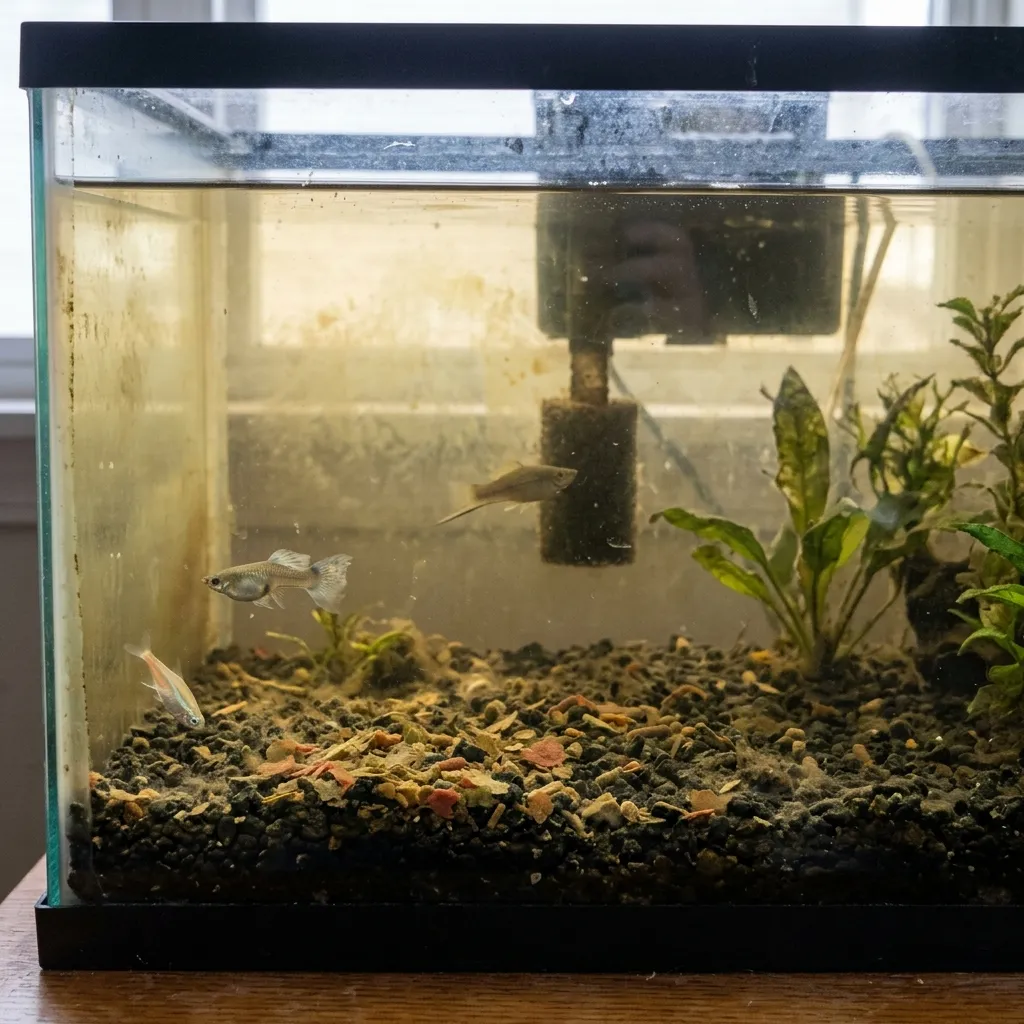
Uneaten food remaining after feeding may be a sign to review portions. If food is still floating or sitting on the substrate several minutes after feeding, the portion may be larger than the fish can consume promptly.
Other signs can include:
- Uneaten food collecting on the substrate, decorations, or around the filter intake.
- Cloudy water, particularly when it occurs alongside excess food or other signs of increased organic waste.
- Algae growth, which can have multiple possible contributors.
- Fish appearing bloated or showing digestive discomfort after consistently large meals.
- Ammonia or nitrite readings that may warrant reviewing feeding alongside other conditions.
- Food accumulating in areas that are difficult to clean, such as gravel or decorations.
Cloudiness after feeding may be associated with food particles or changing organic waste, but timing alone does not identify the cause. Consider other aquarium conditions and check water parameters when concerned.
None of these signs alone proves that overfeeding is the cause. A swollen belly, for example, can also result from bacterial infection, dropsy, internal parasites, or egg retention. Aquarium problems can have several causes, so check water parameters and consider the tank's overall maintenance routine before changing other parts of the setup.
Why Overfeeding Causes Water Quality Problems
Uneaten fish food becomes additional organic waste in the aquarium. As microorganisms break this material down, it contributes nitrogenous waste that can increase ammonia levels. Beneficial bacteria in an established biological filter then process ammonia into nitrite and subsequently nitrate as part of the aquarium nitrogen cycle.
This process is normally an important part of a functioning aquarium, but excessive food creates an additional waste load. If the amount of waste exceeds what the aquarium's biological filtration and maintenance routine can handle, ammonia or nitrite can accumulate to harmful levels.
Uneaten food and other organic material may contribute nutrients; algae and water chemistry can be affected by multiple factors.
In a new or immature aquarium, the risk can be greater because the biological filter may not yet have developed enough capacity to process the aquarium's waste load efficiently. This is one reason controlling feeding is particularly important during aquarium cycling and shortly after adding fish.
How to Fix Overfeeding
The simplest correction is to reduce the amount of food offered at each feeding. Offer an amount suited to the species and life stage, observe consumption, and adjust portions to avoid routinely leaving food uneaten. Feeding requirements vary considerably by species, fish size, food type, and the number of fish in the aquarium, so there is no single portion size that is correct for every tank.
If food remains uneaten after feeding:
- 1Remove visible leftover food with a net, siphon, or suitable aquarium-cleaning tool.
- 2Reduce the next feeding rather than adding more food to compensate.
- 3Check ammonia and nitrite if excessive feeding has been occurring repeatedly.
- 4Continue normal aquarium maintenance and monitor water quality.
- 5For ammonia or nitrite concerns, assess those parameters separately and choose any response based on livestock and measured conditions.
Do not rely on fasting alone to correct poor water quality. Stopping food may reduce the production of additional waste, but it does not immediately remove ammonia, nitrite, or dissolved nutrients that are already present in the aquarium.
Whether to reduce or pause feeding depends on the species and circumstances; do not use fasting alone to correct water quality. Persistent swelling, abnormal swimming, loss of appetite, or other concerning symptoms should not automatically be attributed to overfeeding.
How Much Should You Feed Fish?
There is no universal amount of food that every aquarium should receive. Fish have different nutritional requirements, and feeding needs change with species, age, size, activity level, temperature, and the type of food being used.
Instead of relying on a fixed measurement, start with a small portion and observe how quickly the fish consume it. Offer an amount suited to the species and life stage, observe consumption, and adjust portions to avoid routinely leaving food uneaten. The goal is to provide enough food to meet their nutritional needs without routinely leaving significant amounts uneaten.
Watch the fish during feeding and adjust the portion gradually. If food consistently remains after feeding, reduce the next portion. If the fish consume everything immediately and remain active and healthy, the portion may need to be adjusted based on the species and feeding schedule rather than simply increasing food automatically.
Preventing Aquarium Overfeeding
Consistent feeding habits are one of the easiest ways to prevent overfeeding. Measure or portion food deliberately instead of adding an amount based only on habit.
- Feed an appropriate amount for the species and number of fish.
- Observe feeding behavior rather than assuming that hungry-looking fish always need more food.
- Remove significant leftover food instead of allowing it to accumulate.
- Keep feeding portions consistent from one feeding to the next.
- If several people feed the aquarium, agree on a single feeding schedule and portion.
- Monitor ammonia, nitrite, and nitrate when troubleshooting recurring water-quality problems.
- Maintain the aquarium's normal filtration and water-change routine.
Some aquarists occasionally skip a feeding, but this should not be treated as a universal requirement for every fish. Feeding frequency should be based on the species, life stage, health, and overall aquarium conditions.
Overfeeding and the Nitrogen Cycle
Overfeeding is closely connected to the aquarium nitrogen cycle because excess food becomes additional organic waste. As that waste decomposes, it can increase the amount of nitrogenous material that the biological filter must process.
In an established aquarium, beneficial bacteria convert ammonia to nitrite and then nitrate. However, biological filtration has a finite capacity. Adding substantially more waste through excessive feeding can therefore contribute to ammonia or nitrite accumulation, particularly in a new aquarium or one with an immature biological filter.
If you are troubleshooting repeated ammonia or nitrite problems, review feeding habits alongside stocking levels, filtration, aquarium maturity, and maintenance rather than assuming that feeding is the only possible cause.
When to Check Water Parameters
Testing the water is especially useful when overfeeding has occurred repeatedly or when fish show signs of stress. Check ammonia and nitrite first when there is concern about toxic nitrogenous waste, and monitor nitrate levels as part of the aquarium's normal maintenance routine.
If ammonia or nitrite is detectable at a concerning level, take appropriate corrective action promptly. Reducing additional waste, removing uneaten food, maintaining adequate biological filtration, and performing an appropriate water change can all be part of restoring stable conditions.
The Aquarium Water Change Calculator estimates a single nitrate-dilution change and does not calculate ammonia or nitrite dilution or select a treatment.
Frequently Asked Questions
What happens if you overfeed fish?
Uneaten food remains in the aquarium and eventually breaks down into additional organic waste. This can increase the aquarium's waste load, contribute to ammonia and nitrite problems, and provide additional nutrients that can encourage algae growth.
Can overfeeding cause cloudy aquarium water?
Cloudiness after feeding may be associated with food particles or changing organic waste, but timing alone does not identify the cause. Consider other aquarium conditions and check water parameters when concerned.
Can overfeeding cause ammonia spikes?
Excess food can add organic waste that contributes to ammonia production. Whether ammonia accumulates depends on the aquarium's biological filtration and conditions; check test results and consider other possible sources.
How long can uneaten fish food stay in the tank?
Uneaten food should not be intentionally left in the aquarium. Remove significant leftover food as soon as practical rather than allowing it to accumulate and decompose.
Should I stop feeding my fish if I overfed them?
Do not assume that a prolonged fast is necessary for every fish. Whether to reduce or pause feeding depends on the species and circumstances; do not use fasting alone to correct water quality. More importantly, remove leftover food and check water quality if excessive feeding has occurred.
Does overfeeding cause algae?
Uneaten food may be one contributor to nutrient inputs, but algae growth can have multiple causes. Consider lighting, nutrients, maintenance, and other aquarium conditions.
How can I prevent overfeeding my fish?
Start with small, appropriate portions, observe how quickly the fish consume the food, and adjust feeding amounts based on the species and aquarium conditions. Avoid routinely leaving uneaten food in the tank and keep feeding practices consistent.
Run Precision Calculations For Your Setup
Check species compatibility, volumetric displacement, and filtration turnover benchmarks for your specific aquarium parameters.
🐟 Associated Species Profiles & Susceptibility
Browse All Fish Profiles →
⚙ Diagnostic & Sizing Calculators
Estimate a single water-change percentage and volume to dilute measured nitrate toward a selected target.
Estimate the net usable water volume in your aquarium.
Estimate realistic fish stocking capacity using adult size, bioload, filtration, swimming space, tank maturity, plants, and maintenance habits. Suitable for community tanks, cichlids, predators, and planted aquariums.
Overfeeding Corrective Actions Compared
| Action | Purpose | Cost | Timing | Notes |
|---|---|---|---|---|
| Adjust feeding amount and frequency | Match feeding to species, needs, stocking, and observed consumption | Varies | Monitor over time | No universal precise feeding-time rule |
| Remove uneaten food when appropriate | Reduce food left to decompose | May require suitable tools | As appropriate to the setup | Continue monitoring water quality |
| Review other contributing conditions | Consider water quality, filtration, stocking, lighting, and maintenance | Varies | Based on findings | Do not assume overfeeding is the only cause |
Frequently Asked Questions
What are the signs I'm overfeeding my fish?
How much food is too much for a fish tank?
Can overfeeding cause ammonia spikes?
Does overfeeding cause algae bloom?
Can overfeeding make a fish bloated or sick?
How long can I stop feeding to correct overfeeding damage?
Why does my water get cloudy every time I feed?
Is it possible to underfeed while trying to avoid overfeeding?
Sources & References
- Publisher:Academic Press
- Accessed:2026-10-14
- Overfeeding as a Primary Contributor to Ammonia Loading in Home Aquaria
- Source:American Association of Fish Veterinarians
- Nutrient Loading and Algal Bloom Thresholds in Ornamental Aquaria
- Source:Journal of Aquatic Plant Management
- Digestive Disorders Associated with Feeding Practices in Captive Fish
- Source:Journal of Fish Diseases