
Panda Corydoras (Corydoras panda)
Quick Answer
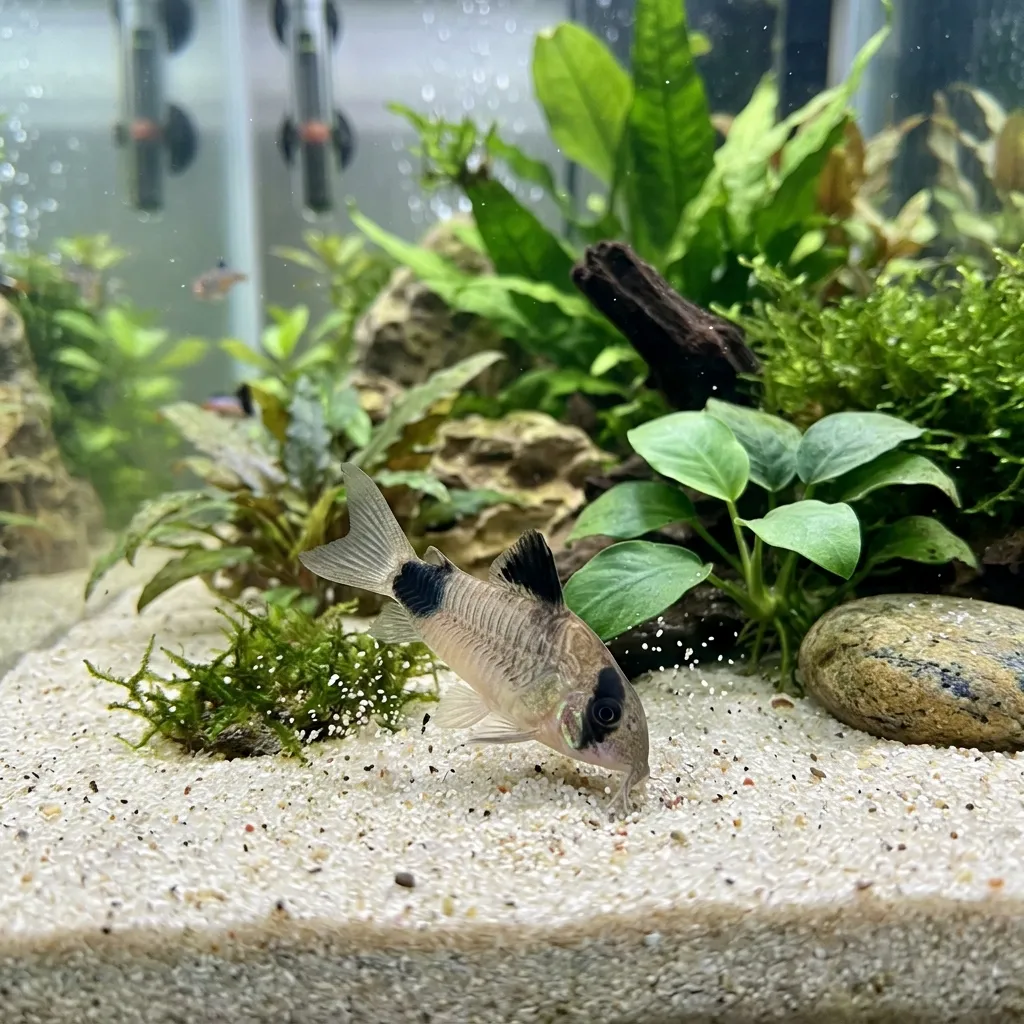
Panda Corydoras (Corydoras panda) is a captivating and highly sought-after freshwater bottom-dwelling species endemic to the upper Amazon basin of Peru. It requires a minimum 20 gallon (75.7 liter) aquarium with a pH of 6.0 to 7.2 and temperature range of 68°F to 77°F (20°C to 25°C). This peaceful omnivore must be kept in groups of 6 or more and makes an exceptional addition to planted community setups with soft sandy substrate.
Quick Facts
| Scientific Name | Corydoras panda |
|---|---|
| Common Names | Panda Corydoras |
| Family | Callichthyidae |
| Genus | Corydoras |
| Type | Freshwater |
| Temperament | peaceful |
| Care Difficulty | beginner |
| Lifespan | 5 years |
| Maximum Size | Up to 2 in (5 cm) |
| Diet | Omnivore |
| Temperature | 68–77°F (20–25°C) |
| pH | 6–7.2 |
| Hardness | 2–10 dGH |
| Minimum Size | 20 gallons |
Key Takeaways
- Requires a minimum group of 6 to 8 individuals; solitary keeping causes fatal stress.
- Requires a minimum 20 gallon aquarium with soft sand substrate; gravel causes barbel erosion and death.
- Cool-water specialist requiring temperatures between 68°F and 77°F (20°C and 25°C).
- Scaleless and extremely sensitive to copper and formalin medications.
- Obligate bottom-dwelling omnivore requiring sinking foods that reach the substrate.
- Endemic to Peru; simulate mountain stream conditions with driftwood, leaf litter, and gentle filtration.
Overview
Species Overview and Natural History
The Panda Corydoras (Corydoras panda) is one of the most visually striking and behaviorally engaging members of the Callichthyidae family. First described by Nijssen and Isbrucker in 1971, this species is endemic to the cool, fast-flowing tributaries of the upper Amazon basin in Peru, specifically the Rio Aquas Claras and Rio Pachitea systems within the Rio Ucayali drainage.
Physical Identification
Adult Panda Corydoras reach a maximum standard length of 2 inches (5.1 cm), with females being slightly larger and deeper-bodied than males. The base coloration is a delicate cream to pinkish-orange, overlaid with three bold black markings that give the fish its common name: a prominent black patch covering the eyes like a mask, a second patch at the dorsal fin base, and a third at the caudal peduncle. The fins are mostly transparent with faint speckling. Unlike the similar-looking Corydoras metae (Bandit Cory), the Panda Corydoras lacks a black stripe through the eye and instead exhibits the distinctive eye patch.
Natural Habitat
In the wild, Corydoras panda inhabits clear, well-oxygenated mountain streams at elevations between 300 and 500 meters above sea level. The substrate consists of smooth sand, small rounded pebbles, and leaf litter. Water flow is moderate to swift, with temperatures rarely exceeding 75°F (24°C) even during the dry season. The rainy season triggers reproductive behavior through temperature drops and increased water volume.
Conservation and Availability
The IUCN lists Corydoras panda as Not Evaluated. The species is commercially bred in Southeast Asian fish farms and by dedicated hobbyists, making it widely available in the aquarium trade. Wild-caught specimens are rare and should be quarantined for 6 weeks due to stress from transport and potential parasite loads.
Care
Aquarium Setup and Maintenance
Tank Size and Dimensions
The absolute minimum tank size for a group of Panda Corydoras is 20 gallons (75.7 liters) with a footprint of at least 30 by 12 inches (76 by 30 cm). A 29 or 40 gallon breeder tank is strongly preferred, as the increased floor space allows natural shoaling behavior and reduces territorial skirmishes. Tank height is irrelevant; these fish occupy the bottom 2 inches (5 cm) of the water column exclusively.
Substrate Selection
Substrate choice is the single most critical factor in Panda Corydoras longevity. You must use smooth, rounded silica sand or pool filter sand at a depth of 1 to 2 inches (2.5 to 5 cm). The sand must pass the finger test: run it between your fingers; if you feel any sharp edges, it is unsuitable. Avoid Eco-Complete, Fluorite, crushed coral, coarse gravel, and sharp decorative sands. These materials abrade the delicate barbels, creating entry points for bacterial infection that leads to barbel erosion and Red Blotch Disease.
Filtration and Water Flow
Use a sponge filter, gentle hang-on-back filter, or canister filter with a spray bar directed at the surface. The goal is moderate surface agitation with minimal current at the substrate level. Strong powerheads or internal filters that blast water across the bottom will exhaust these fish and prevent natural foraging. Ensure there are no stagnant pockets along the substrate by positioning filter outflows to create gentle linear flow.
Hardscape and Planting
Provide driftwood, smooth river stones, and caves for refuge. Plant densely with Cryptocoryne, Anubias, Java Fern, and Amazon Sword. Floating plants such as Water Sprite, Frogbit, or Red Root Floater diffuse overhead lighting and provide security. Add Indian Almond leaves or alder cones to release tannins that simulate blackwater conditions and provide antimicrobial benefits.
Water Change Protocol
Perform 25% water changes weekly without exception. During conditioning for breeding, increase to 25% every 4 days. Use a gravel vacuum gently over the sand surface to remove organic detritus without removing the sand itself. Stir the top half-inch of sand during each water change to prevent anaerobic pocket formation.
Diet
Feeding Requirements and Nutritional Strategy
Panda Corydoras are benthic omnivores with a dietary composition targeting 35% protein, 10% fat, and 55% plant matter and detritus. In the wild, they consume insect larvae, microcrustaceans, algae biofilm, and decaying plant matter sifted from the substrate.
Primary Foods
- Sinking Catfish Pellets: High-quality pellets containing fish meal, spirulina, and wheat germ should form the dietary staple. Feed once daily in the evening.
- Shrimp and Algae Wafers: Vegetarian wafers provide essential plant fiber and prevent constipation. Offer 2 to 3 times weekly.
- Frozen Foods: Bloodworms, blackworms, Mysis shrimp, and daphnia provide protein and stimulate natural hunting behavior. Thaw before adding.
- Live Foods: Live blackworms and grindal worms are exceptional for conditioning breeders. Avoid live Tubifex worms due to parasite risk.
Vegetable Supplementation
Offer blanched zucchini, cucumber, and spinach weekly. These provide fiber that aids digestion in their elongated intestinal tract. Spirulina powder can be dusted onto sinking pellets for enhanced coloration.
Feeding Schedule
Feed once daily, providing only what the group consumes within 3 to 5 minutes. Remove uneaten food after 10 minutes to prevent ammonia spikes. If housed with aggressive surface feeders, feed Panda Corydoras after lights out using wafers placed directly on the substrate.
Common Dietary Mistakes
Never feed beef heart, mammalian meat, or fatty foods. Corydoras lack the digestive enzymes to process mammalian proteins, leading to fatty liver disease. Do not rely solely on flake food, as it rarely reaches the substrate intact and lacks the sinking behavior these fish require.
Health
Health Management and Disease Prevention
Panda Corydoras are generally hardy but possess specific vulnerabilities related to their scaleless skin, cool-water metabolism, and substrate-dependent barbel health. Preventive care through proper substrate selection, stable cool temperatures, and quarantine protocols is vastly more effective than treatment. The following diseases represent the most common threats, ranked by frequency of occurrence in home aquariums.
General Health Monitoring
Inspect your fish daily during feeding. Healthy Panda Corydoras have long, tapering barbels that extend at least one-quarter inch (6 mm) beyond the mouth, clear eyes, and active bottom-foraging behavior. Short, rounded, or eroded barbels are the earliest indicator of impending health crisis. Weight loss, surface gasping, and fin clamping require immediate parameter testing and environmental correction.
Barbel Erosion and Bacterial Infection
The most common preventable disease in captive Panda Corydoras, characterized by progressive shortening and rounding of the barbels followed by secondary bacterial invasion.
- Barbels appear shortened, rounded, or completely absent. Mouth area may show redness or white fuzzy patches. Fish becomes lethargic, loses appetite, and isolates from the shoal. In advanced cases, the mouth itself erodes.
Physical abrasion from sharp gravel, Eco-Complete, or coarse sand damages the barbel epidermis. Bacteria (Aeromonas, Pseudomonas, or Columnaris) colonize the wound. Dirty substrate with accumulated organic detritus accelerates bacterial growth. Low water flow at the substrate level creates anaerobic bacterial pockets.
Use only smooth silica sand or pool filter sand. Vacuum the substrate surface weekly during water changes. Maintain moderate water flow along the bottom. Quarantine new fish for 4 weeks. Never use gravel in a Corydoras tank.
Red Blotch Disease (Corydoras Plague)
A bacterial hemorrhagic condition specific to bottom-dwelling catfish, presenting as bloody red sores or blotches along the belly and flanks.
- Bright red or dark maroon blotches on the ventral surface, flanks, or around the fins. The blotches may start as small spots and expand into large lesions. Affected fish show lethargy, clamped fins, and refusal to eat. Swelling (edema) may accompany severe cases.
Opportunistic bacterial infection (Aeromonas hydrophila, Pseudomonas fluorescens) triggered by chronic stress from incorrect substrate, poor water quality, or temperatures above 78°F (25.5°C). Often associated with barbel erosion as a secondary progression. Imported fish shipped in poor conditions are particularly susceptible.
Maintain pristine water quality with weekly 25% changes. Keep temperature between 68°F and 75°F (20°C and 24°C). Use soft sand substrate and clean it regularly. Remove carbon from filtration during antibiotic treatment to maintain therapeutic levels. Epsom salt at 1 tablespoon per 5 gallons (20 liters) reduces swelling.
Ich (White Spot Disease / Ichthyophthirius multifiliis)
A protozoan parasite that presents as white salt-like grains on the skin and fins. Scaleless fish like Panda Corydoras require modified treatment protocols.
- Small white cysts resembling grains of salt on the body, fins, and barbels. Fish may rub against hardscape (flashing), exhibit rapid gill movement, and show reduced appetite. Advanced cases present with respiratory distress and lethargy.
Introduction via new fish, plants, or equipment without quarantine. Stress from poor water quality or temperature fluctuations weakens immune response and allows parasite proliferation.
Quarantine all new livestock for 4 weeks. Avoid copper-based ich medications and formalin, which are lethal to scaleless catfish. Instead, raise temperature gradually to 86°F (30°C) and add aquarium salt at 2 grams per liter for 10 to 14 days. Increase aeration during heat treatment.
Swim Bladder Disorder
A physiological dysfunction causing buoyancy problems, often mistaken for a bacterial infection but frequently linked to diet or physical trauma.
- Fish floats upside down, sinks to the bottom and cannot rise, or swims at an abnormal angle. May show difficulty maintaining position in the water column. Appetite often remains normal initially.
Constipation from dry pellet-heavy diets without vegetable fiber. Physical trauma from rough handling or transport. Bacterial infection of the swim bladder (less common). Genetic deformity in inbred farm-raised specimens.
Feed a varied diet including blanched vegetables and spirulina to prevent constipation. Avoid catching fish with nets; use a clear container for relocation instead. Fast the fish for 48 hours if constipation is suspected, then feed a cooked pea (skin removed) as a laxative.
Internal Parasites (Nematodes and Cestodes)
Worm infestations that compromise nutrient absorption and cause chronic wasting despite normal feeding.
- Progressive weight loss with a hollow belly (the head appears too large for the body). White, stringy feces that may contain visible worm segments. Lethargy and pale coloration. Fish may eat voraciously but continue to waste away.
Introduction via live foods (particularly Tubifex worms) or contaminated frozen foods. Wild-caught specimens may carry native parasite loads. Overcrowding and poor water quality exacerbate infestation severity.
Avoid live Tubifex worms entirely. Freeze all home-collected live foods for 48 hours to kill parasites. Quarantine new fish and treat prophylactically with Praziquantel at 2.5 mg per liter for 24 hours. Levamisole is effective against nematodes at 2 ppm for 24 hours. Both medications are safe for scaleless catfish when dosed correctly.
Breeding
Breeding Panda Corydoras
Breeding Panda Corydoras requires environmental manipulation that simulates their natural seasonal cycle. Unlike some Corydoras species that spawn readily in community tanks, Corydoras panda typically requires dedicated conditioning and specific trigger events to initiate reproduction.
Broodstock Selection
Select a group of 8 to 10 mature fish aged 10 months or older. Sex them using the criteria outlined in the FAQ section. Maintain a male-to-female ratio of 2:1 to ensure adequate male competition without excessive harassment of a single female.
Conditioning Diet
Feed live blackworms, bloodworms, and grindal worms twice daily for 14 days prior to spawning attempts. Supplement with high-protein sinking pellets containing at least 45% protein. The diet must be rich and varied; malnourished females will reabsorb eggs rather than spawn.
Environmental Triggers
The critical trigger is a temperature drop combined with a large water change. Lower the tank water level to 5 inches (12.7 cm) for 7 days while maintaining 75°F (24°C). Then perform a 50% water change over 2 hours using reverse osmosis water at 68°F to 70°F (20°C to 21°C) with pH 6.5 and hardness below 2 dGH. Increase aeration significantly. This simulates the influx of cool rainwater that triggers spawning in nature.
Spawning Behavior
Males chase the gravid female and perform the classic T-position, during which the male clasps the female's barbels with his pectoral fins. The female deposits 1 to 2 mm adhesive eggs on aquarium glass, plant leaves, or spawning mops placed 1 to 2 inches below the water surface. Unlike Bronze Corydoras that produce hundreds of eggs, Panda Corydoras lay small batches of 10 to 30 eggs per event. Multiple spawning events may occur over 2 to 3 days.
Egg and Fry Care
Remove adults immediately after spawning concludes. Treat eggs with methylene blue at 3 drops per gallon to prevent fungal infection. Eggs hatch in 4 to 5 days at 72°F (22°C). Fry absorb their yolk sac for 48 hours. First feeding should be infusoria or microworms at day 3. Introduce newly hatched brine shrimp at day 7. By week 4, fry reach 1 cm and develop the characteristic panda coloration. Maintain pristine water quality; fry are highly sensitive to ammonia and nitrite.
Tips
Expert Tips and Common Mistakes
Expert Tips for Long-Term Success
- Substrate Depth: Maintain sand at exactly 1 to 2 inches (2.5 to 5 cm). Deeper sand beds develop anaerobic zones that release hydrogen sulfide when disturbed. Shallower beds do not provide adequate foraging depth.
- Feeding After Lights Out: If housed with fast surface feeders, place sinking wafers on the substrate after turning off the aquarium lights. Panda Corydoras have excellent olfactory senses and will locate food in darkness while competitors sleep.
- Cool Water Advantage: Use their cool-water preference to your advantage. In a community tank set at 72°F (22°C), you can house them with other temperate species like White Cloud Mountain Minnows and Hillstream Loaches that would overheat standard tropical setups.
- Barbel Inspection: Make barbel length your primary health indicator. Photograph your fish monthly and compare barbel length. Any shortening indicates immediate substrate or water quality intervention is required.
- Quarantine Protocol: Quarantine all new Panda Corydoras for 6 weeks, not the standard 4. They are often farm-raised in suboptimal conditions and carry bacterial loads that manifest after 3 to 4 weeks. Treat prophylactically with half-strength Metronidazole during week 2 of quarantine.
Common Mistakes to Avoid
- Gravel Substrates: The single most fatal mistake is keeping Panda Corydoras on gravel. It causes barbel erosion, Red Blotch Disease, and premature death within 6 to 12 months.
- Overheating: Setting the heater to 78°F (25.5°C) or higher because other tropical fish demand it. Panda Corydoras suffer chronic oxygen stress above 77°F (25°C) and will die prematurely.
- Insufficient Shoal Size: Purchasing 2 or 3 specimens because they are expensive. This guarantees stress, hiding, and immune collapse. Save until you can afford a proper group of 8.
- Copper Medication: Treating ich or parasites with copper sulfate or formalin. These are lethal to scaleless catfish at standard doses. Always verify medication safety before treatment.
- Strong Filtration: Using powerheads or high-flow canister filters that blast the substrate. These fish evolved in gentle mountain streams, not rapids. Excessive current prevents natural foraging and resting.
- Ignoring Surface Agitation: While they dislike strong bottom current, they absolutely require oxygen exchange at the surface. Completely still water with floating plant cover and no filtration leads to hypoxia.
Compatible Tank Mates






Species Comparison
| Feature | Panda Corydoras | Bronze Corydoras | Sterbai Corydoras | Pygmy Corydoras |
|---|---|---|---|---|
| Scientific Name | Corydoras panda,Corydoras aeneus,Corydoras sterbai,Corydoras pygmaeus | |||
| Adult Size | 2 inches (5.1 cm),2.5 to 3 inches (6.4 to 7.6 cm),2.5 inches (6.4 cm),1 inch (2.5 cm) | |||
| Temperament | Peaceful,Peaceful,Peaceful,Peaceful | |||
| Minimum Tank Size | 20 gallons (75.7 L),20 gallons (75.7 L),20 gallons (75.7 L),10 gallons (37.9 L) | |||
| Temperature Range | 68°F to 77°F (20°C to 25°C),72°F to 79°F (22°C to 26°C),73°F to 79°F (23°C to 26°C),72°F to 79°F (22°C to 26°C) | |||
| pH Range | 6.0 to 7.2,6.0 to 7.5,6.0 to 7.5,6.0 to 7.2 | |||
| Diet | Omnivore (benthic),Omnivore (benthic),Omnivore (benthic),Omnivore (mid-water) | |||
| Key Distinction | Cool-water mountain stream specialist; requires lower temperatures than most Corydoras; distinctive black eye patch and dorsal/caudal markings on cream body,Extremely hardy and adaptable; tolerates wider temperature and pH ranges; bronze-green body with pink underbelly; ideal beginner Corydoras,Warm-water specialist from Brazil; requires temperatures above 73°F; orange pectoral fin rays with white spots on dark body; more sensitive to cool water,Mid-water swimmer unlike bottom-dwelling relatives; smallest Corydoras species; requires larger groups of 8 to 12; active swimmer not confined to substrate |