
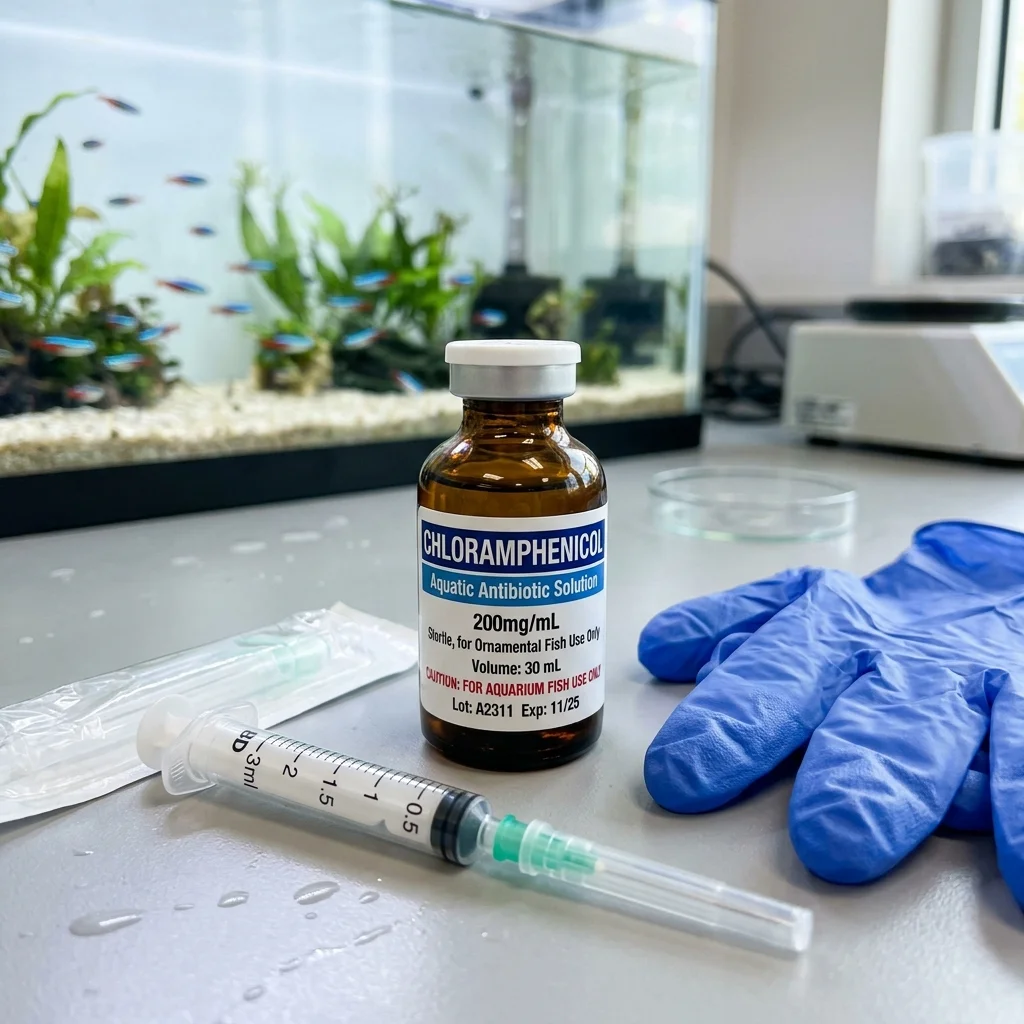
Quick Answer
Chloramphenicol is a broad-spectrum antibiotic with significant human-safety and antimicrobial-stewardship considerations. It should not be treated as a routine aquarium medication or used simply because a fish appears to have a bacterial infection. Where its use is appropriate for a susceptible infection, treatment should be carefully controlled, with appropriate handling precautions and close monitoring of water quality and biological filtration.
What Is Chloramphenicol?
Chloramphenicol is a broad-spectrum antibiotic that acts against a range of susceptible bacteria. It inhibits bacterial protein synthesis by binding to the 50S subunit of the bacterial ribosome and interfering with peptide-bond formation.
Because chloramphenicol has important human-health, veterinary, regulatory, and antimicrobial-stewardship considerations, it should not be treated as a routine aquarium medication.
What Does Chloramphenicol Treat?
Chloramphenicol can act against susceptible bacterial organisms, but choosing an antibiotic should depend on the suspected pathogen and clinical presentation whenever possible.
Conditions such as columnaris and fin disease can have multiple possible causes or contributing factors. A disease diagnosis alone does not establish that chloramphenicol is the appropriate treatment.
Review the relevant Columnaris disease profile or Fin Rot disease profile when assessing possible bacterial disease.
How Does Chloramphenicol Work?
Chloramphenicol inhibits bacterial protein synthesis by binding to the 50S subunit of the bacterial ribosome and interfering with peptidyl transferase activity. Its effect is generally bacteriostatic, although it can be bactericidal against some susceptible organisms at sufficiently high concentrations.
Its broad spectrum does not mean that every bacterial infection will respond. Bacterial susceptibility varies, and inappropriate antibiotic use can contribute to antimicrobial resistance.
Why Human Handling Requires Care
Chloramphenicol requires particular care during handling because human exposure has been associated with serious adverse effects, including potentially severe blood disorders. Veterinary references specifically recommend appropriate protective measures when handling the medication.
Wear gloves when handling chloramphenicol when required by the medication's safety information or veterinary instructions. Avoid direct contact with the medication, and follow the product's safety data and handling requirements.
Do not crush tablets or otherwise create medication dust unless the product and professional instructions specifically permit that procedure. Keep the medication away from children and other people who should not handle it.
Why a Hospital Tank Is Preferable
A separate hospital or quarantine aquarium can provide greater control over antibiotic treatment. It reduces unnecessary exposure of healthy fish and other aquarium inhabitants and makes it easier to observe the treated fish.
A separate treatment system can also make water-quality monitoring and water changes easier. However, a hospital tank may have limited biological filtration, so ammonia and nitrite still need to be monitored throughout treatment.
Aquaculture guidance generally favors isolating antibiotic bath treatments from the main recirculating system because antimicrobial exposure can damage nitrifying bacteria and contributes to environmental and resistance concerns.
Chloramphenicol and the Nitrogen Cycle
Chloramphenicol should not be described as guaranteed to crash every aquarium's nitrogen cycle. Experimental evidence on its effect on nitrification is mixed and depends on the concentration, system, exposure conditions, and microbial community.
Some experimental work has demonstrated inhibition of ammonia oxidation at particular chloramphenicol concentrations, while other laboratory work found no significant effect on nitrification under its tested conditions.
For practical aquarium management, the appropriate conclusion is that biological filtration should be treated as a potential risk during antibiotic treatment rather than assuming that a complete cycle crash is inevitable.
Monitor ammonia and nitrite closely during treatment. If biological filtration becomes impaired, additional water-quality management may be required.
For background on biological filtration and ammonia and nitrite processing, see the Nitrogen Cycle topic.
Antibiotic Stewardship
Broad-spectrum antibiotics should not be used simply because a fish appears sick. Similar symptoms can result from parasites, poor water quality, physical injury, nutritional problems, or other nonbacterial causes.
Unnecessary antibiotic exposure can contribute to antimicrobial resistance and can expose aquarium microorganisms to drugs without a clear therapeutic benefit.
Before selecting chloramphenicol, consider whether the condition is actually bacterial, whether the suspected organism is susceptible, whether environmental problems are contributing to the disease, and whether a more appropriate alternative is available.
When Chloramphenicol May Be Considered
Chloramphenicol should generally be considered only when there is a justified reason to suspect a susceptible bacterial infection and appropriate alternatives are unsuitable or unavailable under the applicable veterinary and regulatory framework.
This is different from saying that every severe bacterial infection requires chloramphenicol or that treatment should begin after standard aquarium antibiotics have simply failed. Where possible, diagnosis and susceptibility information should guide antimicrobial selection.
Food-Fish and Regulatory Considerations
Chloramphenicol has important regulatory restrictions in food-producing animals because of human-health concerns associated with residues. The legal status of a medication depends on the jurisdiction, animal species, intended use, product, and applicable regulations.
Do not assume that a medication available for ornamental aquarium use is approved for fish intended for human consumption. Food-fish treatment should follow the applicable veterinary and regulatory requirements.
Chloramphenicol Treatment Safety
- Use only when there is a justified reason to suspect a susceptible bacterial infection.
- Follow the exact product, veterinary, and regulatory instructions applicable to the formulation and fish being treated.
- Use appropriate personal protective equipment when handling the medication.
- Prefer a controlled hospital or quarantine environment when treatment requires an antibiotic bath.
- Monitor ammonia and nitrite throughout treatment.
- Avoid unnecessary exposure of healthy fish and aquarium invertebrates.
- Do not combine antibiotics or other medications without established compatibility.
- Do not assume that a medication will have the same effect on biological filtration in every aquarium.
- Dispose of medication and treatment water according to applicable product and local requirements.
When Chloramphenicol Is Not the Right Treatment
Chloramphenicol should not be used as a default response to fin damage, ulcers, cloudy eyes, lethargy, poor appetite, or other nonspecific symptoms.
Similar signs can arise from parasites, physical injury, poor water quality, nutritional deficiencies, environmental stress, or other nonbacterial causes.
If a fish does not respond to an appropriately selected treatment, reassess the diagnosis rather than repeatedly escalating antibiotic exposure.
Using a Medication Dosage Calculator
If an appropriate medication product provides a dose that must be calculated from aquarium volume, the Medication Dosage Calculator can assist with the mathematical calculation.
The calculator does not determine whether chloramphenicol is appropriate for a particular fish, disease, or bacterial organism. Product-specific instructions and appropriate veterinary or disease guidance remain the basis for treatment decisions.
Key Takeaway
Chloramphenicol is a broad-spectrum antibiotic that warrants particular caution because of its human-health, environmental, regulatory, and antimicrobial-stewardship considerations. It should not be treated as a routine aquarium medication. When its use is justified, treatment in a controlled environment, careful handling, and close water-quality monitoring can reduce unnecessary risks.
The Problem
My fish appears to have a severe bacterial infection that has not responded to standard treatment.
When to Use This Tool
Consider only when there is a justified reason to suspect a susceptible bacterial infection and appropriate alternatives are unsuitable or unavailable under the applicable veterinary and regulatory framework. A controlled hospital or quarantine system is preferable when an antibiotic bath treatment is appropriate.
Who is this for?
- Advanced aquarists and fish-health professionals seeking evidence-based information about chloramphenicol and its safety considerations.
Chloramphenicol and Other Aquarium Antibiotics
| Medication | General Activity | Human Handling Considerations | Biofilter Considerations |
|---|---|---|---|
| Chloramphenicol | Broad-spectrum activity against susceptible bacteria | Significant; use appropriate handling precautions | Potential impact; monitor water quality rather than assuming a complete crash |
| Erythromycin | Primarily Gram-positive activity | Follow product-specific handling instructions | Antibiotic bath treatments can affect biological filtration |
| Kanamycin | Activity against susceptible bacteria including some Gram-negative organisms | Follow product-specific handling instructions | Monitor biological filtration during treatment |
Troubleshooting Guide
1 Ammonia or nitrite increased during treatment.
Treat the rise as a potential water-quality or biological-filtration problem rather than assuming that chloramphenicol always causes a complete biofilter crash. Test ammonia and nitrite, perform appropriate water changes, increase aeration when needed, and move or maintain treatment in a controlled hospital system where appropriate. Follow the medication's instructions for water changes and treatment continuation.
2 The fish is not improving during treatment.
Do not automatically increase the dose or extend treatment. Reassess the diagnosis, water quality, likely pathogen, and medication suitability. If possible, obtain veterinary or diagnostic guidance and consider whether the suspected organism is actually susceptible to chloramphenicol.
3 A person accidentally handled the medication without protection.
Avoid further exposure, wash the affected skin thoroughly, and follow the product safety information. For significant exposure or concerning symptoms, seek appropriate medical advice and provide the healthcare professional with the medication name and formulation.
Frequently Asked Questions
Why is chloramphenicol rarely used in home aquariums?
Will chloramphenicol destroy my biofilter?
Why should chloramphenicol be handled with gloves?
Should chloramphenicol be used in the main display aquarium?
Glossary of Terms
- Broad-spectrum antibiotic
- An antibiotic that is active against multiple groups of bacteria rather than being limited to a narrow range of bacterial organisms.
- Antimicrobial stewardship
- The responsible use of antimicrobial drugs to achieve appropriate treatment while reducing unnecessary exposure, adverse effects, and the development or spread of antimicrobial resistance.
- Biological filtration
- The microbial process by which beneficial microorganisms in an aquarium convert toxic ammonia into nitrite and then nitrate.
- Nitrification
- The biological oxidation of ammonia to nitrite and nitrite to nitrate by specialized microorganisms in an established biological filter.