
Quick Answer
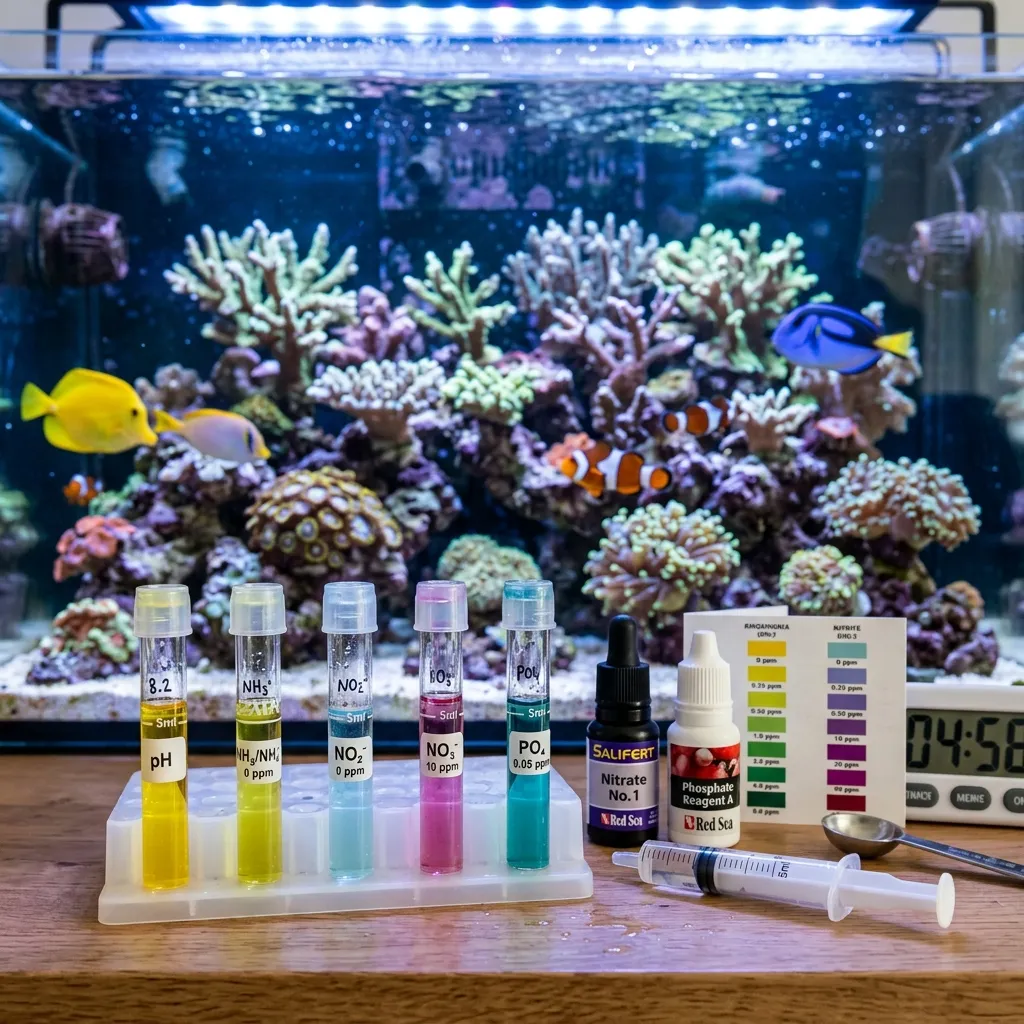
Marine water quality requires significantly tighter tolerances than freshwater. Alongside managing the standard nitrogen cycle (keeping Ammonia and Nitrite at 0 ppm), marine aquarists must precisely maintain salinity (1.025-1.026 SG) and pH (8.1-8.4). For reef tanks, you must also monitor and dose the 'Big Three': Calcium (400-450 ppm), Alkalinity (8-12 dKH), and Magnesium (1250-1350 ppm) to ensure coral skeleton growth and chemical stability.
Introduction to Marine Water Chemistry
The ocean is the most chemically stable environment on Earth. Because of this, marine fish and invertebrates have not evolved the osmoregulatory flexibility that freshwater fish possess. They cannot adapt to rapid changes.
In a marine aquarium, stability is the absolute highest priority. A suboptimal parameter that remains perfectly stable is far better than the "perfect" parameter that swings wildly up and down.
Foundational Marine Parameters
Before worrying about corals, you must master the foundation of the marine environment.
### Salinity / Specific Gravity Salinity is the measure of dissolved salts in the water. In the aquarium hobby, it is most commonly measured as Specific Gravity (SG) using a refractometer. * **Fish-Only (FOWLR):** 1.020 - 1.023 SG. Keeping the salinity slightly lower increases dissolved oxygen and reduces the metabolic stress on fish. * **Reef Tanks:** 1.025 - 1.026 SG (approx. 35 ppt). Corals require natural seawater levels to thrive.
*Crucial Rule:* Evaporation raises salinity. You must have an Auto Top-Off (ATO) system that adds pure RO/DI water daily to maintain a stable salinity level.
### pH Marine organisms require a highly alkaline environment. * **Ideal Range:** 8.1 - 8.4 If your pH drops below 7.8, coral calcification slows down drastically. Because saltwater is heavily buffered by carbonates, low pH is almost always a result of high indoor CO2 levels rather than a chemical deficiency.
### The Nitrogen Cycle Just like freshwater, marine tanks must process fish waste. * **Ammonia:** 0 ppm (Highly lethal) * **Nitrite:** 0 ppm (Toxic) * **Nitrate:** < 10 ppm for Reefs, < 20 ppm for FOWLR. (High nitrates fuel nuisance algae like Dinoflagellates and Cyanobacteria).
The "Big Three" for Reef Tanks
If you plan to keep stony corals (LPS and SPS) or clams, you must manage the Big Three. Corals extract these elements from the water column to build their calcium carbonate skeletons. As corals grow, they deplete the water, requiring you to test and dose them regularly.
### 1. Alkalinity (dKH) Alkalinity is the measure of carbonate and bicarbonate buffers in the water. It is the most critical of the Big Three because it fluctuates the fastest and directly impacts pH stability. * **Target Range:** 8.0 - 12.0 dKH. * **Rule:** Choose a number in that range and keep it absolutely stable. A swing of more than 1 dKH in a 24-hour period can cause SPS corals to undergo Rapid Tissue Necrosis (RTN) and die overnight.
### 2. Calcium (Ca) Calcium is the primary building block of coral skeletons. * **Target Range:** 400 - 450 ppm. * Calcium depletes slower than alkalinity. It must be balanced with Alkalinity; if you have 12 dKH Alkalinity, you should aim for higher Calcium (around 450 ppm).
### 3. Magnesium (Mg) Magnesium is the unsung hero of the reef tank. It binds to the surfaces of developing calcium carbonate crystals, preventing the Calcium and Alkalinity from precipitating out of solution (turning into solid "snow" in the water). * **Target Range:** 1250 - 1350 ppm. * If your Magnesium is low, you will not be able to raise your Calcium or Alkalinity, regardless of how much supplement you pour into the tank. Always test and correct Magnesium first.
Testing and Dosing
In a new marine tank with few corals, regular water changes using a high-quality reef salt mix will replenish the Big Three adequately.
However, as the corals grow into large colonies, their consumption will outpace what water changes can provide. At this stage, you must implement a dosing regimen:
1. **Test Daily:** Test Alkalinity, Calcium, and Magnesium at the same time every day for a week without dosing. 2. **Calculate Consumption:** Subtract the day 7 reading from the day 1 reading and divide by 7 to find your tank's daily consumption rate. 3. **Dose:** Use a 2-part dosing system (one liquid for Alkalinity, one for Calcium) via automated dosing pumps to replace exactly what the corals consumed that day. Never dose Calcium and Alkalinity at the exact same time or in the exact same spot in the sump, as they will precipitate upon contact.