
Quick Answer
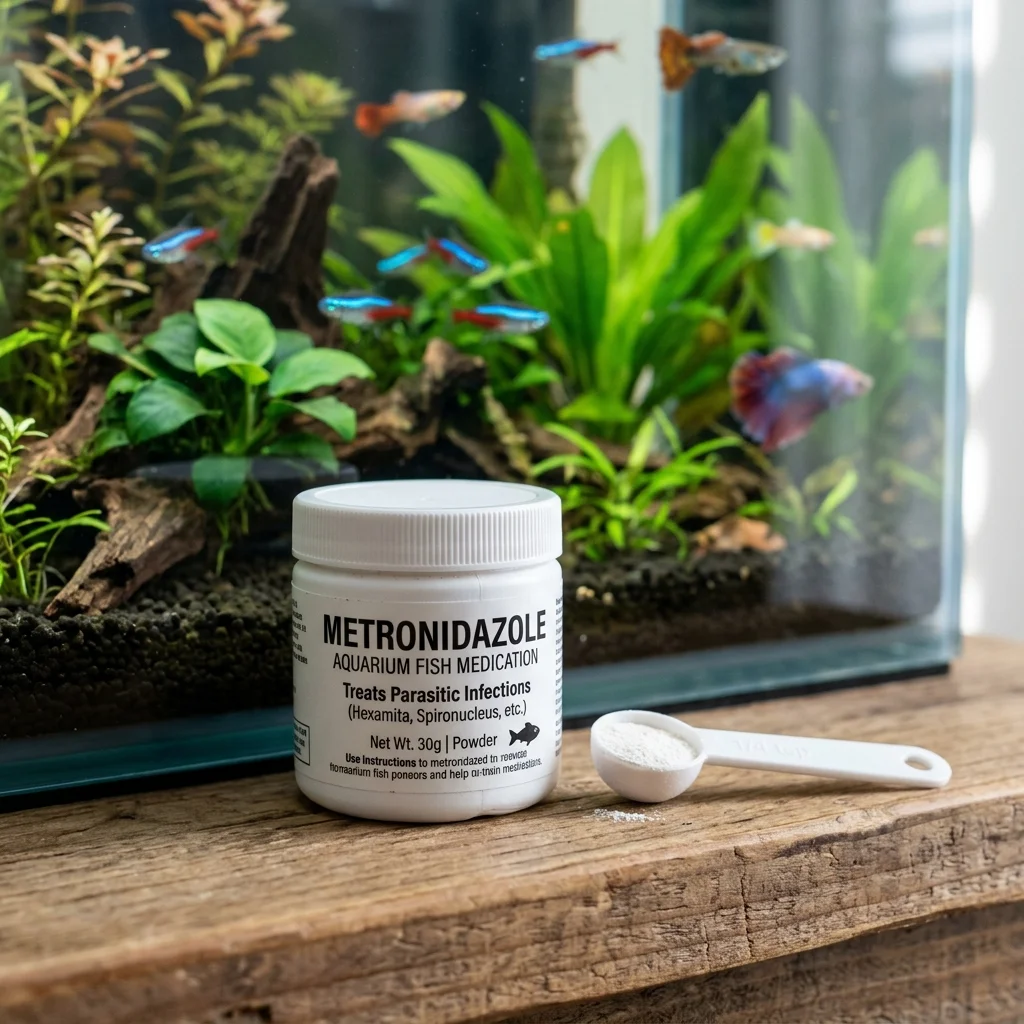
Metronidazole is an antimicrobial drug with activity against susceptible anaerobic bacteria and certain protozoa. In ornamental fish, it is used particularly for susceptible intestinal protist infections such as Spironucleus. When an internal infection is suspected and the fish is eating, medicated food can provide an oral route; water treatment may be considered when fish are anorectic or oral treatment is impractical. The diagnosis, fish condition, product instructions, and applicable regulations should guide treatment.
What Is Metronidazole?
Metronidazole is an antimicrobial medication with activity against susceptible anaerobic bacteria and certain protozoa. In aquarium fish, it is commonly discussed in connection with intestinal protist infections, particularly infections involving Spironucleus.
It is not a universal treatment for unexplained weight loss, poor appetite, wasting, abnormal feces, or other nonspecific fish symptoms. Those signs can have multiple possible causes and should be interpreted together with water quality, husbandry, clinical signs, and diagnostic findings.
What Does Metronidazole Treat in Fish?
Metronidazole may be used when a susceptible protozoal or anaerobic bacterial infection is suspected or identified. Veterinary references specifically describe its use against intestinal protist infections involving Spironucleus in ornamental fish.
Older aquarium literature often uses names such as Hexamita when discussing similar clinical presentations. Because the taxonomy and terminology can be inconsistent, it is better to identify the suspected organism or disease process rather than treating every case of wasting or appetite loss as a generic "Hexamita" infection.
Metronidazole is not effective against every organism that can cause gastrointestinal disease. For example, veterinary references distinguish Cryptobia iubilans from Spironucleus and report that metronidazole does not appear effective against gastric infections caused by Cryptobia iubilans.
How Does Metronidazole Work?
Metronidazole belongs to the nitroimidazole group of antimicrobial drugs. In susceptible microorganisms, the drug is reduced under anaerobic conditions to active metabolites that damage DNA and interfere with essential cellular functions.
This mechanism gives metronidazole activity against susceptible anaerobic bacteria and certain protozoa. It does not mean that the medication will treat every bacterial, fungal, or parasitic disease seen in aquarium fish.
Medicated Food vs. Water Treatment
The route of administration matters when treating fish. For internal disease, medicated food can provide a direct oral route when the fish is still eating reliably.
Veterinary aquarium guidance generally considers medicated food appropriate for many internal problems, while bath or water treatments can be considered when fish are anorectic or when oral treatment is impractical.
If the fish is not eating, medicated food cannot provide reliable treatment. A water-based treatment may be considered in appropriate circumstances, but the correct concentration, duration, water changes, and treatment system depend on the exact product and veterinary or disease guidance.
Do not assume that water treatment is automatically equivalent to oral treatment for an internal infection.
Effect on the Biological Filter
Metronidazole should not automatically be described as a medication that will destroy or crash every aquarium's biological filter. Its effect depends on the treatment conditions, concentration, formulation, exposure, and aquarium system.
However, antimicrobial treatments delivered through the aquarium water can expose nitrifying microorganisms to the drug. For that reason, water quality should be monitored during treatment rather than assuming that the biofilter will remain unaffected.
When a bath treatment is appropriate, a separate hospital or treatment system can reduce unnecessary exposure of the display aquarium and its biological filter.
Metronidazole and Sensitive Fish
There is no universal rule that all scaleless or otherwise sensitive fish require a particular reduced dose of metronidazole.
Treatment tolerance can vary with species, health status, formulation, concentration, water conditions, and treatment method. Follow the instructions for the exact product rather than substituting a generalized half-dose rule.
Metronidazole and Invertebrates
Do not describe metronidazole as universally safe for shrimp, snails, or other aquarium invertebrates unless the exact product provides compatibility information.
Formulations, concentrations, exposure conditions, and the sensitivity of non-target organisms can differ. If invertebrates are present, check the medication's specific compatibility information and consider treating the affected fish separately when appropriate.
Light, Storage, and Product Handling
Metronidazole formulations can have product-specific storage, preparation, and handling requirements. Claims about rapid degradation under aquarium lighting should not be generalized to every formulation.
Follow the manufacturer's storage, preparation, and treatment instructions for the exact product. If the product specifically provides light-protection instructions, those instructions should be followed.
Metronidazole Treatment Safety
- Identify the suspected disease or pathogen before treatment whenever possible.
- Use the manufacturer's instructions for the exact medication product.
- Choose the administration route based on the suspected location of the infection and whether the fish is eating.
- Monitor appetite, behavior, respiration, feces, and other clinical signs during treatment.
- Monitor ammonia and nitrite when treating an aquarium system.
- Do not combine medications unless compatibility has been established.
- Use a hospital or quarantine tank when appropriate.
- Do not assume that the presence of white or stringy feces by itself proves an internal protozoal infection.
When Metronidazole Is Not the Right Treatment
Metronidazole should not be used as a catch-all treatment for bacterial, fungal, parasitic, nutritional, or environmental problems without considering whether the suspected organism is susceptible.
Weight loss, sunken abdomen, poor appetite, abnormal feces, lethargy, and similar signs can have multiple causes. Poor water quality, crowding, nutritional problems, other parasites, and nonresponsive gastrointestinal diseases should also be considered.
If symptoms persist despite appropriate treatment, reassess the diagnosis rather than repeatedly increasing or extending medication exposure.
Metronidazole and Hole-in-the-Head Disease
Metronidazole is often discussed in aquarium literature in connection with hole-in-the-head or head-and-lateral-line presentations. However, the presence of pits or erosions on the head does not by itself establish that metronidazole is the appropriate treatment.
These presentations can involve multiple environmental, nutritional, infectious, and husbandry factors. Treatment should therefore be based on the overall clinical assessment rather than the symptom alone.
Regulatory Considerations
The legal status of metronidazole depends on the jurisdiction, species, intended use, and regulatory framework.
In the United States, veterinary references state that metronidazole is not approved for veterinary species and that nitroimidazoles are prohibited from extralabel use in food-producing animals. Merck's aquarium-fish guidance also identifies metronidazole as a medication that may not be used in food fish in the United States.
Do not assume that a medication available for ornamental aquarium use is legal or appropriate for fish intended for human consumption. Food-fish treatment should follow applicable veterinary and regulatory requirements.
Using a Medication Dosage Calculator
When the product instructions require calculating a treatment quantity from aquarium volume, the Medication Dosage Calculator can assist with the arithmetic.
The calculator does not determine whether metronidazole is appropriate for a particular fish, disease, or suspected organism. It also does not replace product-specific treatment instructions or veterinary guidance.
Key Takeaway
Metronidazole can be useful against selected susceptible protozoal and anaerobic infections in ornamental fish, particularly some intestinal Spironucleus infections. When an internal infection is suspected and the fish is eating, medicated food can provide an appropriate oral route; water treatment may be considered when the fish is anorectic or oral treatment is impractical.
The diagnosis matters. White or stringy feces, weight loss, a sunken abdomen, or head lesions do not by themselves establish that metronidazole is the correct treatment. Follow the exact product instructions, consider applicable regulations, and monitor both the fish and aquarium water quality during treatment.
The Problem
My fish has weight loss, poor appetite, abnormal feces, a sunken abdomen, or another presentation that may indicate an internal protozoal infection, and I need to understand whether metronidazole is an appropriate treatment.
When to Use This Tool
Consider when a susceptible protozoal or anaerobic infection is reasonably suspected or identified and metronidazole is appropriate under the applicable product, veterinary, and regulatory framework. For internal disease, medicated food can be an appropriate route when the fish is eating; water treatment may be considered when oral treatment is impractical.
Who is this for?
- Hobbyists and advanced aquarists seeking evidence-based information about metronidazole, its treatment routes, safety considerations, and limitations.
Metronidazole Delivery Methods
| Delivery Route | When It May Be Appropriate | Biofilter Considerations | Key Limitation |
|---|---|---|---|
| Medicated Food | Internal disease when fish are eating reliably | Less direct exposure of the display aquarium water than a bath treatment | Cannot reliably treat fish that are not eating |
| Water Treatment | When oral treatment is impractical, including some anorectic fish | Can expose biological filtration to the medication | Requires careful control of concentration, exposure, and water changes |
Troubleshooting Guide
1 Fish refuses to eat medicated food.
Oral treatment cannot be relied upon when the fish is not eating. Depending on the suspected disease and product, a water-based treatment or another professionally appropriate route may be considered. Do not automatically compensate by increasing the concentration without appropriate treatment guidance.
2 Ammonia or nitrite increased during treatment.
Treat the increase as a water-quality or biological-filtration problem rather than assuming that metronidazole always causes a complete biofilter crash. Test ammonia and nitrite, perform appropriate water changes, maintain adequate aeration, and follow the medication's instructions for treatment and water changes.
3 The fish is not improving during treatment.
Do not automatically increase the dose or extend treatment. Reassess the diagnosis, water quality, likely pathogen, treatment route, and medication suitability. If possible, obtain appropriate diagnostic or veterinary guidance.
4 The fish has white or stringy feces but no other clear signs.
Do not use the fecal appearance alone to diagnose an internal protozoal infection. Review feeding, water quality, body condition, appetite, behavior, and other clinical signs before selecting treatment.
Frequently Asked Questions
Should metronidazole be given in food or added to the water?
Is metronidazole safe for shrimp and snails?
Will metronidazole destroy my aquarium biofilter?
Does white stringy poop mean my fish needs metronidazole?
Does metronidazole treat Hole-in-the-Head disease?
Glossary of Terms
- Spironucleus
- A genus of diplomonad protists that can occur in the intestinal tract of aquarium and aquaculture fish and is associated with disease in susceptible fish.
- Anaerobic microorganism
- A microorganism that can grow or survive under conditions with little or no oxygen. Metronidazole has activity against susceptible anaerobic bacteria and certain protozoa.
- Medicated food
- Fish food containing a measured amount of medication so that the drug is delivered orally when the fish consumes the food.
- Bath treatment
- A treatment in which medication is introduced into the aquarium or treatment water so the fish is exposed through the surrounding water.