
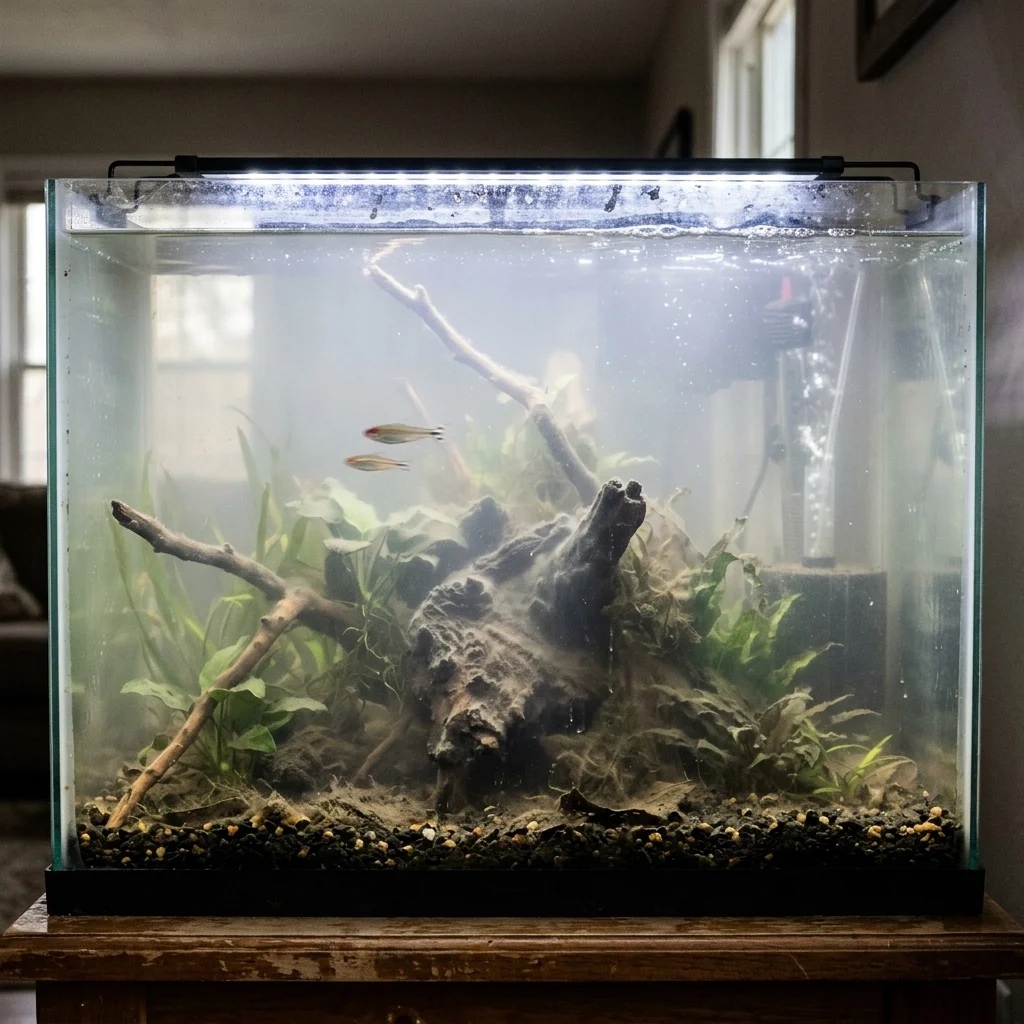
Quick Answer
Cloudy water usually comes down to a handful of causes: a milky-white bacterial bloom in a new tank (typically 3-7 days), green free-floating algae from too much light (often cleared with a 3-4 day blackout or UV), or brown dust from disturbed substrate (24-48 hours with fine filter floss). Identify the colour first, then apply the matching fix. Clarifiers only hide the symptom.
Key Takeaways
- Identify the colour first: milky white means bacteria, green means algae, brown means substrate dust or diatoms, and tea or amber means tannins.
- New-tank bacterial blooms are normal and usually clear in 3-7 days; repeated large water changes just to clear the water are commonly reported to prolong them, but always change water if fish show ammonia or nitrite.
- Green water usually responds to less light, a 3-4 day blackout or a UV sterilizer, but it can return if you do not reduce the light and nutrients feeding it.
- Fine poly-fil floss replaced regularly clears brown substrate dust in 24-48 hours (3-5 days for planted soils).
- Clarifiers and UV sterilizers suit specific causes; using them to mask poor maintenance leads to recurring problems.
- Gasping fish, laboured breathing, a rotten-egg smell or ammonia or nitrite above 0.25 ppm needs immediate action: add aeration, do a 25-30% water change and use a conditioner that detoxifies ammonia, following the label.
Cloudy aquarium water is alarming, but the colour tells you most of what you need to know. Use the decision tree below to identify the likely cause, then apply the matching fix. Chemical clarifiers may make the water look better for a while, but if you do not fix the cause the cloudiness will return.
When cloudy water is dangerous
Cloudy water itself rarely harms fish, but the conditions behind it can. Act immediately if you see any of these:
- Fish gasping at the water surface
- Rapid gill movement or laboured breathing
- Unusual lethargy, loss of colour, or fish sitting on the bottom
- Rotten-egg or sulphurous smell
- Ammonia or nitrite above 0.25 ppm
What to do now:
- Increase surface agitation now: add an air stone or point the filter output at the surface.
- Do a 25-30% water change with dechlorinated, temperature-matched water.
- Use a water conditioner that detoxifies ammonia and nitrite, following the label. This is a temporary measure only.
- Stop feeding, remove any dead fish, and confirm the filter is running.
- Test ammonia and nitrite again after a few hours and repeat the water change if needed.
- A rotten-egg smell can mean waste trapped in deep substrate: siphon it out gently and do a water change.
Quick diagnosis chart: colour to cause
Match what you see to the row below. Times are typical ranges, not guarantees.
| Appearance | Most Likely Cause | Time to Clear | Right Fix | Don't Do This |
|---|---|---|---|---|
| Milky white or grey haze in a new tank (first weeks) | Bacterial bloom while the biological filter establishes | Usually 3-7 days; up to about 2 weeks | Wait, feed lightly, add aeration, test ammonia and nitrite | Repeated large water changes or a clarifier to force clarity |
| Milky white or grey haze in an established tank | Organic overload: overfeeding, dead animal, clogged filter, media rinsed in tap water | A few days after the source is fixed | Remove the source, 25-50% water change, feed less, clean media in old tank water | Keep feeding heavily or clean all media at once |
| Green, like pea soup (stays green in a glass of water) | Free-floating algae bloom | About 3-7 days with a blackout or UV | Cut light, blackout 3-4 days or use UV, reduce nutrients | Rely on water changes or a clarifier alone |
| Brown or grey dust after setup or rescape (swirls and settles when filter is off) | Substrate dust | 24-48 hours (3-5 days for planted soils) | Fine floss or polishing pad in the filter, replaced when clogged | Vacuum aggressively or add a clarifier first |
| Yellow or tea tint, water still clear | Tannins from driftwood or leaf litter | Weeks to months | Activated carbon or Purigen, water changes, pre-soak wood | Treat it as an emergency |
| Brown dust film on glass and decor in a young tank (wipes off easily) | Diatoms | Usually weeks, as the tank matures | Wipe off and wait | Run a blackout or medicate |
| Fine white mist right after a water change (tiny bubbles clinging to glass) | Micro-bubbles, disturbed debris, or additives reacting in hard water | Hours to a day | Wait, add water slowly, match temperature, dose one product at a time | Add more chemicals |
How long will it take to clear?
- Substrate dust: 24-48 hours, or 3-5 days for fine planted soils.
- Micro-bubbles after a water change: hours to a day.
- New-tank bacterial bloom: usually 3-7 days, sometimes up to two weeks.
- Green water: around 3-7 days once you cut the light, run a blackout or fit UV.
- Tannins: weeks to months, depending on how much wood and how much water you change.
White or milky water: bacterial bloom
A milky white or grey haze is usually a bloom of free-floating bacteria feeding on dissolved waste. It is common in a new tank and after cleaning or replacing filter media, when the biological filter has not caught up. In an established tank, look for a different source: overfeeding, a dead animal, or a clogged filter.
New tank or freshly cleaned filter:
- Leave the filter running and add surface agitation. Bacteria use oxygen, so aeration helps.
- Feed lightly, or not at all in a fishless cycle.
- Test ammonia and nitrite. If fish are present and either is above zero, do a water change and use a conditioner that detoxifies ammonia, following the label. Fish safety comes first.
- Otherwise, avoid repeated large water changes just to clear the water. They do not fix the bloom and are commonly reported to prolong it. See the Nitrogen Cycle Guide for how the cycle finishes.
Established tank: remove the source, do a 25-50% water change with dechlorinated, temperature-matched water, rinse mechanical media in old tank water, and feed only what is eaten in about two minutes.
Green water: how to clear it
If the whole tank looks like pea soup, free-floating algae are multiplying on light and nutrients. Surface algae on glass and decor is a different problem and needs different treatment.
Reduce the light and the food supply
Block direct sunlight, shorten the photoperiod, and reduce the nutrients feeding the algae by feeding less and keeping up regular water changes.
Blackout
A 3-4 day blackout often clears green water: turn the lights off, cover the tank so no light gets in, keep the filter and aeration running, and feed lightly. It usually works, but it is not guaranteed. If the cause is still there when the lights return, the bloom can come back. Plants may lose some leaves. Dying algae can use up oxygen, so keep the tank aerated.
UV sterilizer
A properly sized UV sterilizer clears free-floating algae as water passes through it, and is a good option for persistent blooms. It does not affect algae growing on surfaces.
Water changes only dilute green water temporarily, and clarifiers do not address the cause. Green water attracts a lot of search interest on its own, so it may deserve its own dedicated guide.
Grey or brown water: substrate dust, tannins, diatoms
Substrate dust
Fine particles from new or disturbed substrate stay suspended. Add fine filter floss or a polishing pad to the filter and replace it when it clogs, at first daily. Leave the tank alone while it clears (24-48 hours, or 3-5 days for fine planted soils). Rinse substrate before use next time.
Tannins
Driftwood, roots and leaf litter release tannins that tint the water yellow or tea-brown while keeping it transparent. They are generally harmless, though they can lower pH slightly in soft water. Activated carbon or Purigen and regular water changes remove the tint, and pre-soaking wood reduces it. It can take weeks to months.
Diatoms
Diatoms appear as a brown dust film on glass, substrate and decor, mostly in young tanks. Wipe it off and wait. It usually fades as the tank matures.
Cloudy water after a water change
If the tank is still cloudy after a water change, work through what you did.
What water change did you do?
- Tap-water gas: cold or pressurised tap water can carry dissolved gas that comes out as tiny bubbles when it warms in the tank, giving a fine sparkling mist that clears in hours to a day. Add water slowly and match the temperature.
- Hardness and additives: in hard water, dosing buffers, calcium products, pH adjusters or fertilisers can cause a white cloud in some cases. Add one product at a time and space the doses apart.
- Disturbed debris: vacuuming deeply or pouring water onto the substrate stirs up waste. Let it settle and use fine floss.
- Unfinished cycle: in a young tank, or if you rinsed media in tap water or replaced it, the change may have triggered a bloom. Test ammonia and nitrite.
- Size of the change: the Water Change Calculator can help you plan volumes, and the Tank Volume Calculator helps if you are not sure of your actual water volume.
Is cloudy water normal in a new tank?
Yes. Two things cause it: dust from new substrate, and a bacterial bloom while the biological filter establishes. Both are self-limiting. Feed lightly, keep the filter running, test ammonia and nitrite regularly, and be patient. Fish should not be added heavily until the cycle is established. Read the Nitrogen Cycle Guide for the full process.
Water clarifier vs UV sterilizer
Both are useful tools, but each fits a specific cause. Clarifiers clump fine suspended particles so the filter can catch them, which helps with dust. They do nothing about the reason particles are there. A UV sterilizer is useful against free-floating algae. Neither fixes overfeeding, poor filtration or too much light, so using them to hide those problems just delays the next episode.
| Method | Works For | Doesn't Work For | Cost | Risk |
|---|---|---|---|---|
| Water change | Organic overload, ammonia or nitrite spikes, diluting tannins | Green water (only temporary), new-tank bloom (does not fix it) | Low: water and conditioner | Temperature or chemistry shock if water is not matched |
| Clarifier (flocculant) | Fine suspended particles that the filter can then catch | Root causes, green water regrowth, dissolved tannins | Approx. ₹300-1,000 / $6-15 per bottle | Overdosing can cloud water further and clog filter media; follow the label |
| UV sterilizer | Free-floating green algae | Surface algae, tannins, substrate dust, ammonia | Approx. ₹3,000-12,000 / $35-150 | Must be sized to the flow; bulb needs replacing; does not fix the cause |
| Blackout | Green water (free-floating algae) | Bacterial bloom, dust, tannins | Free | Stresses some plants; dying algae can use up oxygen, so keep the tank aerated |
| Filter media change (fine floss, carbon) | Suspended dust (floss), tinted water (carbon) | Green algae, ammonia problems | Approx. ₹200-1,500 / $3-20 | Replacing all biological media at once can restart a bloom |
Prices are approximate. Check current listings. A good filter also prevents many of these problems; see the Filtration Guide.
Chemical reactions and pH swings
Some cloud comes from chemistry rather than biology: mixing several additives at once, especially in hard water, or big swings in pH or temperature can cause fine white precipitate. The fix is patience plus discipline: dose one product at a time, follow the label, and change water gradually.